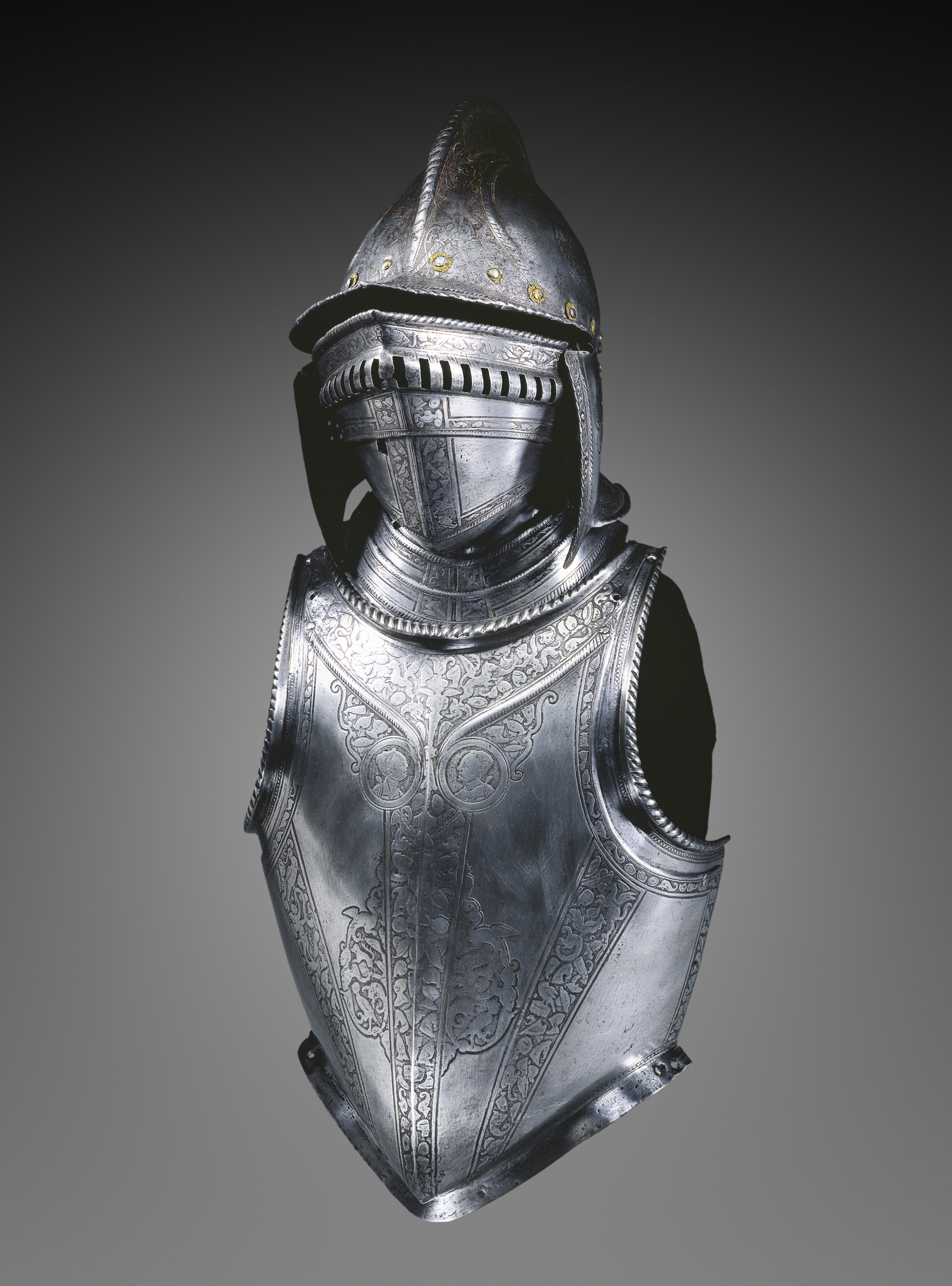
Technical Deconstruction: The Armorer's Canvas
The object in question is a 16th-century North Italian breastplate, a foundational piece of plate armor. Its primary technical specification—etched steel—is the gateway to its profound narrative. We must first understand the base material: hammer-forged steel, shaped for ballistic defense, representing the pinnacle of metallurgical and functional design of its era. The etching process was not mere decoration; it was a transformative technical act. Artisans would apply a resist (often a waxy varnish) to the meticulously polished steel surface, manually incising the intricate designs through this layer. The plate was then exposed to acid, which bit into the exposed metal, creating recessed lines. This was frequently followed by fire-gilding or bluing, where heat applied mercury amalgam or created oxide layers to fill these etched channels with contrasting, lustrous gold or deep, protective black. The result was a surface of extreme duality: the implacable, cool strength of steel and the warm, shimmering narrative of precious metal.
The Iconographic Code: Trophies and Medallions as Data Sets
The etched bands are not random ornament. They are a highly formalized visual language. The trophies—composed of captured weapons, banners, and armor—are symbols of military virtue and concrete victory. They speak to the wearer's profession, aspirations, and achieved glory. The medallions often contain figurative scenes: mythological allegories (of Hercules, Mars), classical deities, or personifications of Virtue and Fortune. This iconography directly links the wearer to the valor of ancient heroes and the intellectual humanist revival of the Renaissance. It is a claim to a dual legacy: martial prowess and cultivated, classical learning. In our Lab's terms, this is not unlike a modern brand's use of heritage codes and logo placement. The etched bands form a structured "grid" or "data stream" across the thoracic architecture, positioning the wearer within a specific sociocultural matrix.
Conceptual Synthesis: The New DNA Strand
The directive to reference a New DNA Strand is pivotal. It instructs us to look beyond historical replication and to isolate the core genetic sequences of this artifact for recombinant expression in an Avant-garde context.
Core Genetic Sequences Identified:
1. The Augmented Body: The breastplate is the original wearable technology. It is a hard, external exoskeleton that enhances, protects, and re-silhouettes the human form. It creates a second skin of authority and capability.
2. Surface as Story: The etching transforms a functional surface into a legible interface. It encodes identity, achievement, and ideology directly onto the garment/armor.
3. Duality of Materiality: The coexistence of the industrial (steel) and the precious (gold), the defensive and the decorative, creates a powerful tension. It is armor as art and artifact as propaganda.
4. Structured Ornament: The decoration is not fluid or floral but contained within rigid bands and cartouches. This imposes geometric order on symbolic narrative, creating a modern, graphic quality.
Avant-Garde Expression: Zoey Fashion Lab Prototype
Drawing from this DNA, an avant-garde collection would not produce historical armor. It would translate these sequences into contemporary signifiers of protection, identity, and augmentation.
Proposed Design Manifestations:
Garment as Armor/Architecture: Explore rigid yet wearable structures in thermoformed polymers, laser-sintered metals, or molded composites. Think chest plates integrated into tailored blazers, or ergonomic spinal supports that become aesthetic bustles. The silhouette is sharp, imposing, and consciously augmented.
Modern Etching: Digital Skin: Replace acid etching with laser engraving, digital printing, or embedded LED matrices. The "trophies" become personal data visualizations—social media graphs, digital footprints, or biometric patterns. The "medallions" could be micro-screens displaying generative art or encrypted personal icons. The surface tells a 21st-century story.
Material Duality 2.0: Juxtapose technical fabrics (ballistic nylon, neoprene, recycled carbon fiber) with unexpected luxe elements (pietra dura stone inlays, gold electroplating on circuit-board patterns, fluid silk emerging from rigid shells). This echoes the steel/gold contrast.
The Banded Grid as Design Framework: Use harness straps, articulated panel lines, or bold seaming to create the etched band effect. These functional seams become graphic elements, framing areas of the body like the historical bands framed medallions. They create a built-in, structural graphic language.
The New Narrative: From Battlefield to Identity Field
The 16th-century knight displayed trophies of physical conquest. The modern wearer must armor themselves in a landscape of digital exposure, social performance, and information overload. The avant-garde breastplate becomes a site for projecting curated identity. It is armor for the psyche and the persona. The etched bands could represent personal milestones, intellectual influences, or digital communities. The "medallions" could be symbols of personal belief systems, abstracted logos, or QR codes linking to an artistic manifesto.
In conclusion, this North Italian breastplate offers a masterclass in functional art as identity technology. For Zoey Fashion Lab, its New DNA Strand is clear: the garment as a structured, augmented interface for legible self-definition. The avant-garde expression lies in transmuting the language of martial and classical glory into a contemporary lexicon of digital, personal, and existential armor. The result is not a costume of the past, but a provocative, wearable architecture for the present.