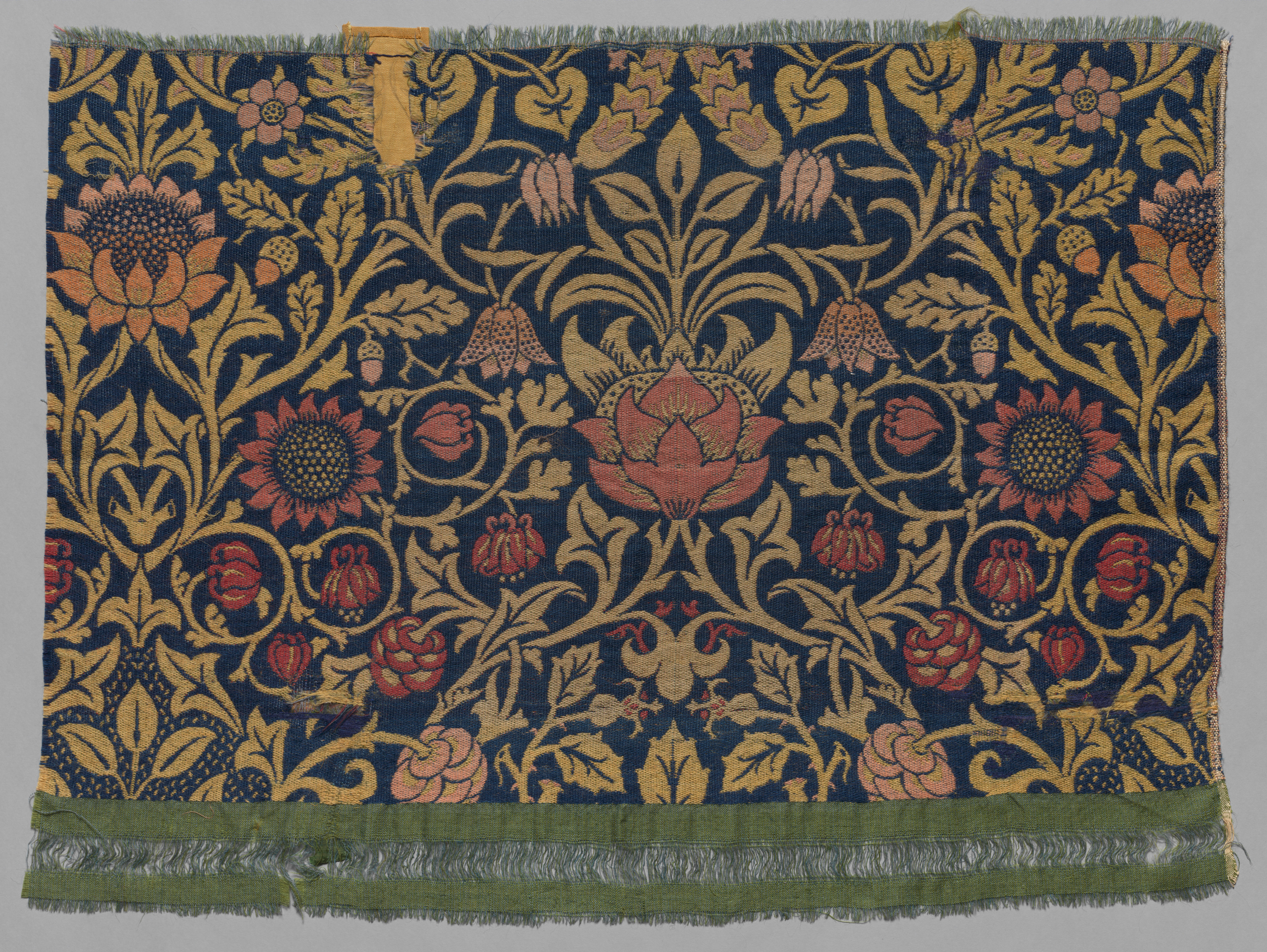
Technical Deconstruction & Material Synthesis: Violet and Columbine
The specimen designated Violet and Columbine originates from the Merton Abbey workshops, a locus synonymous with the late-19th century Arts and Crafts movement's reconciliation of artisanal integrity with nascent industrial technique. The foundational structure is a double-cloth, weft-faced twill, engineered on a jacquard loom. This is not merely a fabric; it is a stratified textile architecture. The double-cloth construction creates two discrete layers of interlacing warps and wefts, bound at the pattern points. This technique yields a cloth of exceptional density, weight, and insulative property, while allowing for pure, unblended colour application on each surface—a foundational principle for the design's visual impact.
The material palette of wool and mohair is a calculated dialogue between earth and aura. The wool, likely from English breeds, provides the substantive body, resilience, and matte, absorptive ground. The mohair, with its characteristic halo and luminous sheen, is deployed as the strategic weft that captures and refracts light. In the weft-faced structure, these mohair threads dominate the visible surface, meaning the "violet" and "columbine" hues are not flat colours but living fields of light, their intensity shifting with the viewer's perspective. The twill weave’s diagonal rib (the technical resonance of a painter’s deliberate brushstroke) provides a directional grain, guiding light along its axis to enhance depth.
Archive Resonance: A Woven Dialectic of East and West
The archival reference invokes a potent period of transcontinental aesthetic exchange: the 16th-17th centuries, when global trade routes became conduits for visual language. This was an era where 器物 (artifacts) and 绘画 (paintings) served as the primary vectors for cross-cultural inspiration. The "Violet and Columbine" pattern directly channels this dialectic. The botanical subject matter—stylized, yet observant—echoes the herbals and floral studies of Northern European Renaissance art. However, their formal arrangement—the rhythmic repetition, the balanced yet dynamic distribution across the field, the sense of a boundless, scrolling garden—bears the unmistakable influence of Asian textile arts, specifically the flowing, asymmetrical designs of Japanese kosode and Chinese silk damasks that flooded European markets via the Silk Road and maritime trade.
This fabric, therefore, is a Merton Abbey interpretation of that historical moment of collision. It translates the aesthetic principles of Asian decorative arts—flatness of plane, masterful negative space, organic rhythm—through the distinctly European medium of figurative botanical drawing and the mechanical precision of the jacquard loom. It is not a copy, but a resonance; a 19th-century echo of a 17th-century conversation. The pattern’s complexity, made commercially viable by the jacquard mechanism, itself mirrors the period's technological advancements intersecting with a renewed appetite for the "exotic."
Avant-Garde Reformation: From Archive to Edge
For Zoey Fashion Lab, the avant-garde potential of "Violet and Columbine" lies not in its literal reproduction, but in its radical deconstruction and re-contextualization. Our methodology must honor its stratified technical and cultural history while propelling it into a contemporary discourse. We propose a three-pronged strategy:
1. Structural Disassembly & Re-stratification: Exploit the double-cloth as a functional canvas for modern layering. We can engineer strategic cuts and incisions that reveal the "underside" layer, creating unexpected colour flashes and textural contrasts—a literal unveiling of the fabric’s hidden history. Sections could be de-laminated, leaving sheer mohair veils anchored to solid wool bases, playing with opacity and weight. The inherent stiffness of the dense weave can be subverted through laser-cutting or thermo-molding to create rigid, architectural forms that contrast with fluid drape.
2. Material Transmutation & Hybridization: Respect the wool-mohair dialogue but escalate it. We can fuse the double-cloth with technical membranes—translucent polyurethane, recycled PVC—sandwiching the historic pattern within a futuristic shell. Alternatively, we can deconstruct the yarns themselves, re-spinning the mohair with conductive metallic threads or biodegradable luminescent fibers, transforming the floral pattern into an interactive, light-emitting surface. The "violet" and "columbine" can be re-interpreted through digital sublimation or eco-reactive dyes over the original weave, creating a palimpsest of old and new colour fields.
3. Conceptual Re-framing: The Garden as Algorithm: The jacquard loom was the 19th century's pixel-based printer. We can extend this by treating the original pattern as source code. Using the archive's botanical drawings, we can generate algorithmic variations—distorting the repeats, fragmenting the blossoms into abstract geometries, or allowing the pattern to respond to data inputs (environmental, biometric). The "garden" becomes a mutable, digital ecosystem printed onto or woven into fragments of the original cloth, creating a dialogue between the hand of the past and the algorithm of the present.
Conclusion: The New Resonance
"Violet and Columbine" arrives at our lab as a perfect specimen of historical synthesis. Our avant-garde mandate is to initiate its next resonant wave. By disassembling its strata, hybridizing its materiality, and re-coding its pattern logic, we transform it from a relic of the Arts and Crafts dialogue with the East into a prototype for 21st-century fashion. It will become a garment that wears its history visibly in its seams, its layers, and its interactive surfaces—a testament to the enduring truth that the most profound innovations are often born from a deep, and deconstructive, conversation with the past.