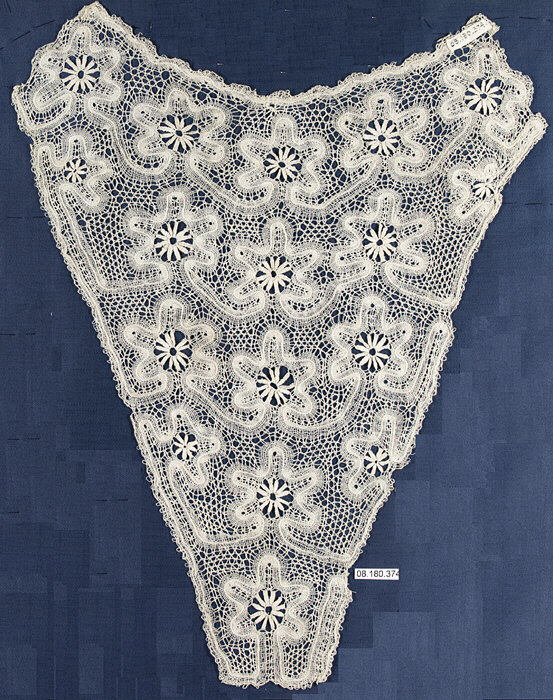
Deconstructing the Armature: The Plastron as Avant-Garde Prototype
Within the lexicon of avant-garde couture, the plastron—historically a rigid, decorative front panel—transcends its ornamental past to emerge as the quintessential architectural substrate for SS26. At Zoey Fashion Laboratory, we interrogate this form not as a relic but as a prosthetic exoskeleton, a site of negotiation between the organic body and the constructed environment of the Global Frontier. This frontier is not a geographical locale but a cognitive and material condition: a hyper-connected, data-saturated landscape where identity is fluid and the body demands both armor and articulation. Our analysis posits the bobbin lace plastron as the critical interface for this new reality, a study in paradoxical materiality where fragility computes as strength and tradition is the raw code for the future.
Material Alchemy: Bobbin Lace as Structural Algorithm
The deliberate selection of bobbin lace is a radical act of semantic inversion. This material, synonymous with heritage, delicacy, and a labor-intensive past, is subjected to a process of structural re-engineering. We do not merely appliqué lace; we treat its construction as a living algorithm. Each twist, knot, and void formed by the bobbins is analyzed for its load-bearing potential and tensile integrity. Through bio-resin impregnation, variable-density 3D printing over the lace matrix, and strategic fusion with aerospace-grade transparent polymers, the lace is transformed. It ceases to be a textile and becomes a monocoque lattice—a self-supporting, breathable architecture that defines form from its own intricate, multiplied patterns. The resulting texture is a cartography of its own making, where shadows and negative space become as substantive as the threads themselves, creating a dynamic play of opacity and transparency that mirrors the data-veil of the Frontier.
Silhouette as Speculative Anatomy: The Frontier Silhouette
The SS26 silhouette emanating from this plastron study is one of kinetic displacement. The body is not merely clothed but re-contextualized. The plastron, as the central architectural node, generates forms that extend, deflect, and amplify the body's natural geometry.
The Asymmetric Torque: Plastrons are engineered to spiral from a single shoulder anchor, traversing the torso in a non-linear path that creates a sense of controlled torsion. This disrupts the frontal plane, suggesting a body in constant, elegant negotiation with unseen forces—a metaphor for navigating the complex vectors of contemporary existence.
The Cantilevered Extension: Leveraging the hardened lace, forms project outward from the hip or sternum without external support. These are not mere embellishments but structural propositions, challenging gravitational expectation and creating a silhouette of purposeful imbalance. They redefine the body's spatial claim, demanding a reconsideration of personal space in crowded digital and physical realms.
The Dynamic Void: The plastron is often designed as a non-contiguous framework, leaving deliberate, strategic apertures that reveal the skin or an underlying substrate. These voids are not absences but focal points, framing the body as a landscape within a larger architectural scheme. They introduce a rhythm of exposure and protection, a critical dialectic for the Frontier self.
Contextual Integrity: The Standalone Study as Manifesto
Presented as a standalone avant-garde study, this plastron series deliberately resists narrative assimilation into a conventional collection. Each piece is a self-contained thesis, a prototype exploring a single material-structural hypothesis. This methodology is fundamental to Zoey Fashion Laboratory's ethos. It allows for pure, unadulterated innovation, free from the commercial imperative of cohesion. The standalone study is our laboratory report, asserting that the future of couture lies not in seasonal themes but in rigorous, iterative experimentation. These plastrons are not "outfits"; they are wearable propositions—debates about form, function, and the body's future rendered in resin-infused lace.
Conclusion: The Plastron as Cognitive Interface
For SS26, Zoey Fashion Laboratory concludes that the avant-garde plastron is ultimately a cognitive interface. It is a hardened, intelligent layer that mediates between the self and the Global Frontier. Its innovation lies in its paradoxical synthesis: it is protective yet permeable, historical yet prophetic, structurally robust yet visually ethereal. By deconstructing and re-engineering the very essence of bobbin lace into a futuristic armature, we propose a new model for couture—one where material intelligence drives form, and where the garment becomes an active participant in shaping the wearer's reality. This study does not predict trends; it engineers the conditions for a new somatic language, establishing the plastron as the foundational syntax for the architecture of tomorrow's self.