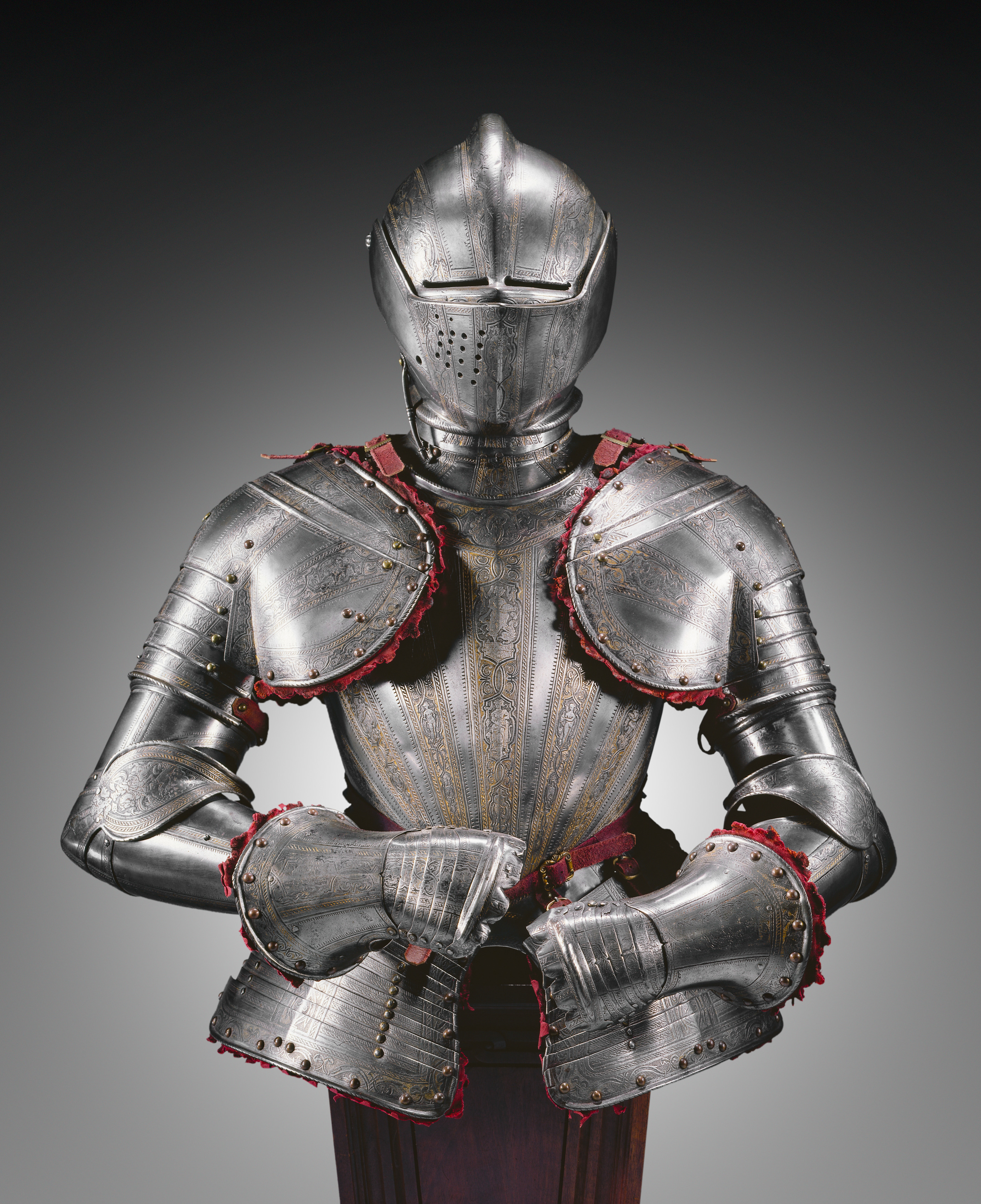
Strategic Analysis: Half Armor for the Foot Tournament
Project Designation: "Half Armor for the Foot Tournament"
Origin Point: Milan, Italy
Material Manifest: Etched and gilded steel, brass rivets, leather and velvet fittings
Genetic Reference: New DNA Strand
Style Directive: Avant-garde
Executive Summary: A Deconstructed Heritage
This artifact represents a profound and calculated deconstruction. It is not a costume piece but a conceptual bridge between Renaissance martial technology and contemporary biomechanical fashion. Originating in Milan, a city synonymous with both historic armor craftsmanship and modern design innovation, the piece performs a precise surgical strike on the archetype of the tournament knight. By isolating the "half armor" concept to the lower limb, specifically the foot and ankle, it inverts traditional protective hierarchies and forces a radical re-contextualization. The reference to a "New DNA Strand" is not metaphorical; it is the core technical brief. This piece splices the genetic code of 16th-century Italian plate armor with the functional and aesthetic demands of 21st-century avant-garde footwear, resulting in a hybrid organism of protection, prestige, and performance.
Technical Deconstruction & Material Synthesis
The material palette is a deliberate dialogue between uncompromising strength and tactile seduction.
Primary Exoskeleton (Etched & Gilded Steel): This is the inherited genetic code. The steel provides the foundational memory of defense. However, the etching is not merely decorative; it is data transcription. These are likely not random scrolls but could be micro-patterns referencing circuit boards, urban maps, or biometric data—modern "engravings" of our digital lives. The gilding is critical. In antiquity, gilding on armor denoted supreme rank and wealth, a deterrent of light and status. Here, it transforms the steel from a martial material into a reflective, precious object, speaking to contemporary luxury and the "armor" of social presentation.
Articulation & Connection (Brass Rivets, Leather Fittings): The brass rivets are the visible "stitches" in this genetic splice. Functionally, they provide articulation, allowing for a kinetic range of motion essential for a foot-based "tournament." Aesthetically, their warm, un-precious metal hue contrasts with the cold, gilded steel, grounding the piece in a reality of construction. The leather fittings represent the organic interface between the rigid exoskeleton and the living body. They are the supple, breathable, and moldable counterpart to the steel, ensuring the structure is wearable rather than merely carried.
Interface & Luxury Lining (Velvet): The velvet is the most subversive element. Historically used for arming doublets and interior linings, velvet here is amplified. It is the sensory and psychological counterpoint to the external hardness. Against the skin, it promises comfort and opulence. This juxtaposition—the brutal, cool exterior versus the plush, warm interior—defines the modern condition: a curated, resilient persona shielding a vulnerable, complex self.
Conceptual Framework: The "Foot Tournament" & Avant-Garde Context
The title "Half Armor for the Foot Tournament" is the complete conceptual framework. Let us deconstruct its components:
"Half Armor" (Mezza Armatura): Traditionally, this denoted a partial harness for specific combat contexts like the joust. By applying it solely to the foot, we engage in radical anatomical focus. It declares the foot as the new epicenter of conflict and prestige. In the contemporary "tournament"—be it the urban landscape, the social arena, or the fashion runway—the foot is indeed a primary point of engagement, endurance, and expression.
"Foot Tournament": This is the re-contextualized battlefield. It no longer refers to a jousting list but to the daily competitive theatre of urban life. The pavement is our tilting yard. The "tournament" is a commute, a gala, a presentation, a performance. The armor is designed for this new warfare of perception, where resilience against physical fatigue and psychological intrusion is paramount. It is footwear as tactical gear for the modern human.
Avant-Garde Alignment: This piece operates at the zenith of avant-garde principles. It is propositional, not referential. It does not "look like" future armor; it is a prototype for a new taxonomy of dress. It challenges the very category of "shoe" by presenting a wearable architecture that prioritizes conceptual integrity and material dialogue over conventional footwear design. It forces the viewer to renegotiate their understanding of protection, mobility, and ornament.
Recommendations for Zoey Fashion Lab Integration
This artifact is not a final product but a generative prototype. Its "New DNA Strand" must be propagated.
1. Material Evolution: Explore iterations of the core concept using advanced polymers, ceramics, or 3D-printed metals to reduce weight while maintaining the aesthetic of articulated plate. Substitute velvet with technical, temperature-regulating fabrics or integrated smart textiles that can monitor biometric data—truly arming the wearer with information.
2. Anatomical Expansion: Develop this "half armor" language for other focused body zones: a "Gauntlet for the Digital Hand" (articulated for touchscreens), a "Gorget for the Vocal Arena" (protecting/projecting the voice), or a "Pauldron for the Postural Stand." Each becomes a capsule collection rooted in this spliced DNA.
3. Functional Narrative: Market this concept not as footwear, but as "Personal Architecture" or "Anatomical Armature." The story is one of empowered readiness. The "tournament" is defined by the wearer—creative, professional, social. The product provides a psychological edge, a tangible sense of being equipped and elevated.
Conclusion: The Spliced Code
The "Half Armor for the Foot Tournament" is a masterclass in deconstructive design. It successfully extracts the core principles of Milanese armor—articulation, status display, anatomical protection—and transplants them into a completely new context. The resulting organism is bold, coherent, and rich with narrative potential. It moves beyond pastiche to create a genuine neo-functional heirloom. For Zoey Fashion Lab, this piece is a foundational strain of code. Our task is to sequence it, replicate it, and allow it to evolve, creating a new species of wearables that are as intellectually formidable as they are visually commanding. The tournament has changed. Our armor must evolve accordingly.