Deconstructing the Mandate: An Avant-Garde Exegesis of the Imperial Court Robe
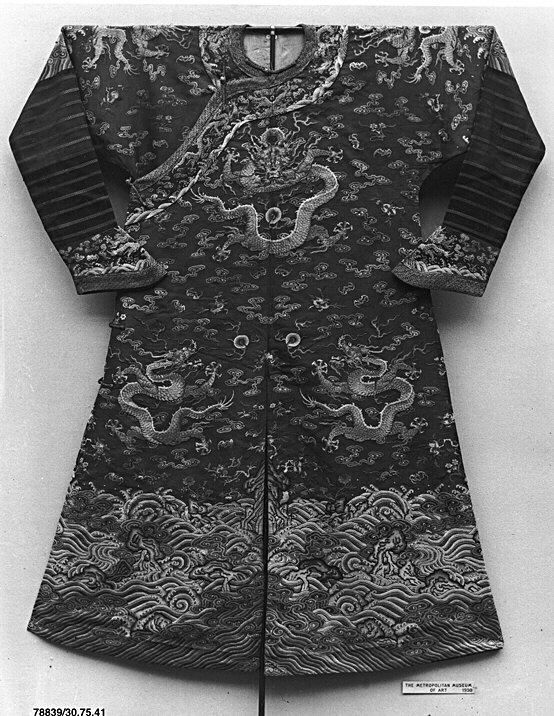
The Imperial Court Robe, a sartorial lexicon of cosmic order and terrestrial authority, presents not a relic but a radical blueprint. For Zoey Fashion Laboratory’s SS26 inquiry, this is not an artifact to be replicated but a genetic code to be spliced. Our analysis discards historical reverence in favor of speculative deconstruction, extracting the robe’s core principles—hierarchical geometry, symbolic cosmology, and restrained opulence—to engineer a future-facing silhouette that interrogates the very architecture of power and the body.
Structural Dogma and Its Dissolution
The traditional robe’s imposition is its foundational thesis: a rigid, cross-collar closure and sweeping, uninterrupted A-line that erases the individual corporeal form to create a monolithic, walking edifice. Zoey’s SS26 interpretation begins with a violent yet precise dissection of this dogma. We propose not a garment that conceals, but one that reveals through strategic absence. Imagine the robe’s planar structure exploded along its seam lines—the central front closure becomes a fissure, held together not by fabric but by tensile architectures of aerospace-grade polymer filaments and memory-wire. The silhouette abandons the monolithic for the modular-exoskeletal.
The body is not hidden but mapped and augmented. Sections of the traditional robe are reimagined as floating panels, anchored to a minimal technical harness worn beneath. The "sleeves," liberated from their armhole origins, become independent kinetic elements—articulated, wing-like appendages that respond to biomechanical data or environmental stimuli. This deconstruction transforms the robe from a symbol of static power into a dynamic interface, where the void between panels is as critical as the material itself, suggesting a new, non-binary relationship between garment and wearer, between containment and exposure.
The Cosmographic Substrate: Silk as Circuitry
The original silk ground, a canvas for embroidered cosmograms, is re-engineered as a smart substrate. Zoey’s SS26 utilizes a proprietary bio-luminescent silk hybrid, grown with integrated protein structures that emit a soft, endogenous glow. Upon this "living" canvas, the metallic thread embroidery is not merely decorative but functional. It is replaced by photo-luminescent conductive yarns, laid in paths that mirror the original celestial diagrams—the sun, moon, and constellations—but which now act as low-voltage circuits or capacitive touch sensors.
This transforms the symbolic cosmology into an interactive data field. The embroidered "three-dimensional mountain" at the hem, a traditional symbol of earthly stability, could be rendered in thermo-chromatic polymers that shift color with body temperature or ambient sound, visualizing the wearer’s biometric state or environmental immersion. The robe’s narrative is no longer fixed by the weaver; it is authored in real-time by the wearer’s interaction with their milieu, making the garment a true psychogeographic instrument.
The Silhouette of Post-Terrestrial Authority
SS26’s ultimate innovation lies in its silhouette, a direct challenge to the robe’s horizontal, earth-bound dominance. We introduce the “Anti-Gravity Drape”. Through a combination of rigid, lightweight internal armatures and fluid, magnetized silk panels, key volumes of the garment—particularly at the shoulders and back—defy gravity, creating suspended arcs and cantilevered forms that appear to float independently of the body’s frame. This creates a halo of architectural space around the wearer, a personal micro-atmosphere that is the futuristic equivalent of the imperial aura.
This silhouette does not walk; it glides and oscillates. The wide, imperial hem is not a trailing weight but an active element. Segmented and interlinked with flexible joints, it can be mechanically or manually articulated into different configurations—a sweeping train for ceremony, a gathered cocoon for transit, or a splayed, radial form for static presentation. This embodies a new, fluid authority suited for a non-static world: power is not in monumentality, but in adaptive performance.
Conclusion: The Laboratory’s Mandate
Zoey Fashion Laboratory’s SS26 study of the Imperial Court Robe concludes with a garment that is its own sovereign entity. It is a wearable manifesto on the evolution of hierarchy from rigid symbolism to fluid, bio-technical expression. By deconstructing its structural dogma, re-engineering its material semiotics, and inverting its gravitational logic, we have not preserved a tradition; we have launched its next evolutionary branch. The resulting silhouette—modular, interactive, and defiantly aerial—proposes a future where couture is not about adorning power, but about engineering a new, conscious anatomy for it. The mandate of heaven is replaced by the algorithm of self-authorship, woven in silk and light.