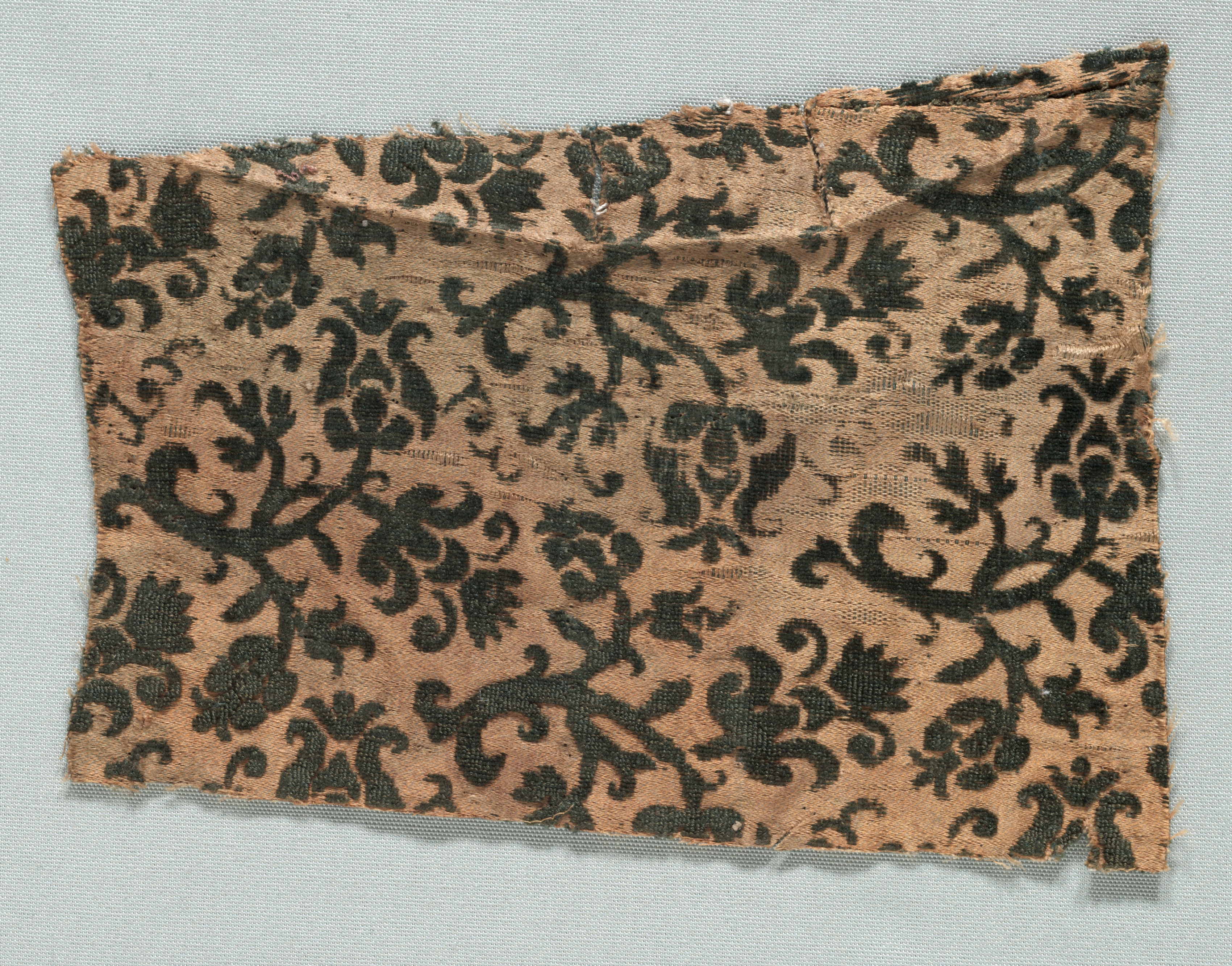
Technical Deconstruction: The Velvet Genome
The submitted fragment is not merely a textile; it is a historical data storage device encoded in warp and weft. Originating from 17th-century Italy, this velvet represents the pinnacle of pre-industrial loom technology. Our analysis treats its structure as a "New DNA Strand," a double helix of technical mastery and cultural intent.
Structural Sequencing
At its core, this velvet is a voided or ciselé velvet, a technique where the pile is selectively cut to create a raised pattern against a sheer, often silk, ground. The "genome" breaks down as follows:
The Ground Warp & Weft (The Backbone): A foundation of fine, tightly spun silk, providing structural integrity. This is the silent support system, the unseen code that makes expression possible.
The Pile Warp (The Expressive Gene): A second set of warp threads, looped over rods during weaving and later cut. The density and height of these cut threads—the pile—create the luxurious depth and light-absorbing quality. The pattern is determined by which rods are used and when, a binary system of "pile" and "no pile."
The Color Saturation (The Phenotype): The fragment's deep, resonant hue, likely achieved with early synthetic dyes like logwood or through complex natural dyeing, is not a surface treatment. The yarn was dyed before weaving, meaning the color is intrinsic to the fiber's identity, baked into its very structure.
Cultural & Historical Context: The Original Code
This velvet was born in an ecosystem of power, religion, and immense wealth. In 17th-century Italy, velvet was less a fabric and more a non-verbal language of status. Worn by the aristocracy and ecclesiastical elite, its cost was astronomical, factoring in the price of silk, the labor of highly skilled weavers (often organized in secretive guilds), and the exotic dyes. The tactile luxury and visual depth of velvet were direct correlates to social and financial capital. It was armor for the court, drapery for the divine. Its very existence was an avant-garde statement of its time—pushing the limits of available technology to create an object of extreme sensory and symbolic impact.
The Avant-Garde Paradox: Old Code, New Operating System
The directive to interpret this through an "Avant-garde" lens is not anachronistic; it is essential. True avant-garde work does not emerge from a vacuum but from a radical re-contextualization of existing codes. This fragment provides the ultimate raw material for such a practice. Our approach is not to replicate but to reverse-engineer and mutate its core principles.
1. De-Functionalizing Luxury: Historically, velvet's function was to denote power. Our avant-garde interpretation strips this social function. We isolate its inherent material properties—light absorption, tactile contrast, structural duality—and redeploy them. Imagine a garment where the velvet exists only on the interior, speaking only to the wearer, or where pile is used not for softness but to create abrasive, textural friction against the skin.
2. Amplifying the "Void": The voided areas in the original fragment are as crucial as the pile. We can expand this concept architecturally. Could a garment be constructed primarily of the delicate ground, with velvet pile appearing only at stress points—elbows, knees, seams—as a form of organic reinforcement? This inverts the hierarchy, making the "negative space" the primary structure.
3. Re-coding the DNA Strand: The "New DNA Strand" metaphor is a direct prompt for material synthesis. We propose cloning the velvet's structural logic with alien materials. Weave a velvet where the pile is not silk but recycled carbon fiber strands or optical fibers. The result: a textile with the historic silhouette and hand of a 17th-century luxury object, but with the technical performance of a 21st-century composite material—conductive, luminous, or structurally load-bearing.
Proposed Design Vectors for Zoey Fashion Lab
Based on this deconstruction, we move from analysis to creation. The following are concrete design vectors that honor the fragment's origin while violently propelling it into a new context.
Vector 1: The Palimpsest Garment
Create a single, foundational piece—a tailored coat or structured dress—using a technically accurate reproduction of the original Italian velvet. This is Layer A, the historical artifact. Layer B consists of avant-garde interventions: bio-fabricated leather grown directly onto the velvet pile in erratic patterns, or electroluminescent wire couched along the original voided pattern lines, causing the historical motif to glow with an unnatural light. The garment becomes a dialogue across centuries, a literal palimpsest where the old and new coexist in tension.
Vector 2: Structural Disintegration & Cybernetic Repair
Here, we embrace entropy. The velvet fragment is subjected to controlled degradation—exposed to enzymes that digest the silk protein, leaving only the most resilient parts of the structure. This fragile, collapsing lattice is then "repaired" or stabilized using 3D-printed biopolymer scaffolds or fused with translucent silicone membranes. The final piece is a document of decay and artificial preservation, questioning fashion's obsession with permanence. It is a relic from a future archaeology.
Vector 3: The Haptic Soundscape
This vector focuses on velvet's most iconic property: its sound. The "whoosh" of crushed pile is a unique sonic signature. We instrument the fabric. By weaving micro-thin piezoelectric threads into the pile warp, pressure and friction on the velvet generate electrical signals. These signals are mapped to a generative soundscape—each gesture of the wearer creates an ambient, wearable composition. The garment becomes an interface, transforming the historic, silent luxury of velvet into an interactive, audible experience.
Conclusion: The Strand Continues
The 17th-century Italian velvet fragment is not a closed archive but an open-source file. Its value to Zoey Fashion Lab lies in its profound material intelligence—a mastery we must understand not to copy, but to hack. By sequencing its technical DNA and cross-breeding it with contemporary technologies and philosophies, we do not disrespect the past; we engage in the most sincere form of homage: continuation. We take the strand and splice it with our own epoch's code, creating a hybrid, avant-garde language that speaks of deep history and imminent future in the same breath. The weave is a protocol. It is now our turn to write the next iteration of its software.