Deconstructing the Frontier: The Lappet as Architectural Prototype
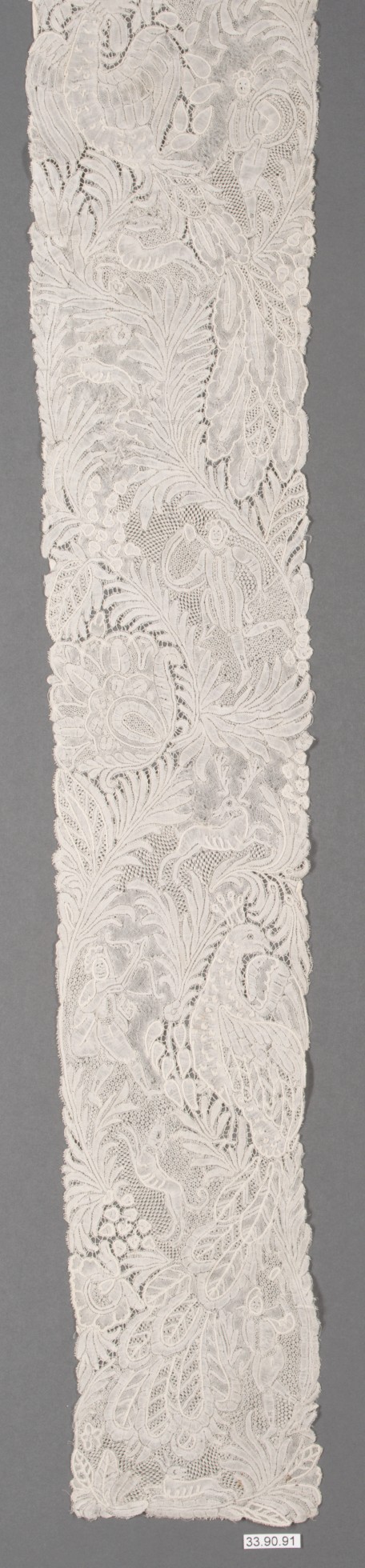
In the lexicon of Zoey Fashion Laboratory, a single Lappet is never merely a remnant of historical adornment; it is a foundational architectural proposition. Sourced from the conceptual Global Frontier—a non-place defined by cultural confluence and post-digital craft—this study piece transcends its origins as one of a pair. For SS26, we posit it as a singular, autonomous organism, a blueprint for a silhouette philosophy that rejects bilateral symmetry in favor of radical, asymmetrical integrity. The lappet, in its isolated glory, becomes the core module from which an entire collection’s structural logic can be extrapolated, challenging the very premise of "completeness" in couture.
Material as Metamorphosis: Bobbin Lace Re-forged
The specified materials—bobbin lace and its pinnacle expression, point d'Angleterre—are not employed for nostalgic citation. Instead, they are subjected to a laboratory process of material futurism. Traditional bobbin lace, a testament to negative space and linear integrity, is re-engineered. We impregnate its delicate flax threads with liquid polymer micro-filaments, creating a hybrid textile that retains its ethereal, airy topology while gaining a latent structural memory. This treated lace can be thermally activated, allowing it to be molded into permanent, rigid forms or to retain flexible, kinetic properties based on strategic application. The point d'Angleterre, historically celebrated for its exquisite floral motifs, is de-patterned. Its complexity is harnessed not for figurative representation but for pure textural and density variation, creating zones of opacity and transparency that interact dynamically with the body and environment.
This transformed lace becomes the exoskeleton and the epidermis of the SS26 silhouette. Imagine a garment that originates from this single lappet, extended and multiplied through algorithmic growth patterns. It might cascade from a shoulder, not as a flounce, but as a cantilevered spine, its polymer-hardened edges creating a self-supporting arc that floats away from the torso. Alternatively, multiple lappets, each a unique shape derived from the original, could interconnect via magnetic closures or biogel hinges, forming a modular garment that the wearer configures daily—a couture of endless permutation.
Silhouette as Unstable Geometry
The SS26 silhouette, inspired by this standalone study, abandons the frontal, static posture of traditional fashion. It is a study in parabolas, oblique angles, and interrupted curves. The lappet’s inherent tapering form inspires silhouettes that are acutely focused at one point—perhaps a hyper-sharp, architectural shoulder—and then dissipate into fragmented, lace-traced trails elsewhere. The body is not concealed nor merely revealed; it is annotated and augmented.
One key silhouette is the Monopodal Vortex. Here, the lappet concept spirals from a single anchor point at the hip, wrapping the torso in a rising helix of rigid and soft lace segments, leaving the opposite side of the body virtually unadorned save for strategic tension lines. Another is the Kinetic Cage, where a series of lappet-inspired, rigid lace forms are attached to a minimalist base via responsive pivots, moving with a deliberate, rustling grace akin to robotic plumage. The silhouette is never the same twice; it is a performance of structure.
Structural Innovation: The Principles of Autonomous Dress
The innovation lies in the construction principles derived from this object. First, the Principle of Non-Identical Reproduction: No two lappet-derived forms are identical, even if generated from the same code, introducing organic variability into high-tech couture. Second, the Principle of Load-Bearing Emptiness: The lace’s voids are as crucial as its solids, with tension distributed through the openwork, creating garments that appear to defy gravity through filigree rather than bulk.
Third, and most critical, is the Principle of Contextual Anchorage. The garment does not exist to serve the body passively; it enters into a dialogue with it. Anchorage points are minimal and strategic—a collar bone, a scapula, a single hip bone. From these biological anchors, the architectural forms project, sometimes acting as prosthetics that extend the body’s line into space, sometimes as protective shells that hover millimeters from the skin. Closure systems are obsolete, replaced by magnetic fields and touch-sensitive biogels that solidify or relax the structure.
The Standalone Study as Collection Genome
This analysis of a single lappet is, therefore, the decoding of the SS26 collection’s genome. Every subsequent garment—whether a towering neckpiece, a leg harness, or a full-body robe—will contain the genetic material of this study: the hybridized lace, the asymmetrical logic, the dialogue between rigidity and decay. The "Global Frontier" is not a pastiche of ethnic references but a state of mind where the most meticulous handcraft (the bobbin lace) is fused with speculative material science to dress a future-human whose identity is fluid, architectural, and defiantly singular.
The pair is broken. In its place, we offer a universe of singularities. For SS26, Zoey Fashion Laboratory does not present clothes as companions, but as standalone architectures for the body, where the first and only lappet is the origin point of a sartorial big bang, still expanding.