Deconstructing the Canopy: The Embroidered Net as Architectural Frontier
In the lexicon of avant-garde construction, the concept of a "cover" is inherently paradoxical. It implies both shelter and revelation, a membrane that obscures as it defines. For Zoey Fashion Laboratory's SS26 inquiry, the directive to explore a Cover fabricated from Embroidered Net sourced from the Global Frontier is not a brief for a garment, but a manifesto for a spatial intervention. This standalone study moves beyond apparel to interrogate the very relationship between body, void, and exoskeleton. The embroidered net ceases to be a mere textile; it is re-engineered as a topological scaffold, a second skin that maps negative space with forensic precision, establishing a new dialectic between opacity and transparency for the coming age.
Structural Innovation: The Calculus of the Void
The foundational innovation lies in a radical re-imagining of the net's structural role. Traditional garment architecture builds from the body outward, using fabric to clad a positive form. Zoey Fashion Laboratory inverts this principle. Here, the embroidered net acts as a three-dimensional cartographic grid, plotting points in space that the body subsequently occupies. The "cover" is not a sheath, but a calibrated matrix of voids. Technical experimentation with variable gauge netting—ranging from rigid, macro-scale hexagonal structures to fluid, micro-scale tulle—creates zones of differential density. This allows for a single piece to simultaneously articulate rigid, exoskeletal shoulders (a literal "global frontier" of the silhouette) while dissolving into a nebulous, cloud-like volume around the torso. The structural innovation is a parametric design logic, where the embroidery is not decoration but integral structural reinforcement, acting as a tensile web that dictates the form's behavior and collapse.
Futuristic Silhouette: The Bio-Mechanical Canopy
The resultant silhouette for SS26 is a study in controlled atmospheric disturbance. It rejects the archaic dichotomy of fitted versus voluminous. Instead, we propose the Bio-Mechanical Canopy. This silhouette operates on the principle of selective environmental interaction. Imagine a form that extends horizontally from the collarbones in a rigid, wing-like plane constructed of resin-infused net, only to cascade into a vertical, fluid trail of knotted filament. The body moves within this cage-cum-aura, its presence revealed only in fragments through the net's apertures. This creates a dynamic, non-linear silhouette that changes its topological profile with motion, akin to a morphing radar signature. The "cover" becomes a personal micro-climate, a portable spatial envelope that interacts with light, wind, and perception as an active agent, not passive drapery.
Material Alchemy: Embroidered Net as Data Field
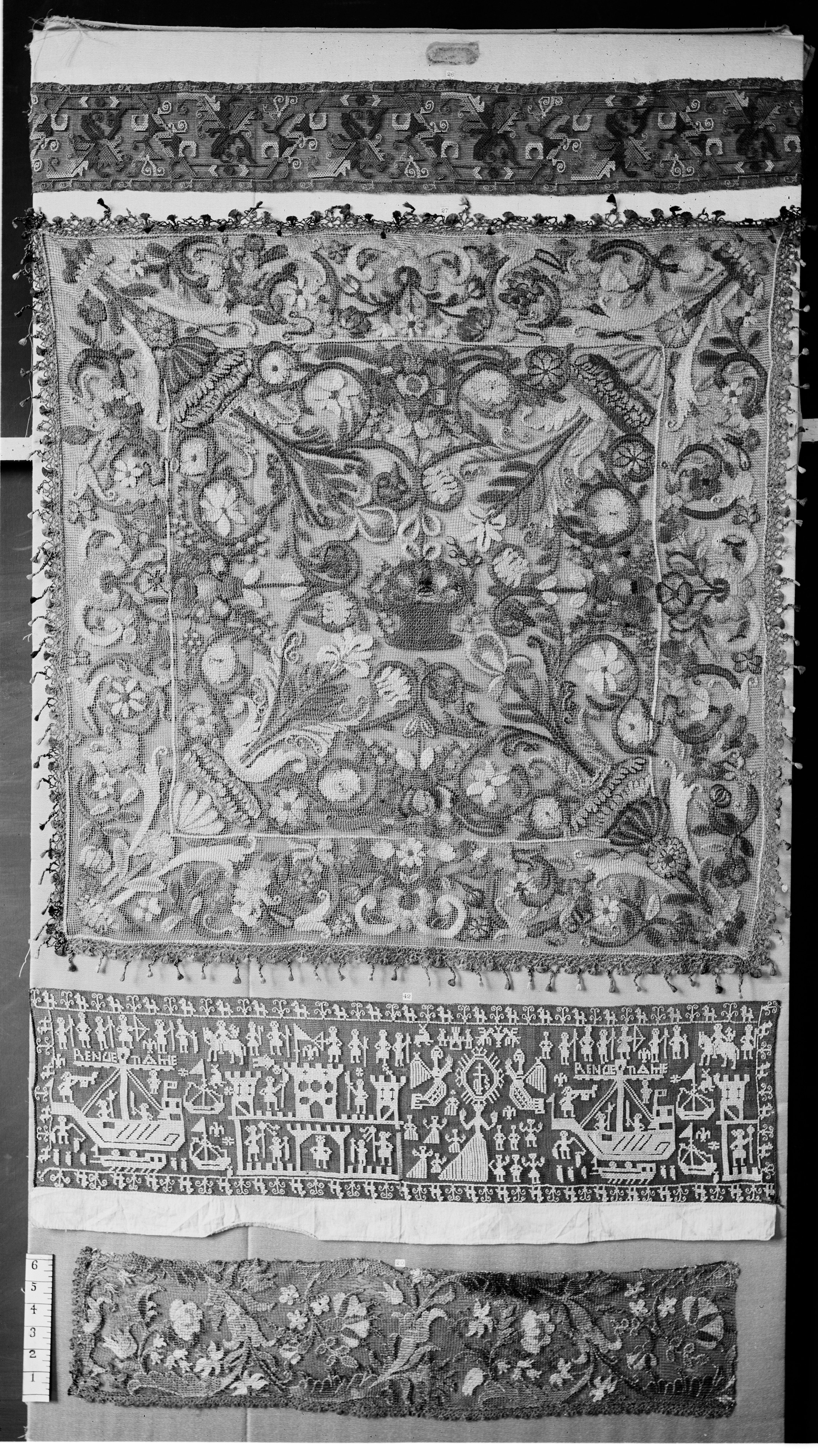
Sourcing from the Global Frontier implies a material narrative of hybridity and raw, untamed potential. The net is the base substrate, a neutral lattice awaiting information. The embroidery is the code. For SS26, this embroidery transcends ornamentation to become embedded functional data. Using conductive threads and photoluminescent micro-threads, the embroidered patterns serve as circuit pathways or charge-holding capillaries. A geometric embroidery motif on the shoulder's exoskeleton might literally illuminate in response to biometric feedback or environmental stimuli. Furthermore, the embroidery is applied with a multi-planar technique, creating knots and clusters that act as structural nodes, distorting the net's plane and introducing unexpected textural relief. This transforms the material from a flat, permeable sheet into a dense, multi-layered information field, where texture, light emission, and structural integrity are woven into a single, complex system.
Contextual Philosophy: The Standalone Avant-Garde Study
As a standalone study, this analysis of the Cover liberates it from the cyclical tyranny of seasonal commerciality. It exists as a pure proposition. Its context is the laboratory itself—a white space of ideation. This freedom allows the concept to engage with broader discourses: architectural biomimicry (spider webs, radiolaria skeletons), digital surveillance aesthetics (the body fragmented by a pixel grid), and post-human garmenting. The Cover does not dress a human for society; it constructs a hybrid entity for an unspecified, future environment. It questions whether protection in an era of data saturation requires physical shielding or rather a curated system of visibility and encryption. The embroidered net, in its final form, is a tool for that curation—a filter for existence.
Conclusion: The SS26 Proposition
Zoey Fashion Laboratory's SS26 study, "Cover: Global Frontier (Embroidered Net)," posits a future where garment architecture is synonymous with spatial design. It is a definitive move from fashion as object to fashion as interactive architecture for the body. The futuristic silhouette is a biomechanical canopy, a dynamic interplay of rigid and nebulous forms. The structural innovation is a parametric calculus of void and reinforcement. The material, a humble net, is alchemized into a smart, structural data field. This analysis confirms that the avant-garde frontier is no longer about what we wear, but about the portable, intelligent spaces we choose to inhabit. The cover is not over; it is the beginning of a new spatial syntax.