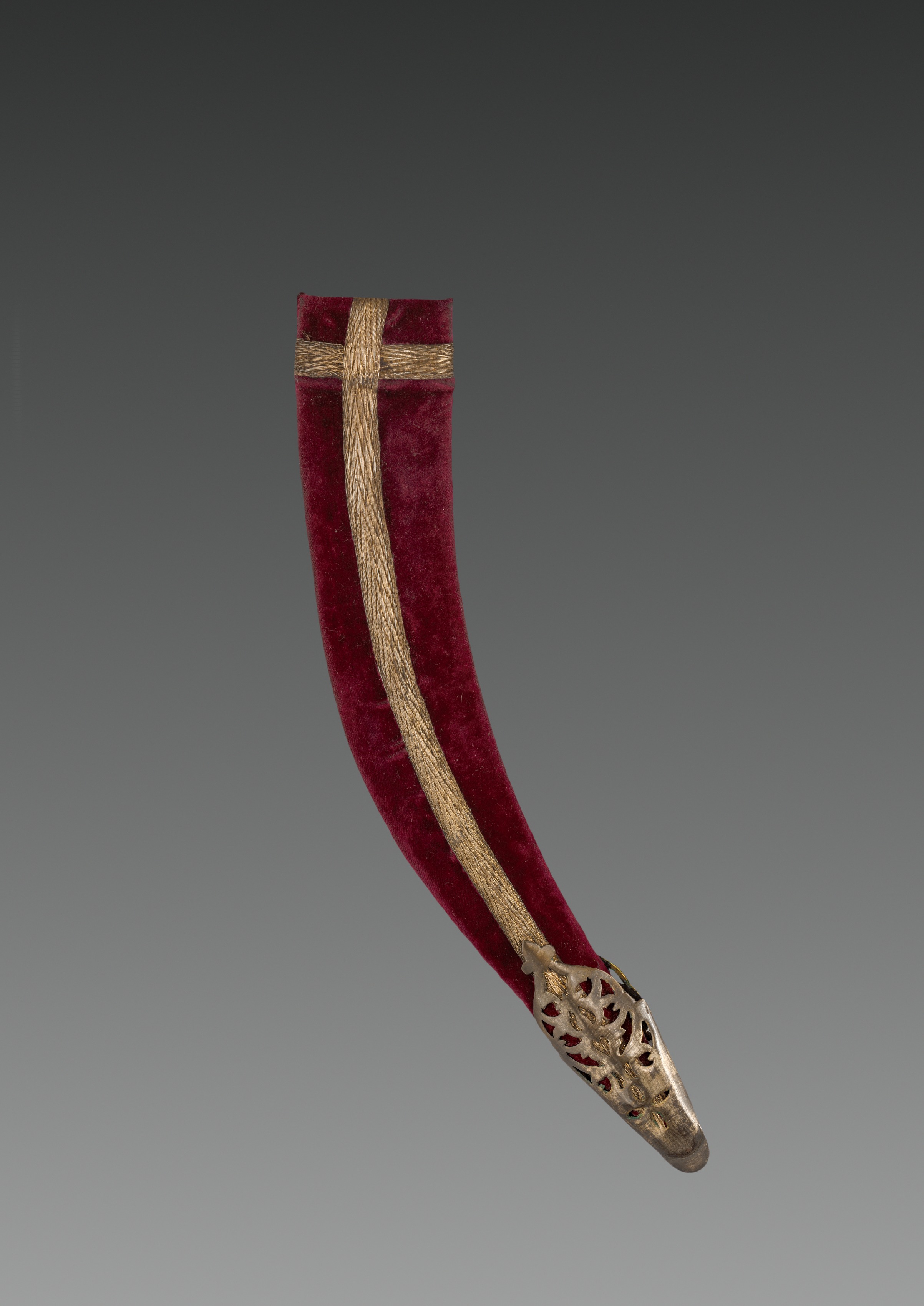
Technical Deconstruction: The Dagger as a Textile Artifact
The provided artifact—a dagger housed in a red velvet case, originating from India, with a wood sheath covered in velvet and metallic thread—presents a profound starting point for material innovation. Our analysis begins not with the blade, but with its container. The wooden sheath is the foundational architecture, a rigid, organic form that dictates silhouette and structure. This translates directly to avant-garde fashion as the potential for structured, body-defining elements: boning in a corset, the rigid spine of a high-collared jacket, or the exaggerated curve of a hip accent. The wood's grain, a natural fingerprint, inspires textured, layered fabrics like bonded jacquards or laser-cut leather with organic, non-repeating patterns.
The velvet covering is the first layer of sensory translation. Red velvet is historically loaded with connotations of power, royalty, and danger—a perfect triad for avant-garde expression. Technically, its pile creates a play of light and shadow, a dimensionality we can replicate through techniques like devoré (burn-out velvet) to create strategic translucency, or through high-pile textiles like mohair or plush felts to mimic its tactile depth. The act of "sheathing" the wood in velvet speaks to a philosophy of concealing the structural with the sensual, a principle that can guide garment construction where hard lines are softened by luxurious drape.
Metallic Thread: The New Genetic Code
The metallic thread embroidery is the most critical "DNA strand" for replication. This is not mere decoration; it is a narrative in linear form, a circuit board of cultural and aesthetic data. The reference to a "New DNA Strand" is pivotal. We interpret this not as literal genetic mimicry, but as the code for creating a new, hybrid aesthetic lineage for Zoey Fashion Lab.
Technically, this demands exploration beyond conventional embroidery. The metallic thread suggests pathways, connections, and fragile strength. This translates to: Conductive threads woven into seams, allowing for integrated, soft-circuit lighting that traces the body's contours. Heat-bonded metallic tape applied in sinuous, strand-like patterns on sheer membranes, creating a fused, second-skin effect. Chainmaille elements constructed not of metal rings, but of linked, 3D-printed bioplastic units, embroidered onto a base fabric to create a mutable, sound-producing texture. The "thread" becomes a structural component, not just a surface application.
Conceptual Translation: From Artifact to Avant-Garde Collection
The overarching theme is "Sheathed Potential: The Dormant Edge." The collection explores the tension between the concealed and the revealed, the protective and the threatening, the historical artifact and the future-facing organism.
Silhouette & Structure
Garments will embody the sheath's dual nature. Look for asymmetric jackets with one rigid, wooden-inspired panel (achieved through molded resin or stiffened, laminated linen) contrasting with a fluid, velvet-draped side. Dresses may feature a structured, torso-hugging "sheath" that erupts into a torrent of slashed velvet or chainmail fringe at the hem—the blade's edge made textile. Hoods and high necklines will reference the case's opening, enveloping the head and revealing only a stark, metallic-embroidered gaze.
Textile Development & Surface Innovation
This is where the DNA strand proliferates. We propose developing a proprietary textile, "Stranded Velvet." This would involve weaving a base of silk and fine copper wire, onto which a velvet pile is selectively grown. The metallic underlayer would gleam through where the pile is sheared or burned away, creating the illusion of embroidery from within the fabric itself. Furthermore, digital printing on velvet can replicate the precise, microscopic swirl of wood grain at a monumental scale, turning a skirt into a forest of texture.
The metallic thread narrative extends to closures and fastenings. Zippers become obsolete, replaced by functional embroidery: lines of metallic-thread shibori that, when pulled, gather and shape the garment. Hook-and-eye closures are reimagined as delicate, embroidered talons or molecular structures.
Color Palette & Emotional Resonance
The core palette derives from the artifact but mutates. Case Crimson (the original velvet), Sheath Wood (a spectrum from pale ash to ebony), and Thread Gold (not gaudy, but a muted, ancient alloy hue). These are disrupted by biomorphic accents: Translucent Bone, Oxidized Green, and a sharp, electric Blade Blue appearing as linings, surgical slices in the fabric, or the glow from within integrated circuitry. The emotion is one of dormant power, ceremonial futurism, and elegant danger.
Conclusion: The New Lineage
For Zoey Fashion Lab, this Indian dagger case is not a relic but a progenitor. Its "New DNA Strand" is a blueprint for a design philosophy where history is a substrate for biotechnology, where protection is an aesthetic, and where embellishment is structural. The final collection will not literally resemble a dagger. Instead, it will feel like its consequence: a wardrobe for a future where fashion is both armor and archive, where every seam contains a coded history, and where the most potent statement is one sheathed in devastating beauty. The velvet case teaches us that the container can be as significant as the weapon; in avant-garde fashion, the garment is both.