Technical Deconstruction & Historical Provenance
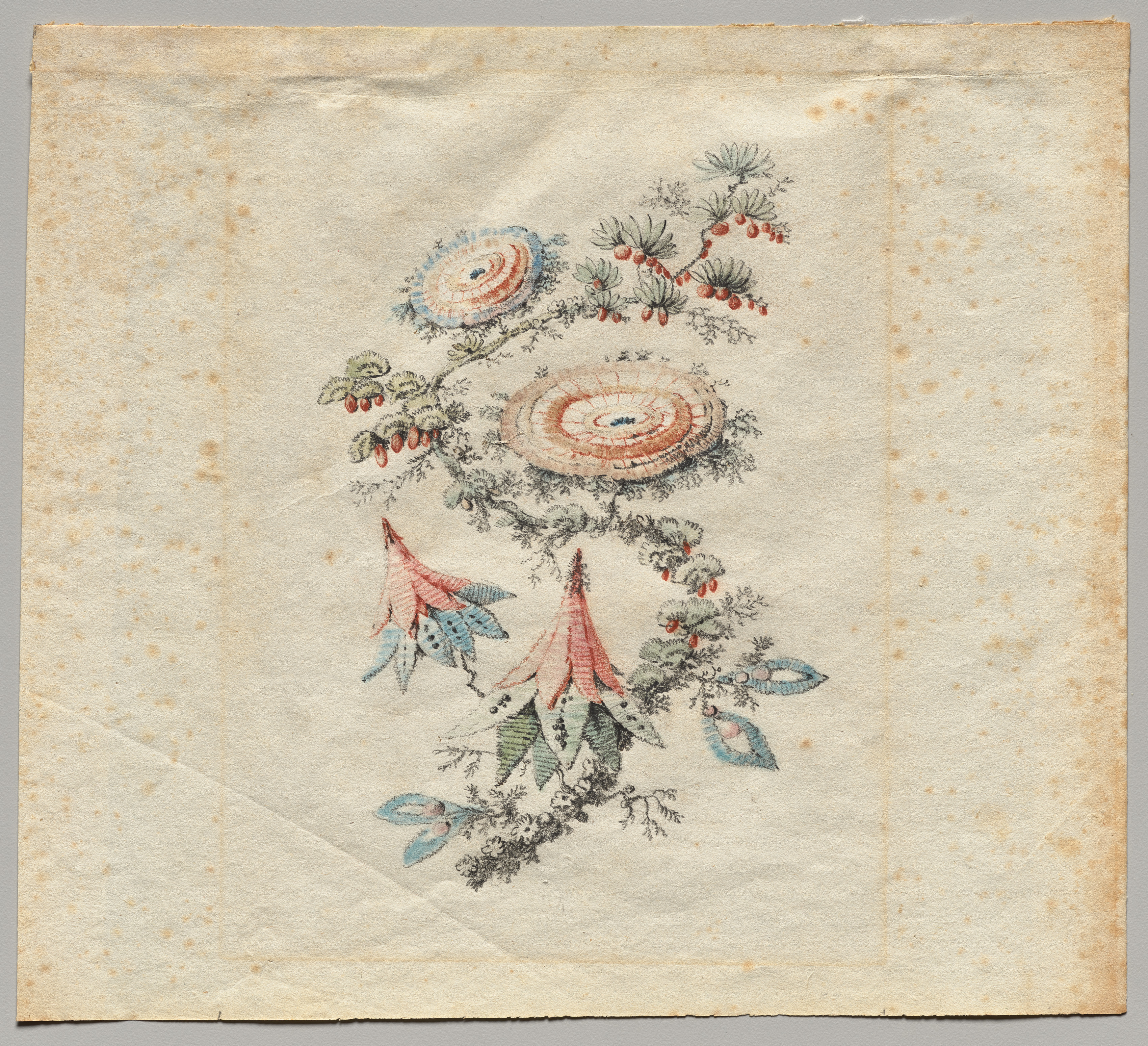
The provided artifact—an 18th-century French flower embroidery design, executed in black and colored crayon on wove paper for the Silk Manufactory of Lyon—represents a pivotal moment in the history of textile art and industrial luxury. To deconstruct this piece is to understand the DNA of European haute couture. Lyon, in the 18th century, was the undisputed global epicenter of silk production, its manufactories operating under royal patronage to supply the courts of Europe. These designs were not mere sketches; they were proprietary blueprints for woven and embroidered luxury, dictating the aesthetic language of power and status.
The medium itself is significant. The use of crayon, a precursor to the modern pencil, allowed for a remarkable softness of line and subtle gradation of tone, essential for rendering the delicate shading of petals and foliage. The "wove paper," a newer, smoother paper technology compared to laid paper, provided an impeccably even surface, enabling the designer to achieve precise, uninterrupted strokes. This combination speaks to a pursuit of technical perfection in the design phase, mirroring the exacting standards of the Lyon looms. The design would have been part of a cartonnier (pattern book), a guarded archive of patterns that were repeatedly used, adapted, and referenced, forming a living library of botanical inspiration.
Decoding the Florilegium: From Naturalism to Abstraction
The core of the 18th-century Lyonese flower embroidery is a studied naturalism rooted in the scientific botanical illustration of the period. Designs typically featured meticulously observed blooms—roses, carnations, tulips, hyacinths—arranged in bouquets, garlands, or scattered en semis. However, they were always stylized, idealized for the medium of silk thread and metallic bullion. The "flower" was a carefully constructed icon, its form simplified into clear, embroiderable planes, its colors heightened beyond nature's palette to dazzle in candlelight.
This is where our reference to a New DNA Strand becomes critically operative. We are not tasked with mere replication. Our mandate is to isolate the core genetic markers of this historical artifact and splice them with avant-garde principles. The historical design provides a genome of elegance, craftsmanship, and symbolic botanical language. Our avant-garde lens acts as a mutagen, initiating strategic and radical expressions.
Recombinant Design Strategy: An Avant-Garde Synthesis
The avant-garde approach is not one of destruction, but of deliberate, intelligent recombination. It asks: What happens when the ordered, courtly beauty of the 18th century is subjected to the disruptive forces of 21st-century thought? Our analysis yields the following recombinant strategies for the Zoey Fashion Lab collection.
1. Structural Decomposition & Scale Dislocation
We propose dissecting the complete floral bouquet into its constituent parts. Isolate a single stamen, a fragment of a petal vein, a cross-section of a pistil. Using the crayon's soft line as a guide, we can render these fragments at a monumental scale. Imagine a single, giant petal vein, embroidered in a raised, padded technique (broderie en relief), traversing the entire length of a silk coat. The "wove paper" background translates to a commitment to flawless, minimalist fabric grounds—heavy silk duchesse satin or crisp organza—that act as the contemporary equivalent of that pristine paper, emphasizing the singular, deconstructed motif.
2. Chromatic Disruption & Medium Transmutation
While the original employed colored crayon within a conventional floral palette, our avant-garde interpretation must disrupt this harmony. We introduce acid-bright neon threads into the classic silk floss palette. Imagine a traditionally rendered rose, but its central shadow is rendered not in deeper pink, but in electric green or cyber yellow. Furthermore, we transmute the medium: the crayon line itself becomes the subject. We can recreate its smudged, graphic quality not with thread, but with techniques like devoré (burn-out) or laser etching on silk velvet, literally "drawing" with absence and texture. The black crayon under-sketch, typically hidden in the final embroidery, can be exaggerated and left "visible" as a guiding graphic element in chain stitch or couched cord.
3. Conceptual Framing: The Laboratory Florilegium
The collection’s narrative shifts from royal patronage to the Fashion Lab as a site of botanical experimentation. Garments become specimen pages from a new, anarchic florilegium. A tailored blazer might feature a "correctly" embroidered stem that suddenly mutates into a strand of synthetic DNA (referencing the "New DNA Strand" brief), rendered in iridescent sequins or bioluminescent thread. The symmetry of the 18th-century design is broken by asymmetric, algorithmic scatter patterns, as if the flowers are undergoing mitosis or data corruption. This reflects an avant-garde preoccupation with biotechnology and the manipulation of natural codes.
4. Tactile Archaeology & Surface Stratification
We honor the artisanry of Lyon by pushing its techniques to extreme, tactile conclusions. The flat embroidery of the past is exploded into three-dimensional topographies. Petals are constructed from layered silk gazar, stiffened and shaped to project from the body. We incorporate unexpected materials that converse with silk's luxury: fine metal meshes over embroidery, translucent silicone "dew drops," or the integration of reclaimed electronic components as futuristic stamens. This creates a surface of stratified history, where the 18th century and the 22nd century collide in a single, tangible form.
Conclusion: The Recombinant Bloom
For Zoey Fashion Lab, this 18th-century design is not a relic but a living code. By applying an avant-garde methodology—deconstructing its form, disrupting its color, re-contextualizing its purpose, and exaggerating its texture—we initiate a recombinant process. The resulting collection will speak a dual language: the whispered elegance of Lyon's silk ateliers and the declarative innovation of the laboratory. It will carry the DNA of history, but express it through a thoroughly modern and disruptive genotype. The flower, once a symbol of natural order and aristocratic refinement, is re-engineered into a symbol of creative mutation, blooming defiantly at the intersection of heritage and hyper-innovation.