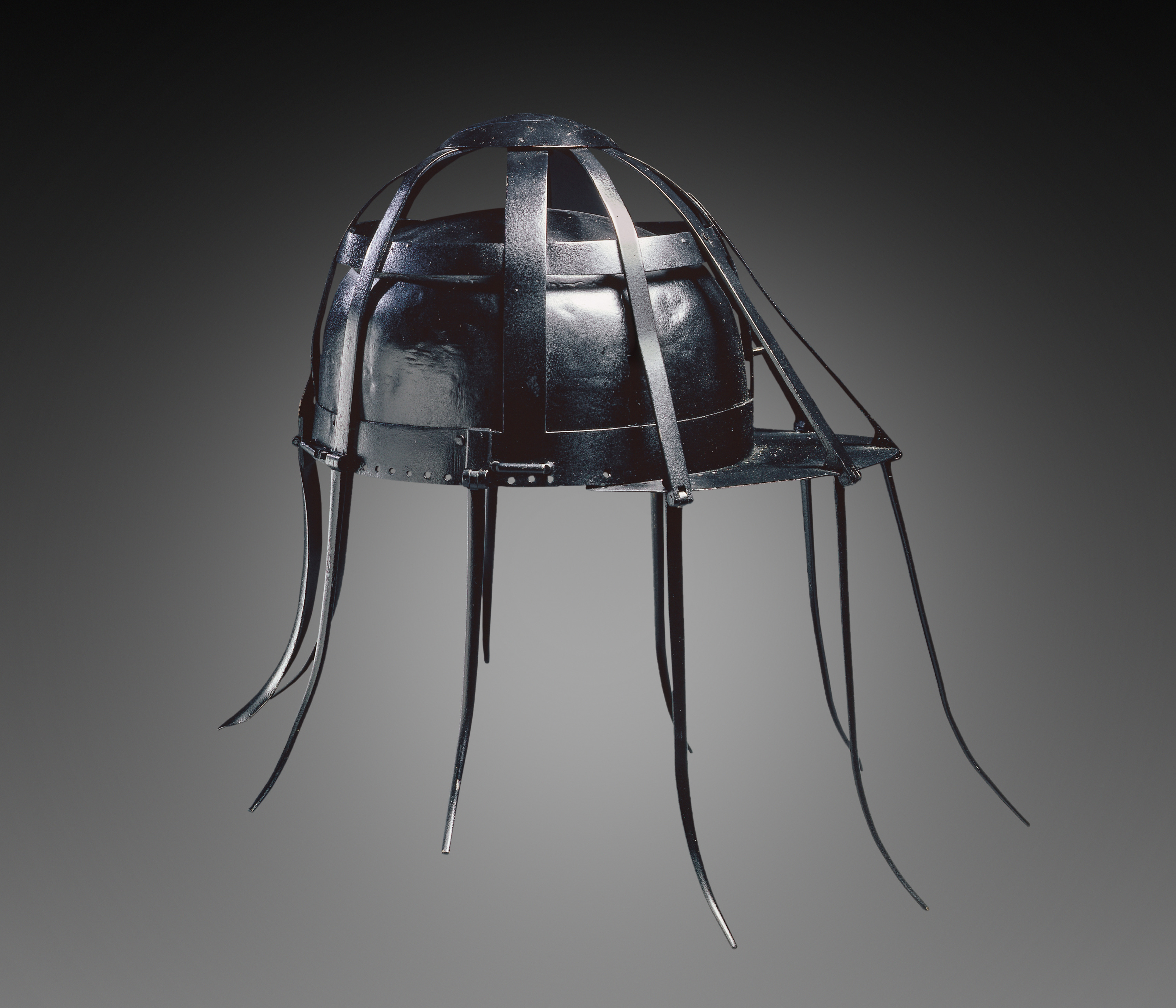
Deconstructing the Cavalry Spider Helmet: A 17th-Century French Iron Relic Reimagined for the Avant-Garde
At Zoey Fashion Lab, the role of the Chief Fabric Deconstructionist is to dismantle historical artifacts not merely as objects of the past, but as living, breathing sources of genetic code for future fashion. Today, we dissect the Cavalry Spider Helmet, a singular piece originating from 17th-century France. Forged from iron and coated in black paint, this helmet is not just a piece of armor; it is a New DNA Strand—a structural blueprint that, when recontextualized through an avant-garde lens, can redefine the silhouette, materiality, and narrative of contemporary design. This analysis will explore the helmet’s technical, symbolic, and aesthetic components, proposing a radical transformation that honors its martial history while propelling it into the speculative future of fashion.
I. The Original Blueprint: Technical and Material Analysis
The Cavalry Spider Helmet is a masterclass in functional engineering. Its primary material—iron—was chosen for its durability and resistance to penetration, essential for a cavalryman facing sword strikes and musket fire. The black paint served a dual purpose: it protected the iron from rust and reduced glare on the battlefield, offering a tactical advantage. The term “Spider” likely refers to the helmet’s distinctive, multi-faceted construction, which mimics the segmented, protective exoskeleton of an arachnid. The helmet’s form is characterized by a low, sweeping brim, a reinforced skull cap, and articulated cheek guards that pivot on rivets. These components are not decorative; they are a system of interlocking defenses, each part designed to absorb and deflect force.
From a deconstructionist perspective, the helmet’s structural integrity is its most compelling feature. The iron is not a single sheet but a series of overlapping plates, a technique that allows for movement while maintaining protection. The black paint, now chipped and patinated, reveals the underlying metal’s texture—a record of time, impact, and wear. This is not a pristine museum piece; it is a worn, battle-tested object. The New DNA Strand we extract from this is the concept of segmented armor as a living, adaptive system. In fashion, this translates to garments that are not static but modular, capable of reconfiguration by the wearer. The helmet’s rivets become a metaphor for articulated joints—points of connection that allow for both rigidity and flexibility.
II. The Avant-Garde Lens: Reimagining Form and Function
To apply an avant-garde lens is to reject the helmet’s original context—warfare—and instead read it as a sculptural object. The avant-garde thrives on tension: between protection and exposure, between the organic and the mechanical. The Cavalry Spider Helmet embodies this tension perfectly. Its iron exoskeleton is a shell that both shields and isolates the wearer. In fashion, we can translate this into a second-skin armor that is simultaneously protective and performative. Imagine a jacket constructed from laser-cut iron panels, each piece coated in a matte black finish, connected by industrial-grade zippers or magnetic clasps. The panels would not be static; they would be arranged in a pattern that echoes the helmet’s overlapping plates, allowing the garment to flex with the body while maintaining a rigid, architectural silhouette.
The black paint, in its current state of decay, offers a rich textural language. The chipped surface reveals a patina of history—a visual record of use. In an avant-garde collection, this can be replicated through distressed finishes on leather or synthetic materials, or through the application of reactive pigments that change color with temperature or touch. The helmet’s low brim, which once shielded the eyes from the sun and enemy blades, can be reinterpreted as a dramatic, asymmetrical visor or a hood that frames the face like a dark halo. The articulated cheek guards become collar extensions that rise to the cheekbones, creating a protective, almost intimidating silhouette.
III. The New DNA Strand: From Armor to Fashion System
The New DNA Strand is not a literal replication of the helmet but a genetic algorithm for design. The key elements we extract are: segmentation, articulation, surface texture, and protective silhouette. These are not merely aesthetic choices; they are functional principles that can revolutionize garment construction. For example, segmentation allows for modular design—a coat that can be disassembled into a vest, a skirt, or a bag. Articulation enables dynamic movement—a sleeve that can be locked into a rigid position or released for fluid motion. Surface texture, derived from the chipped black paint, introduces a tactile narrative—each scratch and mark tells a story of use, making the garment a living archive.
In practice, this could manifest as a “Cavalry Spider” capsule collection for Zoey Fashion Lab. The centerpiece would be a segmented iron corset, constructed from interlocking black-painted aluminum plates. The corset would not compress the torso but instead hover around it, creating a protective shell that is both armor and architecture. The plates would be connected by articulated rivets, allowing the wearer to adjust the fit and form. The surface would be treated with a distressed black finish, with intentional scratches and dents that mimic the helmet’s patina. This corset would be paired with a low-brimmed hood made from stiffened black leather, its shape echoing the helmet’s sweeping brim. The hood would be lined with a reflective material, a nod to the helmet’s tactical origins, but here used to create a dramatic, otherworldly glow.
IV. Symbolic and Cultural Recontextualization
The Cavalry Spider Helmet is a symbol of martial power and protection, but in the avant-garde context, these meanings are subverted. The helmet’s spider-like form evokes both the arachnid’s predatory nature and its delicate web-building. In fashion, this duality can be explored through web-like netting layered over the iron panels, or through spider-leg appendages that extend from the shoulders, creating a silhouette that is both menacing and elegant. The black paint, originally a utilitarian coating, becomes a statement of absence—a void that absorbs light and attention. This is the avant-garde’s fascination with the monochrome, the rejection of color in favor of pure form and texture.
Furthermore, the helmet’s origin in 17th-century France places it within a specific historical narrative of aristocratic warfare and courtly display. By deconstructing this object, we are not erasing its history but recontextualizing it for a contemporary audience. The helmet becomes a commentary on protection in the modern world—not from swords and bullets, but from the gaze, from the environment, from the self. The wearer of a Cavalry Spider-inspired garment is not a soldier but a guardian of their own identity, encased in a shell that is both fortress and fashion.
V. Conclusion: The Helmet as a Living Archive
The Cavalry Spider Helmet, as analyzed through the lens of Zoey Fashion Lab, is far more than a historical artifact. It is a New DNA Strand—a set of design principles that challenge the boundaries of material, form, and function. By deconstructing its iron plates, its black paint, its articulated joints, and its protective silhouette, we have uncovered a blueprint for an avant-garde fashion system that is modular, adaptive, and narrative-driven. The helmet’s martial origins are not a limitation but a source of tension, a dialogue between protection and expression, between history and the future. In the hands of the Chief Fabric Deconstructionist, this 17th-century French relic becomes a living, breathing source code for a new generation of fashion—one that is as armored as it is avant-garde, as functional as it is fantastical.