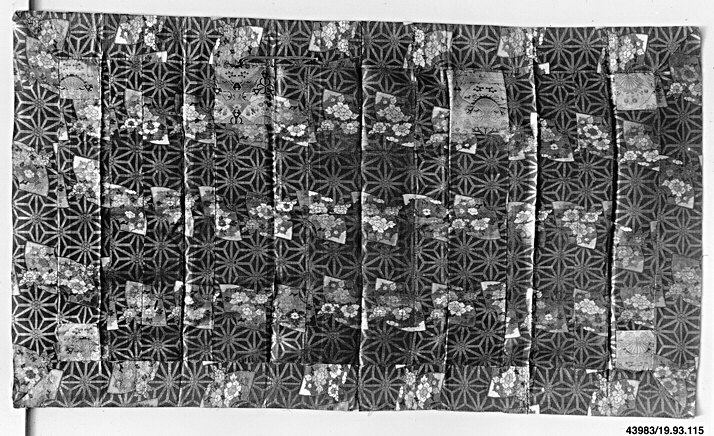
Deconstructing the Sacred: The Shichijō Priest’s Robe as a Blueprint for SS26 Avant-Garde Silhouettes
The intersection of ritual vestments and futuristic fashion presents a fertile ground for avant-garde exploration. Within the hallowed folds of the Japanese Shichijō priest’s robe—a garment steeped in centuries of Buddhist liturgy and spiritual discipline—lies a lexicon of structural innovation that transcends its sacred origins. For Zoey Fashion Laboratory’s SS26 collection, this silk artifact is not a relic to be revered, but a deconstructive catalyst for reimagining the human form as a vessel of kinetic architecture. By dissecting its asymmetrical draping, volumetric layering, and symbolic weight, we unearth a radical blueprint for silhouettes that are simultaneously monastic and futuristic, serene and disruptive.
Silk as a Medium of Temporal Dissonance
The materiality of the Shichijō robe—its lustrous, hand-woven silk—is the first point of departure. In its original context, silk is a mediator between the earthly and the divine, its fluidity embodying the impermanence of existence. For SS26, we re-engineer this fabric through laser-cut latticework and thermoplastic resin coatings, transforming its organic drape into a semi-rigid exoskeleton. The result is a paradoxical textile: one that retains the tactile memory of silk’s caress while adopting the structural integrity of architectural membranes. This hybrid material allows for silhouettes that defy gravity—shoulder lines that cantilever into angular, blade-like forms, and hemlines that flare into asymmetrical, aerodynamic arcs. The priest’s robe, once a symbol of humility, becomes a cyborgian second skin, its folds now housing embedded fiber-optic threads that pulse with ambient light, referencing both the glow of temple lanterns and the neon of Tokyo’s future.
Asymmetry as a Liturgical Rebellion
Central to the Shichijō robe’s design is its deliberate asymmetry—the left side often draped over the right, a subtle nod to the imperfection of the human condition. In our avant-garde reinterpretation, this asymmetry is amplified into a structural manifesto. We deconstruct the robe’s traditional wrap-and-tie system, replacing it with a modular framework of magnetic closures and articulated joints. The left panel, once subordinate, now extends into a sweeping, wing-like appendage that bifurcates the torso, creating a negative space that invites the viewer to question the boundaries of the body. The right panel, conversely, is compressed into a corseted, architectural spine that hugs the wearer’s form, its seams tracing the meridians of the human skeleton. This duality—the left as a liberated, flowing volume; the right as a disciplined, linear contour—creates a dynamic tension that mirrors the priest’s role as a mediator between chaos and order.
Volumetric Layering and the New Monastic Silhouette
The Shichijō robe’s layering system—multiple panels of silk overlapping in a cascade of folds—offers a masterclass in volumetric manipulation. For SS26, we extrapolate this into a series of detachable, inflatable modules that can be inflated or deflated to alter the silhouette in real-time. Imagine a garment that begins as a streamlined, second-skin base layer, then, through a series of pneumatic pumps, expands into a billowing, cloud-like cocoon around the shoulders and hips. This is not mere spectacle; it is a functional response to the fluidity of contemporary life—a garment that can transition from a minimalist, urban profile to a monumental, ceremonial presence. The layering is further complicated by the use of transparent organza and iridescent silk chiffon, which create a visual depth that oscillates between opacity and translucency, much like the interplay of light and shadow in a temple’s inner sanctum.
Structural Innovation: The Robe as Kinetic Architecture
The most radical departure from the Shichijō robe’s original form lies in our reimagining of its structural logic. Traditional Japanese garments rely on straight-line cuts and minimal tailoring, allowing the fabric to conform to the body through gravity and tension. We invert this principle, introducing 3D-printed titanium joints and carbon-fiber stays that create a rigid, exoskeletal framework beneath the silk. The robe’s sleeves, once wide and flowing, are now articulated into geometric, origami-like pleats that can be locked into place, forming angular, wing-like extensions. The back panel, traditionally a single expanse of fabric, is segmented into a series of interlocking, honeycomb-like cells that expand and contract with the wearer’s movement, creating a living, breathing surface. This is not a garment that simply covers the body; it is a wearable machine that amplifies human gesture, transforming each step into a choreography of mechanical and organic motion.
The Futuristic Silhouette: Monastic Minimalism Meets Cybernetic Excess
The SS26 silhouette, derived from the Shichijō robe, is a study in controlled excess. The overall form is elongated and columnar, echoing the verticality of the priest’s posture during ritual. Yet, this verticality is disrupted by explosive bursts of volume at the shoulders, hips, and lower back—zones where the robe’s traditional folds would gather. These bursts are not random; they are algorithmically generated based on the wearer’s biometric data, ensuring that the garment’s volume is always in harmony with the body’s natural kinetics. The color palette, too, is a departure: while the original robe is typically black or deep indigo, our version employs a spectrum of iridescent whites, silver grays, and muted golds, punctuated by accents of neon magenta and electric blue—a nod to the digital age’s influence on the sacred.
Conclusion: The Sacred as a Site of Innovation
The Shichijō priest’s robe, in its original form, is a testament to the power of restraint and ritual. In our avant-garde analysis, it becomes a laboratory for the future of fashion. By deconstructing its asymmetry, layering, and materiality, we have uncovered a language of structural innovation that speaks directly to the SS26 season’s themes of transformation, technology, and transcendence. This is not a costume or a tribute; it is a reimagining of the sacred as a site of radical experimentation. The priest’s robe, once a symbol of devotion to the divine, now becomes a symbol of devotion to the future—a garment that challenges the boundaries of the body, the material, and the spiritual. For Zoey Fashion Laboratory, this is the ultimate avant-garde gesture: to take the most ancient of forms and, through the lens of futuristic design, reveal its hidden potential as a blueprint for the next century of fashion.