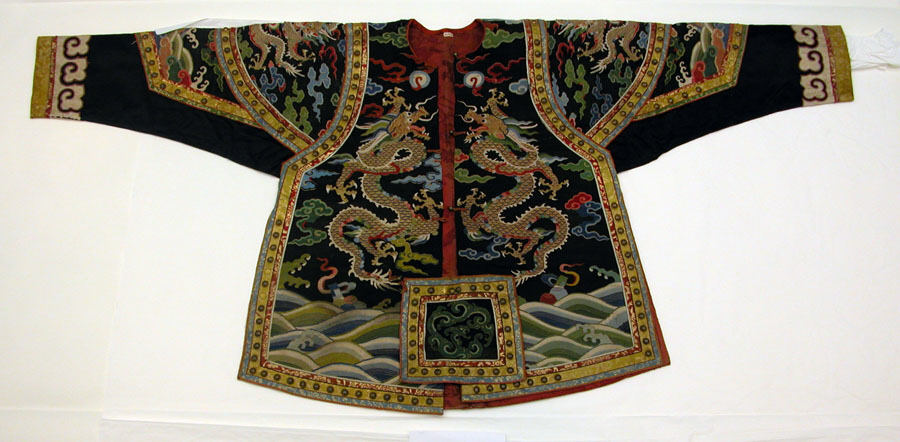
Deconstructing the Mythos: Theatrical Armor as Avant-Garde Protocol
For the SS26 collection, Zoey Fashion Laboratory initiates a profound dialogue between ancestral memory and speculative form, using the archetype of the Chinese dragon and the tradition of theatrical armor as a launchpad for structural innovation. This is not a revival but a recalibration—a laboratory process where myth is disassembled and re-engineered as a wearable, futuristic exoskeleton. The core proposition moves beyond mere aesthetic reference to engage in a rigorous study of protection, performance, and power in a contemporary context. The dragon, a symbol of celestial authority and elemental force, is liberated from its two-dimensional tapestry and tasked with articulating a new, three-dimensional human architecture.
Material Alchemy: Kesi as Bio-Mechanical Interface
The choice of silks and metallic thread tapestry (kesi) is the foundational act of deconstruction. Historically, kesi embodies unparalleled luxury and pictorial narrative, its slit-tapestry technique creating crisp, color-defined forms. Our laboratory subverts this technique’s inherent flatness. We treat kesi not as a decorative surface, but as a structural matrix. By laminating and bonding the delicate silk with biopolymer resins, we engineer a fabric that retains its legendary luminosity while gaining the tensile strength and malleable rigidity of a composite. The metallic threads are no longer simply decorative highlights; they are reconceived as conductive pathways, capable of carrying low-voltage illumination or responding to biometric input, transforming the dragon motif from a static symbol into a dynamic, reactive system.
This material innovation allows for the creation of garments that are simultaneously pliant and armored. A sleeve may cascade in soft, silk folds before coalescing into a rigid, scaled pauldron at the shoulder. The dragon’s form is dissected—its sinuous spine becomes a structural boning element tracing the vertebral column; its coalescing scales form articulated plates at joints, allowing for fluid movement while suggesting imperviousness. The material itself becomes a narrative of contradiction: fragile yet fortified, ancient yet acutely technological.
Silhouette as Speculative Anatomy: The Exoskeletal Framework
The SS26 silhouette philosophy is rooted in the concept of therapeutic armor—garments that provide not physical defense, but psychosocial and kinetic empowerment. The traditional theatrical armor’s broad, square shoulders and trapezoidal torso are digitally mapped and subjected to algorithmic erosion, resulting in silhouettes that appear both organic and engineered.
We propose three key silhouette evolutions: First, the Kinetic Rib-Cage, where the dragon’s torso is abstracted into a lightweight, external cage structure fashioned from molded kesi composite, worn over fluid silk draping. It amplifies the wearer’s breathing, making the rhythm of life visible. Second, the Helical Appendage, which extends from the garment’s back not as a literal tail, but as a sculptural train that coils and suspends in space, its form dictated by tensioned cables within kesi sheaths, creating a dynamic counterbalance to the body’s movement. Third, the Asymmetric Aegis, where armor manifests intensely on one side of the body—a single monumental sleeve or leg encasement—while the opposite side remains minimal and exposed, a study in vulnerability and strength.
These silhouettes reject the closed, monolithic form of historical armor. They are open-frame architectures, revealing the body they simultaneously augment. They consider protection as a selective, intelligent system rather than an all-encompassing shell.
Structural Innovation: Articulation and Bio-Mimicry
The true avant-garde leap lies in the micro-engineering of movement. Inspired by the dragon’s mythical fluidity and the articulated lamellar plates of historical armor, we develop a proprietary Scale-Hinge System. Individual kesi composite scales are interconnected with flexible, 3D-printed joints, allowing for multi-directional movement that mimics dermal articulation. This system is deployed across strategic zones—the cervical spine, the scapula, the knee—creating garments that move in concert with the body’s own biomechanics, rather than restricting them.
Furthermore, the concept of theater is internalized. Garments may incorporate atmospheric diffusion within hollow structural elements, releasing curated scent molecules (ozone, petrichor, smoldering iron) to create an immersive, personal aura. Silhouettes are designed to interact with environmental elements—wind, light—transforming the wearer into a dynamic, kinetic sculpture. A cape of layered, untreated kesi may flutter with a specific, chaotic rhythm, while a rigid, molded breastplate is engineered to catch and refract light in a programmed pattern, making the dragon’s presence felt as an interplay of material and energy.
Conclusion: The Autonomous Ceremonial
This standalone study for Zoey Fashion Laboratory culminates in a vision for SS26 where garment becomes protocol. The theatrical armor with dragons is stripped of its specific historical performance context and reborn as a framework for contemporary ceremony and autonomous identity. It is armor for the psyche, for the negotiation of digital and physical spaces, for the performance of self. By deconstructing the most iconic symbols of Chinese cultural power and re-engineering them through the lens of material science and speculative design, we propose a new lexicon of dressing. It is a lexicon where strength is found in articulation, not opacity; where legacy is a substrate for innovation; and where the wearer, encased in luminous, biomimetic kesi architecture, becomes the protagonist of their own unfolding, futuristic myth.