Technical Deconstruction: The 16th Century Italian Cuirass as Prototype
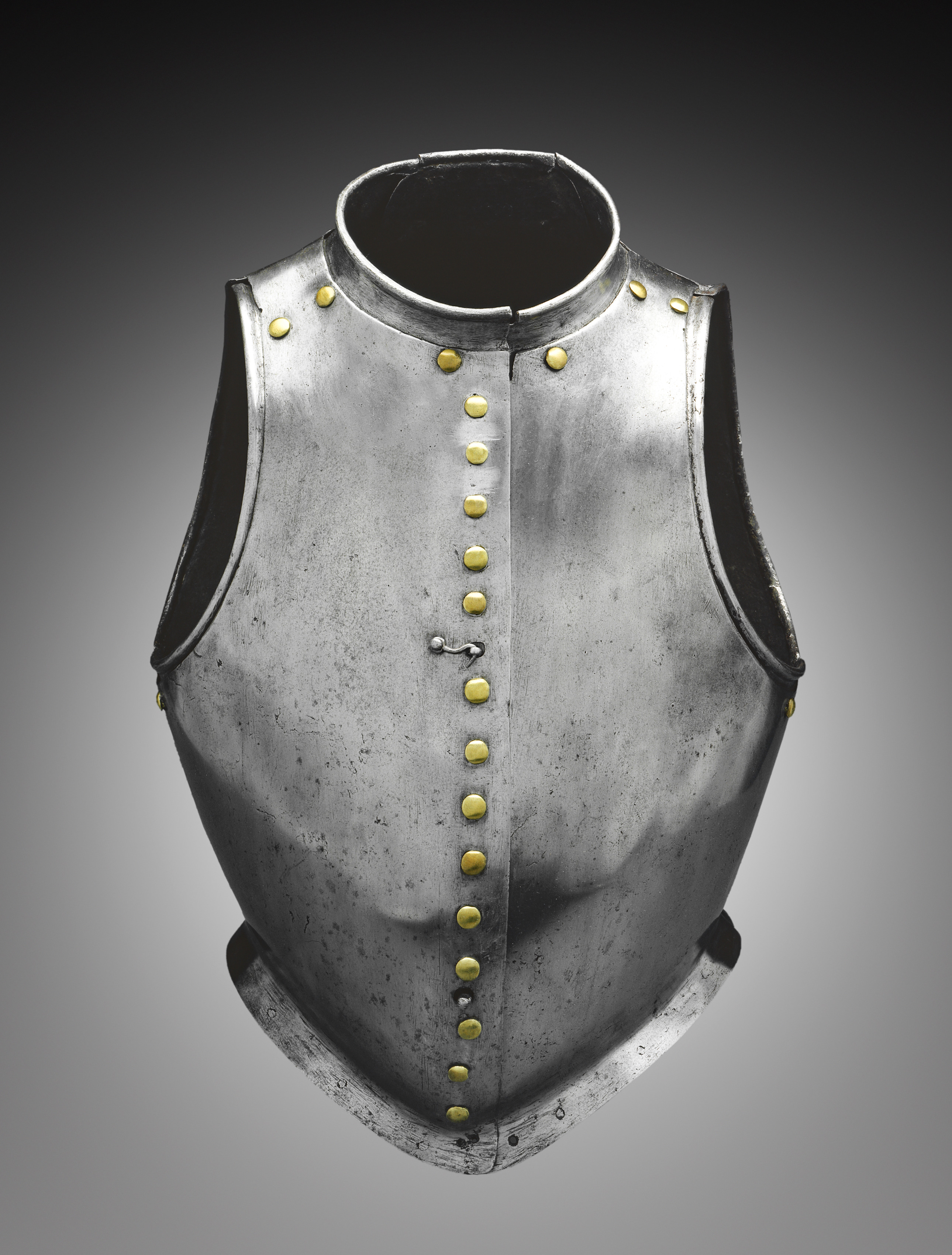
The provided artifact is not a waistcoat in any conventional sense. It is a late-Renaissance cuirass, specifically a combined breastplate and backplate, designed for the battlefield and tournament ground of 16th-century North Italy—a region renowned for the pinnacle of armor craftsmanship. Our analysis begins not with fabric, but with form and intent. The object’s primary function was absolute: to deflect lethal force while allowing mobility. Its "silhouette" is one of anatomical exaggeration, with a pronounced peascod belly on the breastplate that channels blows away from the torso’s center. This is not mere aesthetics; it is biomimetic engineering, a reinforcement of the body's own lines under extreme stress. The steel itself is the "textile"—hammered, tempered, and shaped to a rigidity that fabric could never achieve, yet it follows the contours of the human form with a tailor’s precision.
Material Translation: From Steel Plate to New DNA Strand
The directive to reference a New DNA Strand is pivotal. It instructs us to look beyond superficial homage and to isolate the core genetic code of the artifact for recombinant design. The cuirass’s DNA is composed of several key sequences:
1. The Monocoque Exoskeleton: The cuirass is a single, continuous shell for the torso. In avant-garde fashion, this translates to unbroken, sculptural form. We abandon traditional pattern pieces—darts, side seams, armholes—in favor of molded or engineered textiles that create a second skin. Techniques could include 3D-knitting with variable tension to mimic muscular topography, thermo-molding of bio-polymers, or the use of advanced non-woven composites that hold a rigid, pre-determined shape.
2. The Simulated Fastening System: The brass rivets that simulate buttons are a profound detail. They represent the subversion of functional hardware into pure signifier. The armor is closed by straps at the sides; the rivets are decorative, a vestigial nod to civilian doublets. This is a pre-modern example of deconstruction. Our translation involves creating garments where closures are entirely non-functional or hyper-exaggerated. Zippers may traverse the garment without opening it; magnetic seams may appear as complex plackets; hook-and-eye tape may be used as external, decorative tracery.
3. The Anatomical Amplification: The peascod breastplate does not conceal the body; it redefines it. It creates an idealized, armored physique. This aligns perfectly with avant-garde concepts of body modification and extended anatomy. We interpret this through structured padding, asymmetric understructures, or inflatable bladders integrated into the lining that allow the wearer to actively alter their silhouette. The garment becomes a prosthetic extension of self, not just a covering.
Avant-Garde Synthesis: Constructing the "Cuirass Waistcoat"
Synthesizing this decoded DNA into an avant-garde "waistcoat" requires a radical redefinition of the category. The outcome is a torso-hugging architectural shell, a hybrid of harness, exoskeleton, and tailored garment.
Material Palette & Construction
Steel’s legacy is translated into materials with inherent memory and structure. Primary candidates include:
• Molded Vegetal Leather or Bio-Acetate: Treated and formed over positive molds to create a rigid, lightweight front and back plate, segmented for mobility. The seams become pronounced, technical features.
• Technical Felt with Resin Impregnation: Layered and hardened in specific zones to create differential rigidity—soft at the sides for flexion, rock-hard across the chest and back for form.
• 3D-Printed Polymer Mesh: Creating a single, continuous piece that replicates the cuirass’s form as a porous, cellular structure, blurring the line between protection and garment.
The "brass rivets" are reimagined as functional aesthetic nodes. They could be conductive brass studs that connect to a capacitive layer, allowing the garment to respond to touch with light or sound. Alternatively, they could be magnetic points for attaching modular pouches, armor plates, or decorative insets, making the garment a platform for customization.
Silhouette and Wearability
The silhouette is the peascod form, abstracted. It extends the chest forward and cinches the natural waist, creating a powerful, forward-thrusting posture. The backplate mirrors this, offering a clean, sculptural plane. Crucially, like the original, it is donned not over the head, but closed at the side via a hidden technical closure—a heavy-duty zip, aerospace-grade hook-and-loop, or silent magnetic seam. This preserves the monolithic frontispiece. It is worn over a sheer, draped base or directly against the skin, highlighting its role as a primary, not secondary, layer.
The Avant-Garde Statement
This piece exists at the intersection of multiple discourses. It references military history, cybernetics, and sartorial tailoring. It questions the very purpose of clothing: is it protection, adornment, or anatomy? By deriving a fashion object from a tool of war, we critique the "armor" people don daily—social, professional, emotional. The New DNA Strand here is one of resilient, augmented identity.
For Zoey Fashion Lab, this analysis demonstrates that the deepest innovation comes from forensic deconstruction. The 16th-century armorer was solving problems of physics and mortality; we are solving problems of identity and expression. Yet, the core principle remains: to create a structured, intentional form for the human body that alters its relationship with space and perception. The resulting "Waistcoat Cuirass" is not a costume, but a contemporary proposition—a garment as bastion, a declaration of form forged from the genetic blueprint of the past.