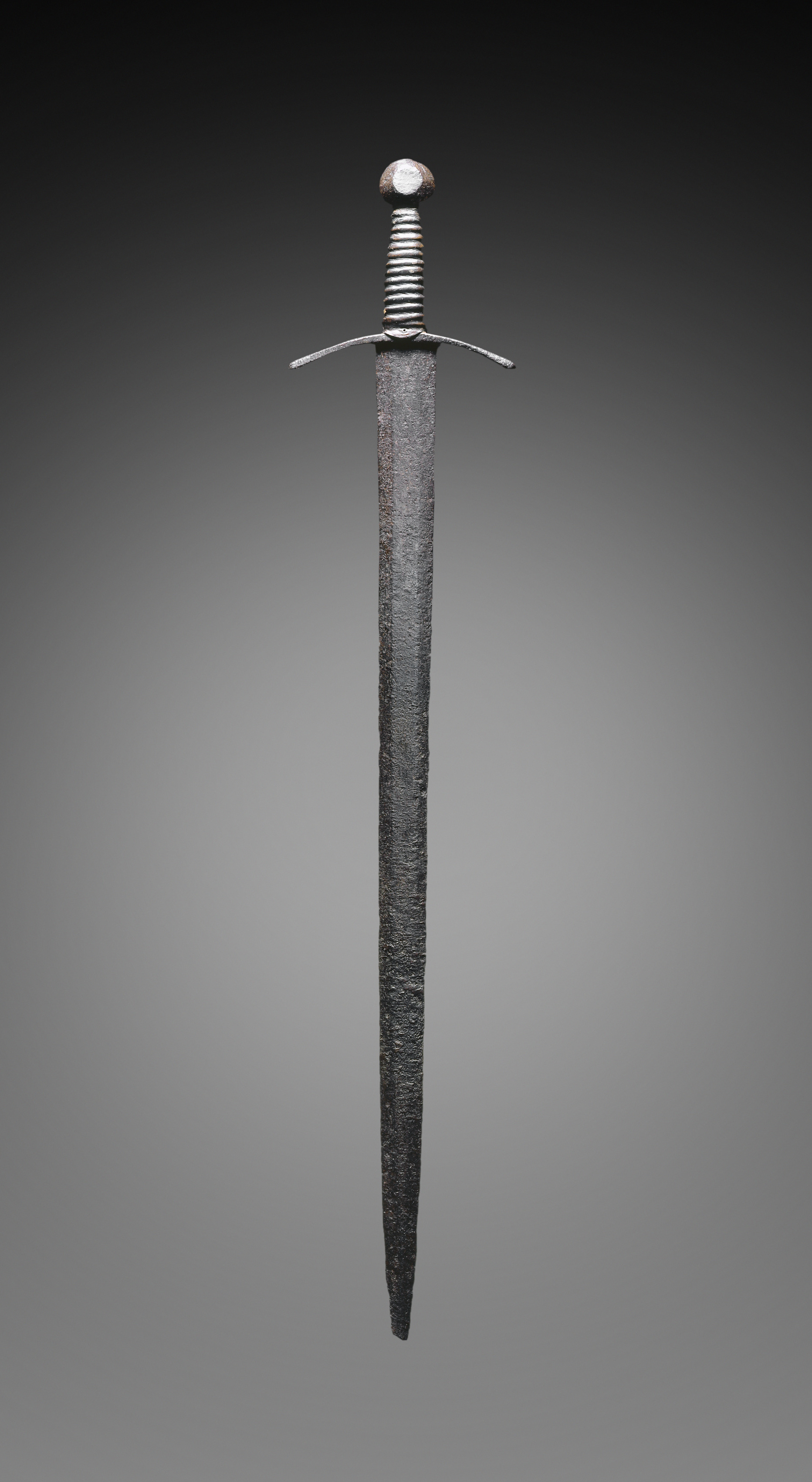
Technical Deconstruction: The Armorer's Blueprint
The subject is not merely a weapon; it is a layered artifact of early 15th-century European metallurgy and craftsmanship. Our deconstruction begins with its core: steel. This is not uniform metal but likely a product of pattern-welding or early refined bloomery steel, creating a blade with a subtle, organic grain—a literal record of its forging, akin to genetic code. The hardness of the edge, married to the flexibility of the spine, presents our first principle: inherent structural duality. The leather of the grip and scabbard is more than a covering; it is a molded, sweat-absorbent, grip-enhancing skin that conforms to the user. The wire, often silver or copper, is wound precisely over underlying cord to create a tactile, non-slip surface, demonstrating how a rigid material can be deployed to create controlled texture and ergonomic security.
DNA Strand Reference: The Helix as Foundational Form
The reference to a new DNA strand is pivotal. We move beyond literal representation to abstract its core attributes: the double helix is a structural backbone that is both supremely strong and dynamically flexible. It is a coded sequence where information (genetic or, for us, design intent) is carried in the arrangement of its components. It is self-replicating in form, its pattern repeating yet capable of infinite variation. This translates into design philosophy not as a motif, but as a methodological framework: creating garments with a central, resilient architectural core from which expression spirals, using sequenced textile codes, and building patterns that can evolve across a collection.
Avant-Garde Synthesis: Forging the New Silhouette
Avant-garde fashion thrives on intelligent contradiction and conceptual rigor. Here, the sword transitions from historical artifact to a prototype for radical contemporary design.
Structural Duality & The Armored Silhouette
The blade's duality inspires fabric treatments where rigidity and fluidity coexist in a single garment. Imagine a tailored jacket with a spine of fused, laser-cut leather or thermo-molded technical felt (echoing the blade's rigidity) that dissolves into cascading, weightless silk georgette or fluid neoprene knit sleeves (echoing its lethal grace). The garment's "edge" is its sharp, defined line, while its "spine" allows for movement. This creates a silhouette that is both authoritative and agile, a modern interpretation of armored poise.
The "Wired" Genome: Texture and Encoded Detail
The wrapped wire grip translates to intricate, three-dimensional textile manipulation. We can engineer "genetic code" into fabrics: sequences of raised welting, created through trapunto quilting or embedded silicone tubing, that spiral around a sleeve or traverse a bodice like a helical ladder. Fine, metallic-cored yarns could be hand-crocheted or machine-knitted in precise, repeating patterns over a base layer, creating a tactile, wire-like surface that is integral to the structure, not merely applied. This is detail as information, texture as code.
Leather as Second Skin & Sheath Architecture
The concept of the scabbard—a protective, form-fitting vessel—is rich with potential. This inspires exploring garments-as-sheaths. A dress could be conceived in molded, vegetable-tanned leather that precisely contours the torso (the blade), before releasing into a separate, flowing skirt or trouser (the scabbard's interior). The fastenings—complex lacings, magnetic closures, or articulated straps—mirror the functional pragmatism of sword fittings, elevated to high jewelry. The leather itself can be treated to show the marks of its making: tooling, staining, and waxing become the "patina" of the piece, telling its unique story.
The Zoey Fashion Lab Collection: "Nexus"
From this analysis, a cohesive avant-garde collection, titled "Nexus", emerges. "Nexus" signifies the point of connection—where history meets biotechnology, where armor meets elegance.
Key Pieces Would Include:
The Helix Coat: A floor-length coat with a spiraling structural seam from shoulder to hem, reinforced with internal boning on one side, releasing into a soft drape on the other. Fabric: a bonded hybrid of technical wool and matte techno taffeta.
The Coded Corset: A torso piece featuring sequenced, raised welts in a helical pattern, achieved through laser-cut leather laminated over stretch technical fabric, laced with metallic, wire-wound cords.
Sheath Trousers: High-waisted, fluid trousers with an integrated, molded leather "scabbard" panel on one thigh, housing a detachable tech-pouch or simply serving as pure architectural form.
Textural Knitwear: Dresses and tops with intarsia-knit "wire wrap" patterns using yarns blended with stainless steel microfibers, creating a garment that moves with a whisper yet holds a sculptural shape.
Conclusion: Beyond the Literal
For Zoey Fashion Lab, the early 15th-century sword is a catalyst, not a template. By deconstructing its material truth (steel, leather, wire), embracing the conceptual framework of the DNA strand, and filtering it through an avant-garde lens, we generate a design language of intelligent contrast, coded texture, and architectural wearability. The outcome is not costume, but a forward-looking dialogue on protection, identity, and form—where the strength of the past is woven into the very genome of future fashion. The garment, like the sword, becomes an interface between the body and the world, engineered for impact and inscribed with meaning.