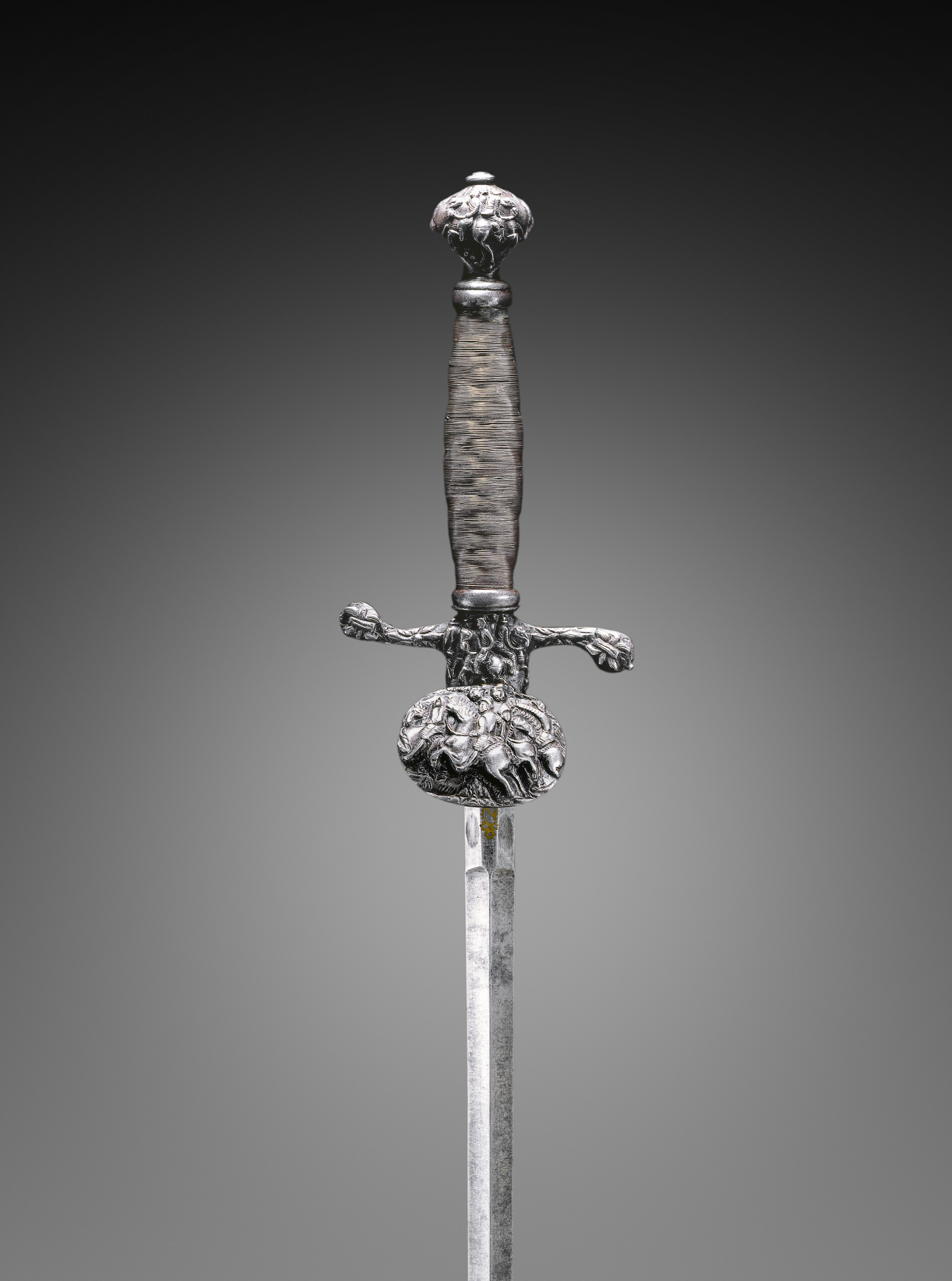
Technical Deconstruction & Material Analysis: The 18th-Century Small Sword
The artifact in question is a paradigm of refined lethality. Its core is a slender, triangular-sectioned blade, forged from high-carbon steel. This geometry is not merely aesthetic; it is a profound engineering choice. The triangular design provides exceptional rigidity along the blade's axis, prioritizing the thrust over the cut. It is a linear instrument, designed for precision penetration with minimal resistance. The material, steel, represents the pinnacle of period metallurgy—hard enough to hold a needle-sharp point, yet with a controlled flexibility to prevent catastrophic failure. The surface would have been meticulously polished, not just for corrosion resistance but to create a disconcerting, mirror-like flash in the duelist's hand, a psychological weapon in itself.
The guard is a masterclass in functional ornamentation. Crafted from steel with copper alloy inlays, it serves as a complex kinetic filter. The shell guard and intricate pas d'âne (ring guards) are not solid barriers but a web of metallic strands, designed to catch, deflect, and entangle an opponent's blade with minimal weight. The inlays of copper alloy—likely a form of brass or tombac—are crucial. They are not mere decoration but strategic visual markers within the guard's negative space, helping the wielder subconsciously gauge angles and distances in the heat of combat. They are data points in a high-stakes geometric equation.
Form Language & Ergonomic Synthesis
The grip demands particular attention. A core of turned wood (often beech or fruitwood) provides a warm, moisture-absorbent foundation. This is overwrapped in a tight, spiraling helix of steel wire. This is the original "technical textile." The wire provides a supremely positive, non-slip grip, channeling the precise pressures of the fingers directly to the blade's forte. The helical pattern is ergonomic genius, conforming to the anatomy of the hand while creating a torsional rigidity that prevents the grip from twisting in action. It is a permanent, metallic expression of a wrapped handle, fossilizing a moment of tension and security.
Conceptual Transmutation: From Duelist's Tool to Avant-Garde DNA Strand
The reference to a New DNA Strand is not a superficial metaphor but a foundational design directive. We are not creating a costume piece inspired by a sword; we are engineering a new sartorial genome using the sword's encoded biological and social data.
Deconstructing the Genetic Code
Gene 1: The Helix. The spiraling steel wire of the grip is the most direct genetic transfer. This translates into core construction techniques for Zoey Fashion Lab. Imagine garments built upon a helical infrastructure—spiral-seamed dresses that twist around the body, providing dynamic fit and stretch. Embroidery and piping could follow double-helix patterns, creating torsional movement in static fabric. Knitwear could integrate helical wire-thread hybrids, creating sculptural, shape-memory silhouettes.
Gene 2: The Triangular Thrust. The blade's profile informs silhouette and cut. We move beyond the circular and the rectangular. Avant-garde tailoring should explore sharp, triangular godets, jagged asymmetric hems that come to a precise point, and dart manipulation that creates faceted, geometric planes on the body. The thrust implies direction and intention. Clothing could feature integrated, rigid "blade" lines—perhaps as internal boning or external architectural elements—that guide the eye and the garment's movement in a single, decisive line.
Gene 3: The Filtering Guard. The guard's function as a permeable shield revolutionizes the concept of layering and transparency. We propose "kinetic filtering" in textiles: layered garments where an outer "shell" of laser-cut leather or rigid tulle, with strategic negative-space patterns reminiscent of the guard, interacts with a vibrant, moving underlayer. The wearer's movement and the environment create a constantly evolving visual, much like the flashing play of light through the sword's guard. This is protection through obfuscation and beauty, not opacity.
The New Avant-Garde Genome: Proposed Manifestations
Collection Concept: "Lignée" (Lineage)
Look 01: The Helix Dress. A column dress constructed from a single, continuous strip of technical jersey, spiraling from ankle to shoulder in a double-helix formation. The seam is accentuated with a fine, copper-alloy micro-cable, tracing the genetic path. It is ergonomic, historical, and profoundly modern.
Look 05: The Thrust Coat. A long, tailored coat in rigid, steel-grey wool. Its silhouette is a perfect, elongated triangle from the shoulders to the floor. The closure is a single, off-center line of polished steel hooks and eyes, mimicking the central ridge of the blade. Movement is linear, sharp, and commanding.
Look 08: The Filter Ensemble. A bodysuit in copper-toned metallic mesh serves as the vibrant "under-blade." Over it, a sleeveless overshirt in stark white, technical canvas is worn. The canvas is pierced with precise, geometric cut-outs derived from the sword's guard pattern, creating a dynamic play of hidden and revealed color, skin, and light with every gesture.
Conclusion: Forging a New Lineage
The 18th-century French small sword is a complete functional organism. Our task at Zoey Fashion Lab is to isolate its dominant genes—the Helix, the Thrust, and the Filter—and splice them into the DNA of contemporary avant-garde fashion. The result will not be historical pastiche but a legitimate new lineage. We are designing for a new duelist: one who engages in the complex, kinetic theatre of modern identity. The weapons are silhouette, texture, and intelligent construction. The arena is the street. The victory is in a garment that is as intellectually rigorous, precisely engineered, and potently expressive as the exquisite artifact that inspired it.