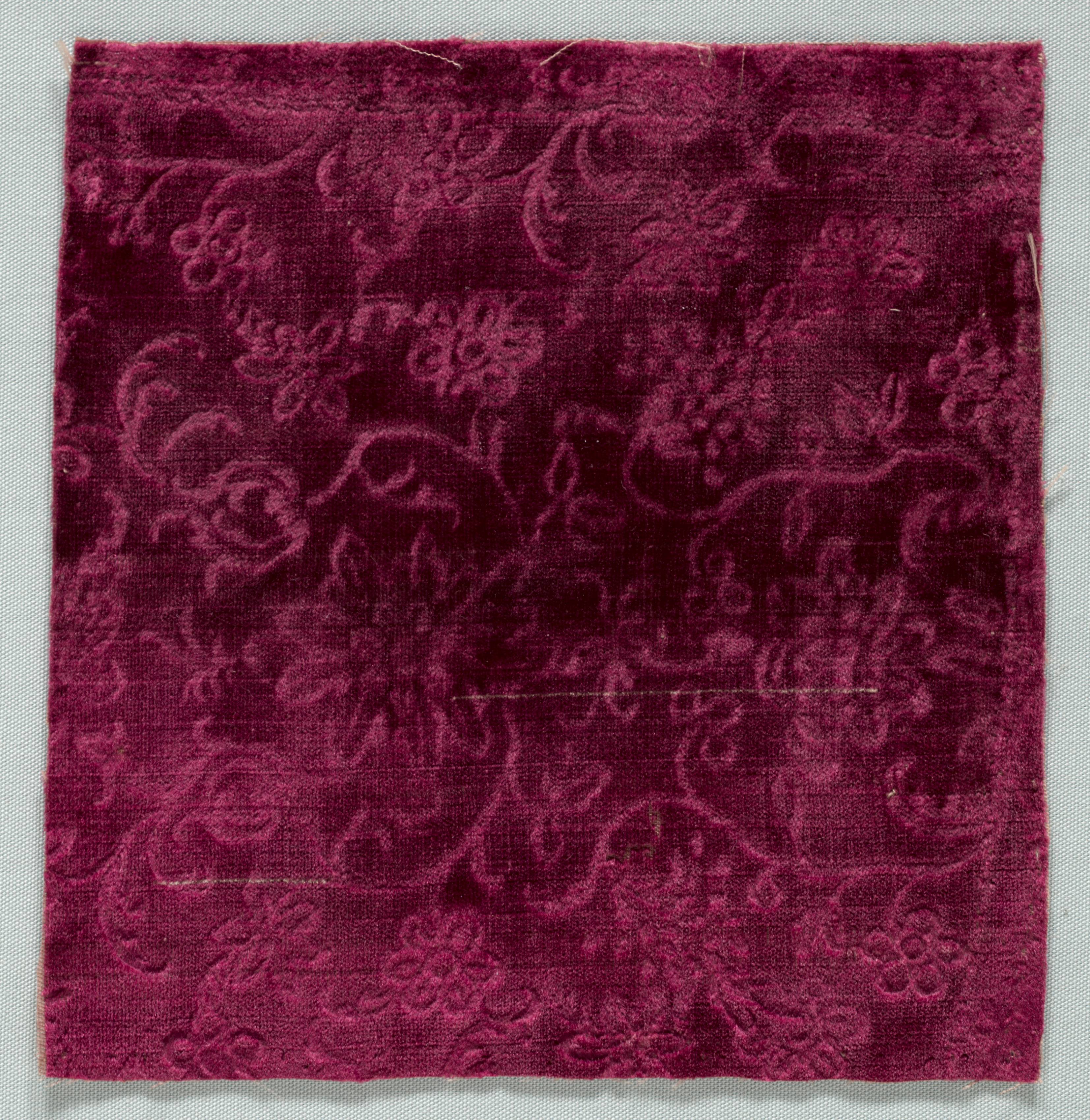
Technical Analysis: The Velvet Fragment as Biological Code
The provided velvet fragment, originating from late 17th-century Italy, is not merely a textile artifact; it is a complex data structure. Our deconstruction begins by rejecting the traditional lens of historical textile analysis in favor of a biological framework. The fragment is re-categorized as a New DNA Strand, a foundational genetic code for avant-garde expression. Technically, the velvet itself—a silk pile woven on a linen ground—represents a double helix. The dense, plush pile (the warp) and the sturdy, hidden ground (the weft) are intertwined in a symbiotic relationship, creating a base sequence of tactile information. The specific cut of the pile, likely a meticulous hand-cut process, determines the light-absorbing and reflective properties, which we interpret as the "gene expression" of the material. The deep, resonant color, achieved through now-fugitive natural dyes, is not a simple hue but a chromatic allele, a piece of inherited information about luxury, opacity, and depth.
Deconstructing the Historical Genome
The fragment's 17th-century Italian origin is its phylogenetic history. This was an era of extreme Baroque opulence, where velvet served as a primary medium for communicating power, spirituality, and wealth. The very weight and density of the fabric were bio-markers of social status. Our avant-garde mandate requires us to sequence this historical genome and identify mutable loci. We isolate key genes: the Gravity Gene (inherent drape and solemnity), the Opacity Gene (zero translucency, complete visual barrier), and the Ornament Gene (a propensity for applied embellishment). The avant-garde opportunity lies not in replication, but in targeted mutation—splicing, inverting, or silencing these historical commands to create new phenotypic outcomes in contemporary form.
Avant-Garde Recombinant Strategy: Mutation and Expression
The "New DNA Strand" must be subjected to rigorous laboratory protocols to realize its avant-garde potential. The goal is to engineer a progeny that is undeniably derived from this historic source yet manifests entirely novel characteristics.
Protocol 1: Silencing the Gravity Gene
Traditional velvet is governed by verticality and fall. We propose silencing this gene through structural intervention. By bonding the velvet to a technical substrate of rigid polymer or memory foam, we transform drape into architecture. The pile becomes a tactile surface on volumetric, geometric forms—sharp shoulders, exaggerated collars, or non-organic silhouettes that defy the body's contours. The fabric's inherent luxury is contradicted by its application, creating a tension between historical softness and futuristic hardness.
Protocol 2: Inverting the Opacity Gene
The fragment's complete opacity is a challenge to contemporary values of layering and revelation. We engineer an inversion by laser-microperforating the velvet ground, creating a controlled, pixelated translucency. Alternatively, we develop a "velvet gauze"—a technique where the pile is applied in isolated, sparse clusters over a sheer silk organza base. This mutation allows light to pass through, rendering the fabric ethereal and fragile, a direct negation of its Baroque solidity. The shadow play between the dense pile points and the transparent ground becomes a key aesthetic, a dialogue between presence and absence.
Protocol 3: Splicing the Ornament Gene with Digital Code
The historical expression of the Ornament Gene was brocade, metallic thread, and passementerie. Our splice replaces this with digital information. Using conductive metallic threads woven into the pile, we create a velvet that can interface with low-voltage LED systems, emitting a soft glow from within its own surface. The ornamentation becomes dynamic, programmable, and interactive—a pattern that breathes, pulses, or responds to environmental stimuli. The tactile warmth of velvet is juxtaposed with the cool emission of light, redefining embellishment as a time-based media.
Proposed Phenotypic Outcomes: The New Organisms
From these recombinant protocols, distinct phenotypic lines can be cultivated for the Zoey Fashion Lab collection.
Phenotype A: The Luminous Carapace. A series of structured outerwear pieces—blazers, coats, and capes—where rigid, architectural forms are clad in the laser-perforated or LED-integrated velvet. The wearer is encased in a shell of mutable light and shadow, a walking contradiction of heavy form and illuminated surface. This phenotype speaks to armored vulnerability.
Phenotype B: The Deconstructed Cassock. Utilizing the "velvet gauze" mutation, we create fluid, layered garments that reference ecclesiastical and ceremonial robes in form (long lines, deep sleeves) but subvert them in substance. Layers of sheer and piled velvet interact, creating a haze of color and texture that dematerializes the body. This phenotype explores ritual through fragility.
Phenotype C: The Bio-Mechanical Hybrid. Here, the velvet is treated not as a covering, but as a living tissue grafted onto technical fabrics. Panels of lush, uncut velvet emerge from seams of neoprene, coated nylon, or transparent vinyl. The mutation highlights the contrast between the biological warmth of the historic fragment and the synthetic, functional surfaces of the modern world. It is a literal visualization of the splicing process.
Conclusion: The Fragment as Founding Cell
The late 17th-century Italian velvet fragment is the founding cell line for this experiment. By treating its technical and historical attributes as a genetic sequence, we move beyond pastiche or homage into the realm of synthetic biology in fashion. The resulting avant-garde creations are not "inspired by" velvet; they are expressions of a mutated velvet genome. They carry the deep, coded memory of Baroque splendor in their very fibers, but express it through a contemporary lexicon of structure, light, and hybridity. For Zoey Fashion Lab, this fragment is not archival; it is prophetic—a dormant strand of DNA awaiting its recombinant future.