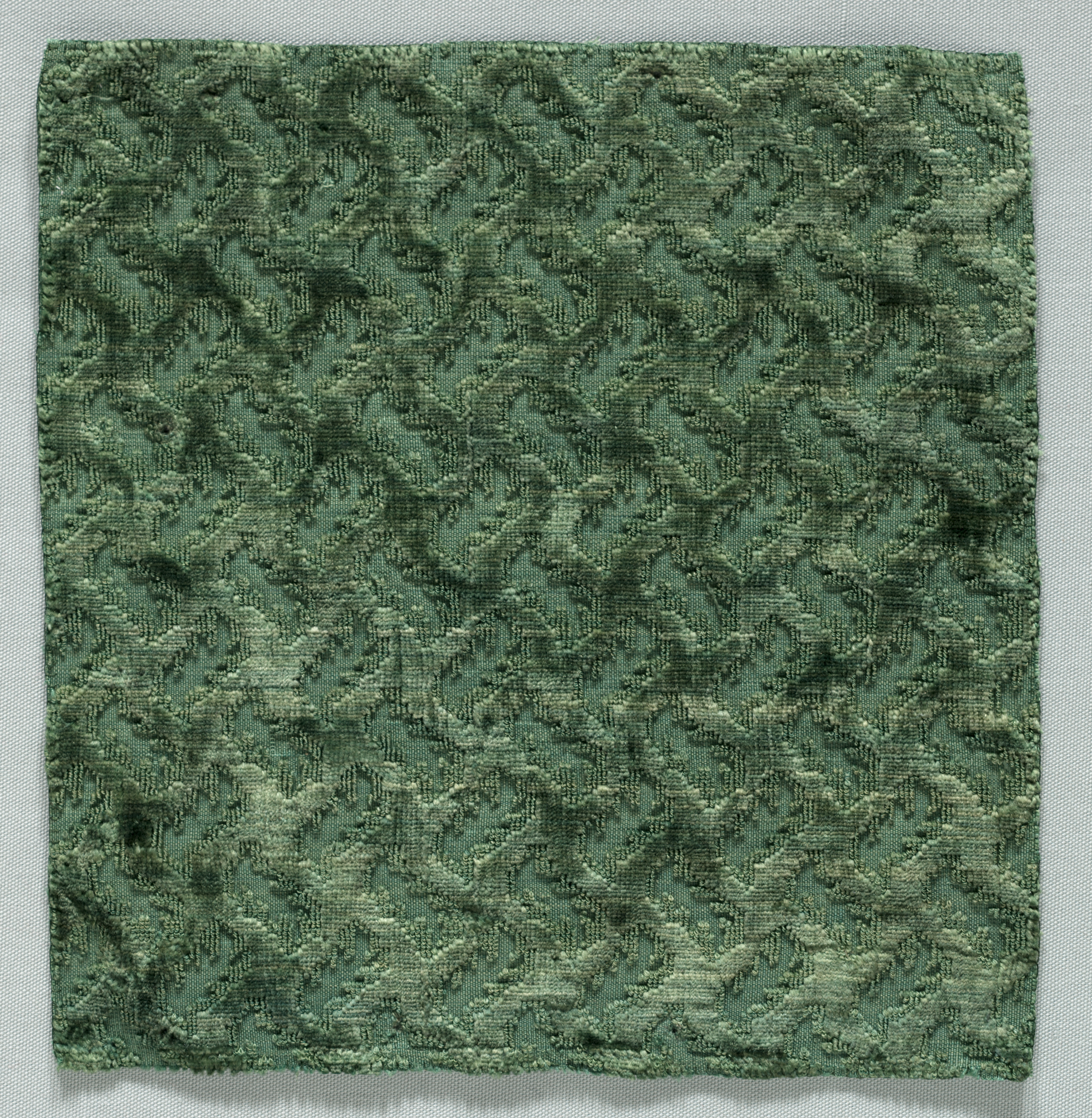
Deconstructing the Velvet Fragment: A DNA Strand for Avant-Garde Innovation
As the Chief Fabric Deconstructionist for Zoey Fashion Lab, I am tasked with dissecting not merely the physical structure of a textile, but its latent potential—the silent language of its weave, its historical weight, and its capacity to be reborn. The subject of this analysis is a fragment of Italian velvet, dating from the late 16th to early 17th century. This is not a relic to be preserved under glass. It is a New DNA Strand—a genetic code of opulence, power, and technical mastery—that, when decoded and re-synthesized through an avant-garde lens, can generate entirely new forms of fashion expression.
Historical Context: The Velvet of Power and Prestige
To understand this fragment, we must first place it within its original ecosystem. Sixteenth-century Italy, particularly cities like Venice, Genoa, and Florence, was the epicenter of European luxury textile production. Velvet was not merely a fabric; it was a statement of immense wealth, political influence, and social standing. The production of a single yard of high-quality velvet could consume the labor of multiple artisans for weeks, using precious materials like silk and, in some cases, threads of gold or silver. This specific fragment, with its dense pile and likely intricate pattern (even in its fragmented state), would have adorned the courtly garments of the aristocracy, ecclesiastical vestments, or ceremonial upholstery. Its very existence is a testament to a world where fabric was a primary medium for projecting power, divine favor, and dynastic legacy.
The technical mastery of this era is staggering. The velvet weave—a complex structure of a ground weave and a supplementary warp that forms the pile—was perfected over centuries. This fragment represents the pinnacle of that craft. The depth of the pile, the clarity of the pattern (likely a pomegranate, thistle, or geometric motif common to the period), and the rich, deep color (perhaps a crimson, aubergine, or deep blue) are not accidents of time. They are the result of precise engineering: the tension of the warp threads, the composition of the dye baths, and the skill of the weaver at the drawloom. This is not a simple cloth; it is a three-dimensional sculpture in fiber, a masterclass in light and shadow manipulation.
Technical Analysis: The Anatomy of a Masterpiece
From a deconstructionist perspective, this fragment is a complex system of interdependent variables. The ground weave, typically a silk taffeta or satin, provides the structural foundation. The pile, formed by loops of supplementary warp that are either left uncut (voided velvet) or sheared (cut velvet), creates the tactile and visual depth. In this fragment, the pile appears to be cut, giving it a plush, almost liquid surface that absorbs and reflects light in a unique way. The pattern is created by selectively raising or lowering the pile warp during weaving, a process that requires a second set of warp beams and a sophisticated harness system. The color is not a simple dye; it is a chemical and botanical achievement, using mordants and natural dyes like cochineal for reds, woad for blues, and weld for yellows, often layered to achieve the deep, resonant hues that characterize Renaissance velvet.
This technical complexity is precisely what makes this fragment a New DNA Strand. The weave structure, the pile height, the color saturation, and the pattern logic are not just historical artifacts. They are genetic instructions that can be read, mutated, and re-expressed. The deconstruction process at Zoey Fashion Lab does not destroy this code; it extracts it. We analyze the thread count, the twist of the silk, the angle of the pile, and the chemical composition of the dyes. We map the pattern repeat and the relationship between the pile and the ground. This is our raw data.
Avant-Garde Re-synthesis: From Fragment to Future
How does a 400-year-old velvet fragment become the blueprint for an avant-garde collection? The answer lies in the principle of creative dissonance. We do not seek to replicate the velvet. We seek to translate its essence into a new language of form, texture, and structure. The avant-garde style is not about comfort or convention; it is about provocation, innovation, and the subversion of expectations.
1. Structural Deconstruction and Reassembly: The fragment’s dense, plush pile can be re-imagined as a three-dimensional architectural element. Instead of a continuous fabric, we can isolate the pile into individual tufts or clusters, applied to a sheer, transparent base. This creates a garment that is simultaneously heavy and weightless, solid and ethereal. The pattern, once a repeating motif, can be fragmented and re-arranged in an asymmetrical, non-repeating layout, echoing the chaotic beauty of a broken mirror.
2. Material Transmutation: The original silk can be replaced with unexpected materials. Imagine a velvet-like pile created from recycled plastic filaments, laser-cut carbon fiber, or even hand-dyed, bio-engineered cellulose. The tactile memory of the original velvet—its softness, its depth—is preserved, but the material itself is radically transformed. This is not a reproduction; it is a mutation of the original DNA. The color, once derived from natural dyes, can be achieved through iridescent coatings, thermochromic pigments, or digital printing that mimics the optical depth of the original.
3. Pattern and Scale Distortion: The intricate patterns of 16th-century velvet were designed for the human form and the static display of power. In an avant-garde context, we can distort the scale of the pattern. A single pomegranate motif from the fragment can be blown up to monumental proportions, covering an entire garment, or reduced to a microscopic texture that is only visible upon close inspection. The pattern can be de-synchronized from the garment’s seams, creating a visual disorientation that challenges the viewer’s perception of the body and its covering.
4. Kinetic and Interactive Elements: The original velvet was a static, opulent surface. The avant-garde re-synthesis can introduce movement and interaction. The pile can be engineered to shift direction with body movement, creating a living, breathing surface. Embedded micro-sensors could cause the pile to rise or flatten in response to touch or ambient light. The garment becomes a dynamic sculpture, a conversation between the wearer, the environment, and the historical DNA of the velvet.
Conclusion: The Fragment as a Catalyst
This Italian velvet fragment is not a dead artifact. It is a living code, a New DNA Strand that contains the instructions for creating fashion that is both deeply rooted in history and radically forward-looking. The deconstruction process at Zoey Fashion Lab is an act of creative archaeology. We excavate the technical and aesthetic principles of the past, not to preserve them in a museum, but to re-sequence them into new forms of expression. The result is a garment that is a paradox: it is both a homage to the master weavers of the 16th century and a defiant rejection of the very idea of a fixed, historical identity. It is velvet, but it is also something else entirely—a testament to the power of deconstruction to unlock the future from the fragments of the past.