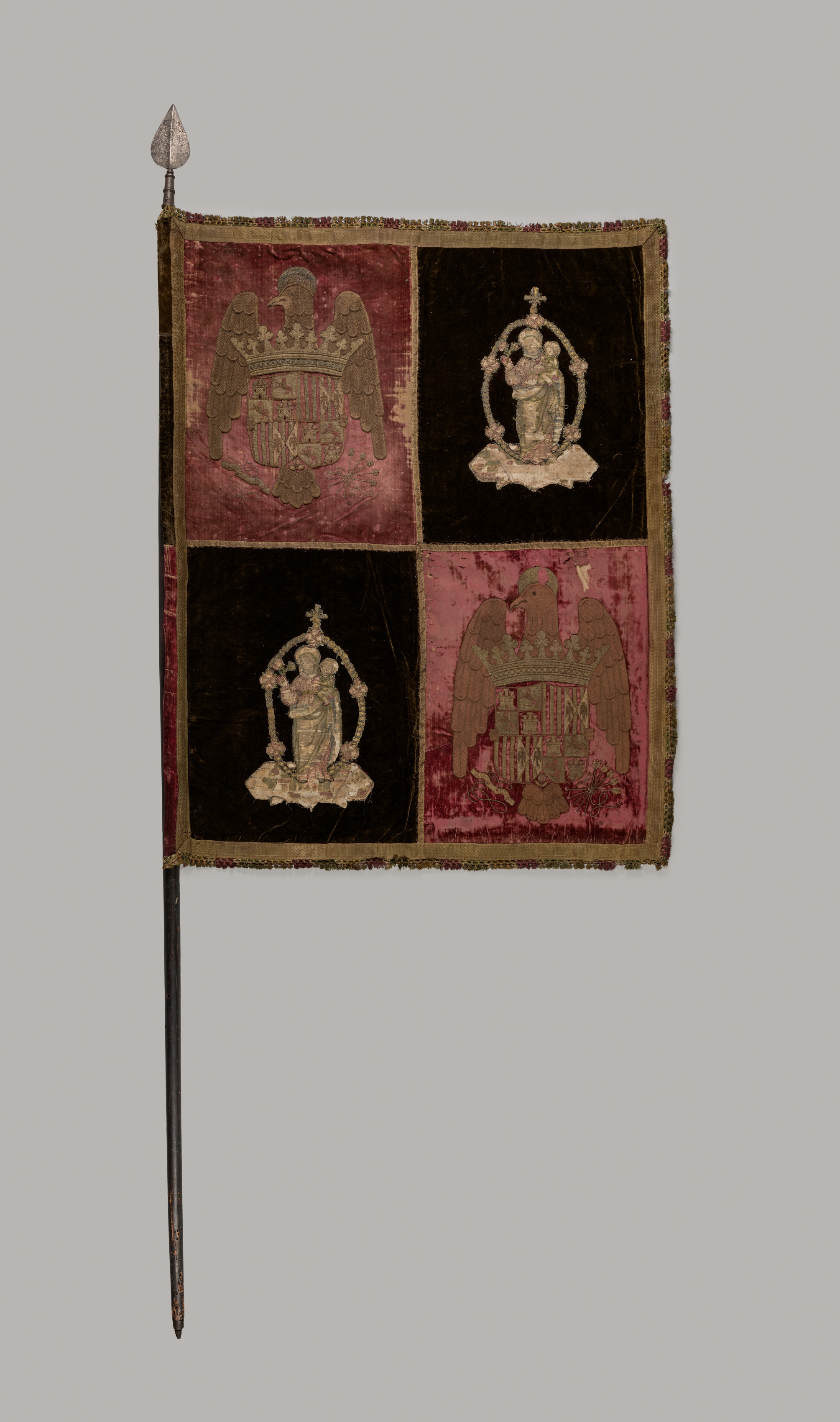
Technical Deconstruction & Material Analysis: The Embroidered Banner
The provided artifact is a heraldic and devotional banner, originating from Spain, constructed primarily from red and dark brown velvet. The core technical narrative is one of layered opulence and symbolic weight. Velvet, a high-status textile historically associated with nobility and the church, forms the foundation. The use of two colors—likely achieved through separate fabric panels meticulously joined—immediately establishes a visual field of contrast, a primal dialogue between passion (red) and earth/spirituality (dark brown).
The primary technical intervention is embroidery. This is not mere adornment but a form of structural storytelling. The Quartered Royal Arms of Spain and the Madonna and Child would have been rendered in techniques such as raised goldwork (likely bullion thread), silk shading, and possibly appliqué. This creates a topographical landscape on the velvet plane. The fringe is a critical functional-aesthetic element; it signifies an edge, a completion, but also movement and transition. It softens the banner's rigid heraldic authority, introducing a tactile, fluid dimension. The object's integrity relies on the tension between the sturdy, ground velvet and the delicate, vulnerable metallic threads—a balance of permanence and fragility.
Conceptual Deconstruction: Decoding the Dual Narrative
The banner's power lies in its dual sovereign narrative: temporal power (the Royal Arms) and spiritual sovereignty (the Madonna). The quartered arms speak of lineage, conquest, and political union—a manufactured identity stitched together through marriage and war. The Madonna and Child represent divine lineage, grace, and a different kind of kingdom. Their juxtaposition is not accidental; it is a deliberate fusion of crown and altar, asserting that earthly power is sanctified by divine favor. The banner is a portable piece of propaganda, a condensed visual manifesto of state ideology.
However, a deconstructionist must look between these dominant narratives. What exists in the negative space? The velvet ground becomes the unseen populace, the silent witness to these imposed symbols. The wear on the fringe, the slight puckering of the embroidery, speak of use—of being carried, displayed, and stored. The object has a life beyond its intended symbolism, absorbing the history it was meant to merely represent.
Reconstruction for Zoey Fashion Lab: The "New DNA Strand"
The reference to a "New DNA Strand" is our core directive. We are not replicating the banner; we are extracting its genetic code and splicing it with avant-garde principles. The old DNA consists of: Dualistic Symbolism, Textile Topography, Sovereign Display, and Woven Propaganda. Our avant-garde lens will mutate these strands.
Avant-Garde Manifestation: "Sovereign Fragments" Collection
Strand 1: Deconstructed Heraldry. The quartered arms are not embroidered but are laser-cut from layers of fused red and brown technical velvet, then reassembled off-kilter or embedded within garment seams. A coat's lining might feature a fragmented, oversized heraldic charge, visible only when in motion. We move from flat display to interactive, personal archaeology.
Strand 2: Embroidery as Structural Engineering. The goldwork embroidery transcends decoration to become exoskeletal reinforcement. Imagine a tailored jacket where the shoulder seam and armhole are defined not by traditional tailoring but by a trail of raised, gilded cable-stitch, mimicking both circuit boards and medieval reliquaries. The fringe is reinterpreted as frayed, weighted tape emerging from seam allowances or as a cascading mane of conductive threads integrated with subtle lighting on a hood.
Strand 3: The Duality Made Wearable. The Madonna/State duality transforms into a dialogue between the sanctity of the self and the structures of society. A garment may feature a severe, architectural outer shell (the "State") in stiff, dark brown coated cotton, which opens to reveal a draped, fluid, red silk interior (the "Sanctuary") embroidered with a abstract, personal motif. The wearer controls the revelation of their inner narrative.
Strand 4: Velvet Re-engineered. We respect the material code but upgrade it. We develop a bi-stretch velvet for movement, or a "vanishing velvet" where the pile is etched away in patterns by laser to reveal a contrasting technical mesh beneath. The dark brown and red palette is preserved but can be modulated through iridescent coatings or thermo-chromic finishes that react to body heat, making the emblematic colors transient and personal.
Final Prototype Vision: The "Charged Relic" Coat
Imagine a full-length coat in engineered red/dark brown paneled velvet. From a distance, it appears as a sleek, modern silhouette. Upon closer inspection, the coat's back panel is a subtle, abstract topographic map created by differential pile heights in the velvet. One sleeve integrates a "fringe" of flexible, fiber-optic threads that emit a low pulse of light, programmable by the wearer. Inside, the lining is a printed, deconstructed digital scan of the original banner's Madonna, but pixelated and interwoven with lines of genetic code sequence—the literal "New DNA." The fastenings are oversized, gilded hooks reminiscent of both ecclesiastical vestments and cyberpunk hardware.
This analysis deconstructs the banner as an object of imposed unity and reconstructs it as a framework for personal sovereignty and hybridized identity. For Zoey Fashion Lab, the past is not a template but a genome. Our avant-garde mission is to isolate its most compelling traits and express them through the radical, wearable language of now.