The Dagger as Silhouette: Deconstructing Mughal Armament for SS26
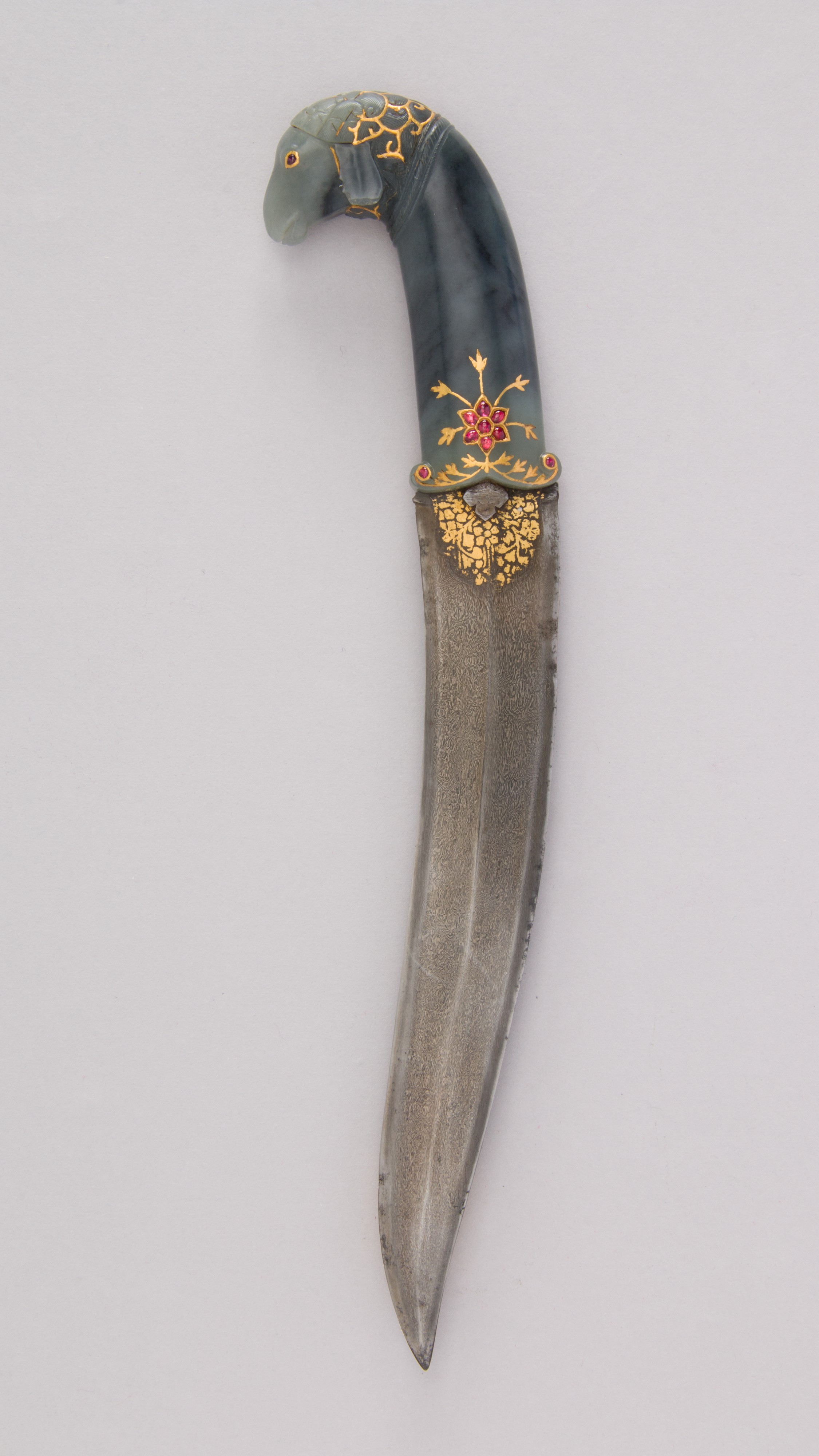
The dagger, specifically the Mughal katar or the ceremonial jamdhar, is not merely a weapon of historical violence; it is a thesis on power, precision, and the architecture of a single, decisive gesture. For Zoey Fashion Laboratory’s SS26 collection, we extract the dagger from its martial context and recontextualize it as a foundational blueprint for futuristic silhouette and structural innovation. The core elements—the steel blade, the jade hilt, the ruby-studded pommel, and the gold inlay—become a lexicon of material tension. The challenge is to translate the dagger’s inherent lethality into a garment that speaks of controlled aggression, aerodynamic grace, and the paradoxical beauty of a weapon rendered inert through fashion.
The steel of the blade is not literal armor; it is the linear, tensile strength of the garment’s architecture. We interpret this as exoskeletal seams—rigid, laser-cut panels of recycled aerospace alloy or liquid-metal-coated nylon that trace the body’s kinetic pathways. These are not soft draperies; they are structural ribs that terminate in sharp, bevelled points, mimicking the blade’s edge. The silhouette for SS26 is a vertical compression—a single, unbroken line from shoulder to hem, reminiscent of the dagger’s thrust. The garment’s core is a slim, columnar micro-dress in matte black, but its surface is disrupted by these metallic “blade” inserts that seem to slice through the fabric, creating a deconstructed, fragmented silhouette that is both protective and exposed. This is not a garment for passive observation; it is a statement of intent.
The Jade Hilt: Articulated Ergonomics and Soft Armor
The jade hilt of the Mughal dagger is a study in organic ergonomics—a smooth, cool counterpoint to the blade’s aggression. For SS26, jade is not a literal material but a color and texture philosophy. We introduce jade-toned bioceramic resins and 3D-printed lattice structures that form the garment’s articulated joints. The hilt’s shape—a flared, ergonomic grip—informs the structural innovation at the shoulders and hips. These are not padded shoulders; they are floating, cantilevered forms that hover above the body, connected by micro-hinges. The jade hue, a milky, semi-translucent green, is used for internal corsetry that appears to grow from the garment’s core, like a second skeleton. The ergonomic logic of the hilt is translated into adjustable tension systems—thin strips of gold-laced carbon fiber that wrap the torso, allowing the wearer to modulate the garment’s fit, transforming it from a static sculpture into a dynamic exoskeleton.
The ruby and gold elements are not mere adornment; they are catalytic points of energy within the garment’s narrative. The ruby, often found in the dagger’s pommel or along the hilt’s spine, is reimagined as thermochromic enamel and micro-LED clusters. These are embedded at strategic pressure points—the collarbone, the wrist, the base of the spine—where the garment’s structure meets the body’s kinetic core. The rubies do not simply sparkle; they pulse with a low, visceral light in response to the wearer’s movement, simulating the dagger’s “life” as an extension of the hand. The gold is not a precious metal in the traditional sense; it is electroformed latticework that traces the garment’s seams, creating a filigree of conductive pathways. This gold infrastructure acts as a structural webbing, holding the jade-like panels together while allowing for micro-flexion. The result is a garment that appears both ancient and extraterrestrial—a fusion of Mughal craftsmanship and bio-engineered futurism.
Structural Innovation: The Blade’s Edge and the Void
The most radical innovation for SS26 is the negative space derived from the dagger’s edge. A blade is defined not by its mass but by its line of separation. We translate this as laser-cut voids that run along the garment’s vertical axis—a single, uninterrupted slit from the sternum to the hem, bordered by the steel-like panels. This is not a simple cut; it is a controlled rupture. The edges of this void are treated with shape-memory alloys that can be programmed to open or close based on the wearer’s temperature or ambient light. The void reveals a secondary layer—a sheer, liquid-silver mesh that mimics the reflective surface of polished steel. This interplay between solid and void, between the exposed and the concealed, echoes the dagger’s dual nature: a tool for both protection and attack. The silhouette is thus asymmetrical and volatile, a single, decisive line that cuts through the body’s landscape.
Futuristic Silhouettes: The Sculpted Thrust
The overall silhouette for SS26 is a vertical, aerodynamic form that eschews volume for tension and release. The garment is a second skin, but one that is constantly in a state of potential motion. The shoulders are sharp, blade-like projections that extend beyond the natural frame, creating a V-shaped, predatory profile. The waist is cinched not by a belt but by a floating, jade-hued cage that mimics the hilt’s grip. The hem is asymmetrical, with a single, sweeping point that trails behind the wearer like the tip of a drawn sword. This is not a silhouette for static display; it is a kinetic sculpture that changes form with every step. The garment’s futuristic quality lies in its sublimation of function—it does not merely clothe; it augments and threatens. The dagger’s essence is not in its steel but in its promise of action. For Zoey Fashion Laboratory, SS26 is a collection of wearable armaments—garments that are as much about the space they occupy as the space they create through their own deconstructive energy.
In conclusion, the Mughal dagger for SS26 is a catalyst for a new architectural language in fashion. The steel, jade, ruby, and gold are not materials to be imitated but principles to be extrapolated. The result is a collection that is unapologetically aggressive, intellectually rigorous, and aesthetically transcendent. It is a testament to the power of deconstructive aesthetics to forge a future where the garment is not a passive covering but an active agent of transformation.