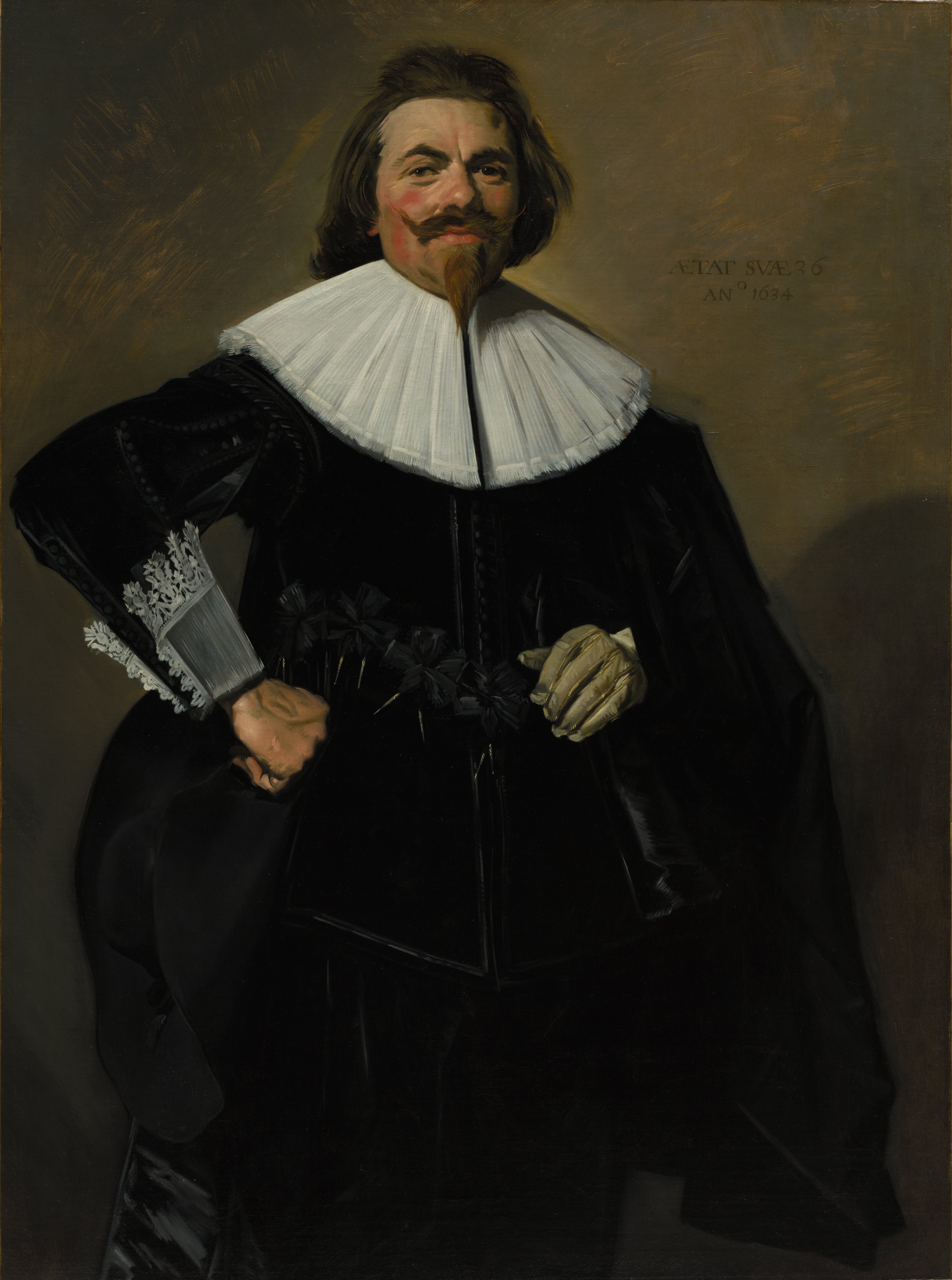
Deconstructing the Threads: A Zoey Fashion Lab Analysis of Tieleman Roosterman
At Zoey Fashion Lab, our mission is to unravel the fabric of history, extracting the genetic code of past aesthetics to engineer the future of fashion. We approach each artifact not as a static relic, but as a living, mutable blueprint. Today, we deconstruct Portrait of Tieleman Roosterman (1634) by Frans Hals—a masterpiece of Dutch Golden Age portraiture. Painted in oil on canvas, this work embodies the rigorous precision, material opulence, and social stratification of 17th-century Netherlands. Yet, for our avant-garde laboratory, it is not the sitter’s identity that commands our attention, but the fabric itself. We see not a man, but a New DNA Strand—a sequence of textile codes, color palettes, and structural tensions waiting to be spliced, mutated, and reanimated for a post-modern wardrobe.
The Fabric as First Language: Reading the Canvas
Before we apply our avant-garde lens, we must first decode the original DNA. Hals’s portrait is a study in textile realism. Tieleman Roosterman, a wealthy Haarlem linen merchant, is draped in the uniform of his success. The black silk doublet, slashed to reveal a white under-tunic, is not merely clothing—it is a statement of economic power. The crisp, starched white ruff, a collar of intricate lace, is a marvel of engineering, a rigid halo that both frames and confines the face. The black wool broadcloth of his outer garment is dense, almost architectural, while the silk reveals a subtle, almost liquid sheen. Hals’s brushwork is a lexicon: thick, rapid strokes for the lace’s delicate loops; smooth, blended layers for the skin; bold, directional strokes for the fabric’s folds.
This is not a passive portrait. The fabric speaks. The black silk absorbs light, signifying sobriety and wealth (black dye was expensive). The white lace, imported from Flanders or Venice, broadcasts international trade connections. The slashed sleeves, a remnant of 16th-century Landsknecht fashion, hint at military virility now tamed by commerce. Every thread is a social signifier. But for Zoey Fashion Lab, these signifiers are raw material—a genetic sequence we will fragment, amplify, and recombine.
The Avant-Garde Intervention: Splicing the DNA Strand
Our avant-garde approach rejects the notion of the portrait as a finished, closed object. Instead, we treat it as a genetic database. The New DNA Strand we extract is not biological, but material—a set of instructions for constructing garments that challenge linear time, gender, and function. We identify three core genetic sequences from the Roosterman portrait:
1. The Collar as Exoskeleton: The starched ruff is a marvel of textile rigidity. In our avant-garde reengineering, we extract its geometry—the concentric circles, the precise pleating—and reimagine it as a wearable architecture. We replace linen with carbon-fiber-reinforced polymer, laser-cut into a fractal lattice. The ruff becomes a detachable collar that can be worn as a helmet, a visor, or a halo. Its white is not dyed but generated by embedded LEDs, pulsing in response to the wearer’s heartbeat. This is the collar as biometric armor, a piece that both protects and exposes the wearer’s inner state.
2. The Slashed Silhouette as Deconstruction Blueprint: The slashed sleeves of Roosterman’s doublet are a historical precursor to deconstruction—a deliberate exposure of the garment’s inner layers. We take this concept to its extreme. The outer black silk is laser-perforated in patterns derived from Hals’s brushstrokes, revealing a second skin of iridescent, thermochromic fabric beneath. As the wearer moves, the heat of their body changes the color of the underlayer from deep burgundy (a nod to the merchant’s wealth) to electric blue (a signal of digital connectivity). The slash is no longer a static historical reference but a dynamic interface between body and environment.
3. The Black as Void and Canvas: Black in the original portrait is a color of authority and absorption. In our strand, black becomes a negative space for projection. We develop a fabric woven with micro-cameras and flexible OLED screens. The black of Roosterman’s doublet can display live feeds from the wearer’s surroundings, or it can be programmed to show digital lace patterns—an animated version of the original ruff. The garment becomes a living portrait, capable of recording and replaying the wearer’s own movements, creating a feedback loop between the historical self and the present moment.
Recombinant Structures: From Canvas to Wearable System
The genius of Hals’s portrait lies in its tension between stasis and motion. Roosterman’s pose is formal, but the fabric hints at life—the slight sag of the doublet, the asymmetry of the collar. Our avant-garde collection amplifies this tension. We construct garments that are inherently unstable. The outer shell of a jacket, based on the doublet’s silhouette, is made from shape-memory alloys that contract and expand with humidity, creating a constant, subtle flutter reminiscent of Hals’s loose brushwork. The inner lining is a network of haptic sensors that vibrate in patterns derived from the original painting’s composition—a gentle pulse on the left shoulder where the light hits, a stronger vibration on the right where the shadow deepens.
This is wearable deconstruction as a form of time travel. The wearer does not merely don a garment; they inhabit a dialogue with history. The black silk is no longer a sign of 17th-century mercantile pride but a quantum fabric that can, at the press of a button, transform into a digital rendering of a different era—a 1920s flapper fringe, a 1980s power suit, or a 2050s bio-luminescent gown. The portrait’s DNA is not static; it is a library of potentialities.
Conclusion: The Fabric as Future Archive
Zoey Fashion Lab’s analysis of Portrait of Tieleman Roosterman is not a critique of the past but a generative act. We refuse to treat history as a museum. Instead, we see it as a raw, mutable material. The New DNA Strand we extract is a set of instructions for creating garments that are responsive, adaptive, and self-aware. The ruff becomes a helmet. The slash becomes a screen. The black becomes a void for projection. This is fashion as experimental archaeology, where the canvas is not a finished work but a starting point for infinite recombinatory possibilities. In our lab, the portrait is never complete—it is always being rewritten, one thread at a time.