Deconstructing the Archive: An Avant-Garde Analysis of the Nasca Procession Cloth
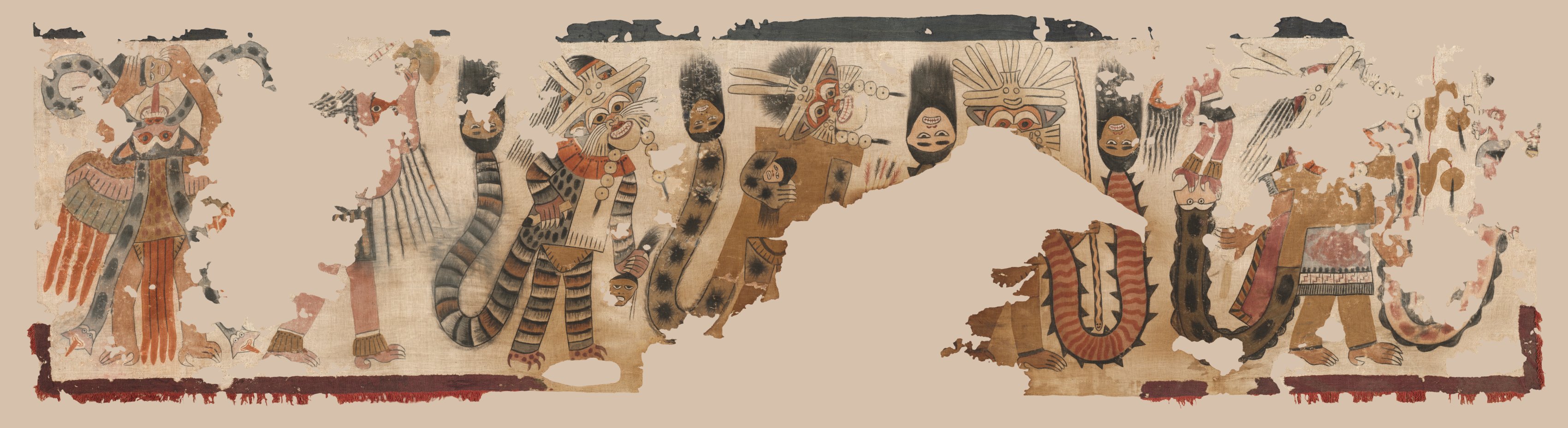
At Zoey Fashion Lab, our mission is to dismantle the historical artifact, not to preserve it in a sterile vacuum, but to extract its latent kinetic energy and re-synthesize it into a language of radical modernity. The subject of this analysis—a cloth from the Central Andes, specifically the South Coast Nasca culture, featuring a procession of figures—is not a mere textile. It is a temporal transmission, a coded message from a pre-Columbian matrix of ritual, power, and material ingenuity. Constructed from humble cotton and pigment for its field, and luxurious camelid fiber for its borders and fringe, this object is a paradox: a durable yet fragile record of a society’s deepest cosmological rhythms. Our deconstruction will treat this cloth not as a finished artwork, but as a design blueprint for a future garment, a resonant archive whose frequencies we can amplify.
Material Dialectics: The Politics of Fiber and Pigment
The technical dichotomy of this cloth is its first avant-garde statement. The field, woven from cotton—a plant fiber native to the coastal valleys—and colored with mineral and organic pigments, speaks to a grounded, terrestrial existence. Cotton is soft, absorbent, and intimately linked to the body. It is the canvas of daily life and ritual touch. In stark contrast, the borders and fringe are crafted from camelid fiber (likely alpaca or vicuña), sourced from the high-altitude puna. This fiber is stronger, warmer, and possesses a natural luster that cotton lacks. It is a material of prestige, of the highlands, of the sacred.
This is not a simple decorative addition. It is a geographical and spiritual suture. The cloth’s very structure enacts a dialogue between two ecological zones: the coast and the mountains. The cotton field is the plane of human action, the space where the procession occurs. The camelid border is the frame of the sacred, the threshold that separates the mundane from the numinous. The fringe—those dangling, tactile threads—is the point of contact, the liminal interface where the cloth meets the world. In an avant-garde reinterpretation, we would invert this hierarchy. Imagine a garment where the body is encased in a rigid, structured camelid fiber exoskeleton, while the cotton field becomes a loose, flowing, painted “skin” that billows and reveals the procession in motion. The fringe could become a series of kinetic sensors, triggering shifts in the garment’s color or pattern as the wearer moves.
The Procession as a Choreographic Score
The central motif—a procession of figures—is not a static narrative. It is a choreographic score for a ritual performance. Nasca processions, often depicted on their pottery and textiles, were likely tied to agricultural cycles, ancestor veneration, or water rites. The figures, rendered in a stylized, rhythmic repetition, march across the cloth’s field. They are not individuals; they are archetypes, cogs in a cosmic machine. Their bodies are elongated, their heads often adorned with elaborate headdresses or trophy heads, their movements synchronized.
From an avant-garde perspective, this repetition is a proto-algorithmic pattern. The cloth is a pre-modern punch card for a ritual computer. Each figure is a unit of meaning, a pixel in a larger, abstract design. The procession’s direction—left to right or right to left—suggests a temporal flow, a cyclical return. The empty spaces between the figures are not voids; they are intervals of potentiality. In a contemporary garment, these intervals could be rendered as cutouts, sheer panels, or LED matrices that activate the “negative space” of the procession. The wearer would become both the stage and the performer, their own body the field upon which the ancestral figures march.
Archive Resonance: Echoes of the 16th–17th Century
The reference to “Archive Resonance” and the 16th–17th centuries is critical. This cloth, though Nasca (which flourished roughly 100 BCE to 800 CE), was likely preserved and perhaps even re-contextualized during the Colonial period. The Spanish conquest introduced a violent rupture, a collision of worldviews. Indigenous textiles were often collected as curiosities, repurposed as church vestments, or buried as offerings. The “resonance” here is the echo of trauma and survival. The cloth carries the memory of its own near-erasure.
An avant-garde design must acknowledge this violent history. The cotton field, with its painted procession, could be deliberately distressed, frayed, or stained to evoke the passage of time and the brutality of conquest. The camelid borders, once a symbol of indigenous prestige, could be reimagined as a protective armor, a woven shield against colonial gaze. The fringe could be treated as a memory thread, each strand representing a lost weaver, a broken lineage. The garment would not hide this history; it would wear it as a scar, a testament to resilience. The 16th–17th century resonance is not a romantic echo; it is a dissonant chord that must be heard.
Toward a Future Garment: Synthesis and Subversion
How do we translate this analysis into a tangible, wearable object for Zoey Fashion Lab? The garment must be a living archive, a second skin that performs the procession.
1. The Silhouette: A modular, asymmetrical form. The cotton field forms a loose, floor-length cape or train, painted with a digitized version of the Nasca procession. The figures are not static; they are printed with thermochromic ink that shifts color with body heat, making the procession appear to move as the wearer walks. The camelid fiber borders become a structured, high-collared bolero or corset, providing a rigid counterpoint to the flowing cotton. The fringe is concentrated at the hem and cuffs, where it can catch light and create a shimmering, kinetic edge.
2. The Materiality: We honor the original materials but push them into new territory. The cotton is treated with a bio-resin to create areas of stiffness and transparency, mimicking the effect of age and wear. The camelid fiber is blended with a conductive thread, allowing the border to become a touch-sensitive interface. When the wearer touches the border, a low-frequency hum or vibration is emitted—a sonic echo of the ritual music that once accompanied the procession.
3. The Performance: The garment is not meant for a static display. It is a costume for a ritual of deconstruction. The wearer, in a controlled environment, would walk a predetermined path—a modern-day procession. As they move, sensors in the garment trigger a projection mapping onto the surrounding walls, showing the original Nasca cloth in a state of digital decay and reconstruction. The fringe, equipped with micro-cameras, captures the wearer’s own image and blends it with the ancestral figures, creating a hybrid procession across time.
Conclusion: The Cloth as a Portal
The Nasca Procession Cloth is not a relic. It is a portal. It connects the cotton fields of the Peruvian coast to the highland pastures of the Andes. It bridges the ritual world of the Nasca with the colonial violence of the 16th century. It speaks to the eternal human need to process—to march, to chant, to mark time. At Zoey Fashion Lab, we do not copy the past. We fracture it, amplify it, and re-assemble it into a new form of wearable critique. This garment will not be a costume. It will be a critical instrument, a tool for the wearer to process their own relationship to history, materiality, and the act of moving through space. The cloth with a procession of figures becomes a garment with a procession of meanings—each step a deconstruction, each thread a resonance.