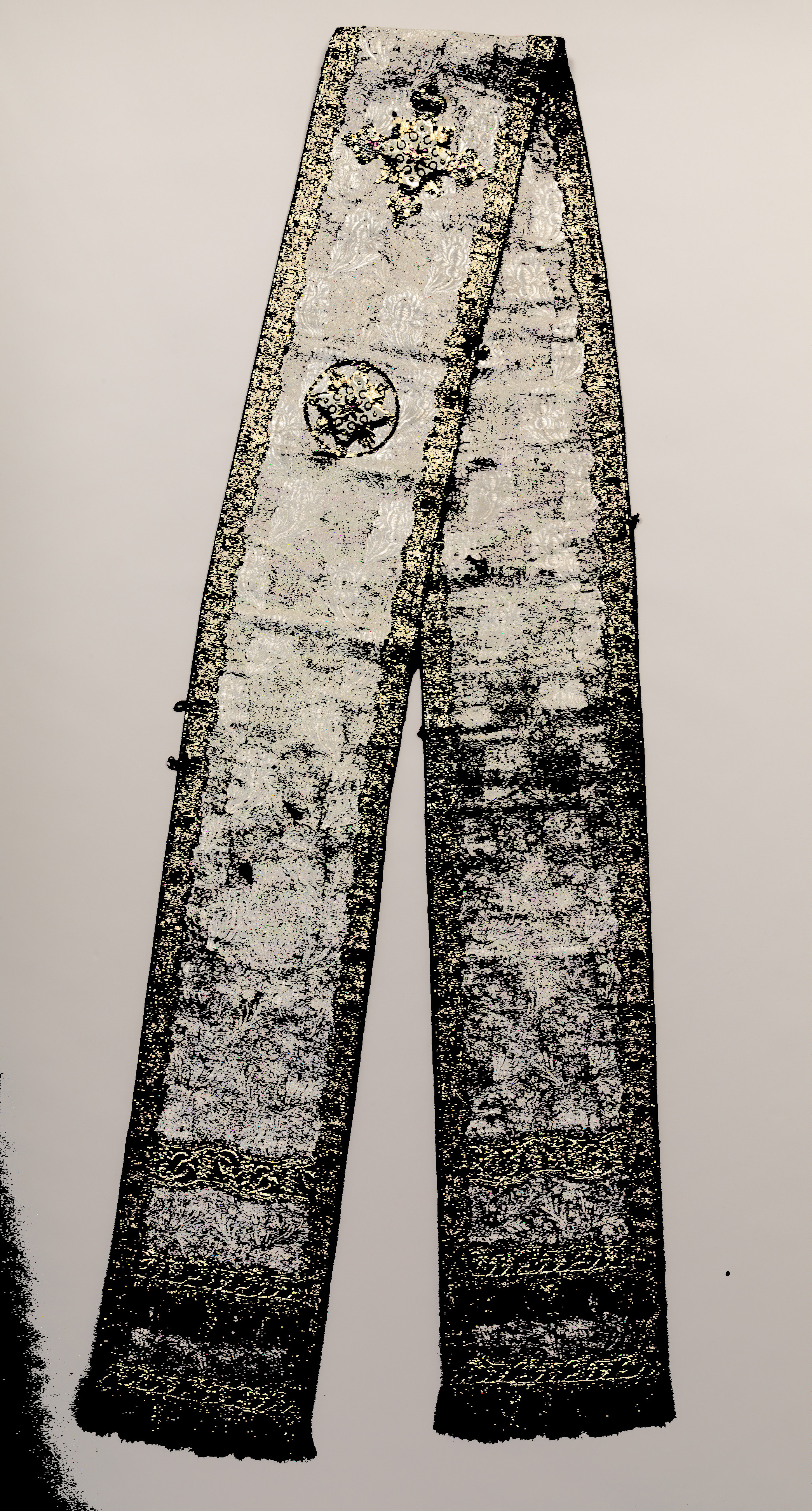
The Omophorion Reconfigured: A Study in Structural Transcendence for SS26
The omophorion, historically a liturgical vestment signifying episcopal authority and the weight of spiritual stewardship, undergoes a radical metamorphosis within Zoey Fashion Laboratory’s SS26 avant-garde couture analysis. This is not a mere garment; it is a sculptural provocation that interrogates the boundaries between the sacred, the industrial, and the post-human. By fusing metal and silk thread, the omophorion is reimagined as a dynamic, futuristic silhouette that challenges conventional notions of wearability, drape, and symbolic resonance. This standalone study deconstructs the vestment’s traditional form—a long, narrow band of fabric worn over the shoulders—and reconstructs it as an architectural framework for the body, one that speaks to the tensions between rigidity and fluidity, tradition and innovation, the terrestrial and the cosmic.
Deconstructive Aesthetics: The Metal-Silk Dialectic
The material choice of metal and silk thread is a deliberate act of structural alchemy. Silk, historically associated with luxury, softness, and organic movement, is here subjugated to the cold, linear precision of metal. The metal—likely a lightweight alloy such as titanium or anodized aluminum—is not merely an accent but the primary load-bearing element. It is woven, laser-cut, and articulated into a lattice that mimics the omophorion’s traditional width but extends its length into an exaggerated, almost architectural train. This is not a garment that drapes; it cantilevers. The silk thread, in contrast, is used as a tensile binder, threading through the metal framework in delicate, almost calligraphic patterns. This creates a visual and tactile tension: the hardness of the metal versus the fragility of the silk, the static versus the kinetic. For SS26, this dialectic is crucial. It reflects a frontier where garment construction is no longer about covering but about defining space around the body. The omophorion becomes a tool for spatial intervention, a wearable infrastructure that repositions the human form as both the anchor and the obstacle.
Futuristic Silhouettes: The Omophorion as Exoskeletal Wing
The silhouette of this reconfigured omophorion is radically different from its historical antecedent. Instead of resting passively on the shoulders, it is engineered to project outward and upward, resembling an exoskeletal wing or a cybernetic halo. The metal structure is articulated at key pivot points—the clavicle, the scapula, and the nape—allowing for controlled movement. When the wearer stands still, the omophorion forms a rigid, geometric arc that frames the face and shoulders, creating a silhouette that is both protective and aggressive. In motion, the metal segments shift, creating a shimmering, undulating effect as the silk threads catch light. This is not a garment for passive observation; it is a performative architecture that demands interaction with space. The futuristic silhouette for SS26 is defined by this interplay of expansion and contraction. The omophorion can be configured in multiple states: a closed, compact form that hugs the body like a collar, or an open, fan-like form that extends up to two meters in width, transforming the wearer into a living, breathing monument. This versatility speaks to a frontier where garments are not static but mutable, responsive to the wearer’s intent and environment.
Structural Innovation: The Tension of the Invisible
At the core of this study is a structural innovation that redefines how a garment can bear weight and shape. The metal framework is not a monolithic cage but a tensile system. Thin, nearly invisible silk threads are tensioned across the metal lattice, creating a web that distributes stress and allows for a degree of flexibility. This is reminiscent of tensegrity structures in architecture, where compression and tension coexist to create stability without rigidity. The omophorion’s weight is minimal—approximately 1.5 kilograms—thanks to the use of hollow metal tubes and a honeycomb-inspired internal grid. The silk threads, dyed in a gradient from deep indigo to silver, are woven with a microfilament core that prevents fraying while maintaining a gossamer-like transparency. This transparency is key: it allows the metal structure to be fully visible, celebrating the engineering rather than hiding it. The result is a garment that is simultaneously armor and air, a paradox that challenges the viewer to reconsider what a couture piece can be. For SS26, this innovation is a statement: the future of fashion lies in the synthesis of material science and conceptual rigor, where every stitch and rivet is a declaration of intent.
Symbolism and Context: The Global Frontier of Identity
The omophorion’s historical role as a symbol of authority and divine connection is not discarded but transmuted. In this avant-garde context, it becomes a meditation on the global frontier—a liminal space where boundaries dissolve and new identities emerge. The metal represents the industrial, the technological, the digital; the silk represents the organic, the cultural, the human. Together, they form a hybrid that speaks to the current moment: a world where tradition is continuously renegotiated through the lens of innovation. The omophorion, as a standalone piece, is not meant for daily wear but for ritualistic performance—a fashion-as-art object that interrogates the wearer’s relationship to power, spirituality, and the future. For SS26, this aligns with Zoey Fashion Laboratory’s ethos of pushing beyond the commercial into the conceptual. The omophorion is a challenge to the fashion industry: to see garments not as commodities but as architectural propositions for the body in a post-human world.
Conclusion: The Omophorion as a Blueprint for Tomorrow
This analysis of the omophorion, crafted from metal and silk thread, is a definitive statement for SS26. It is a blueprint for how avant-garde couture can transcend its own history, using deconstructive aesthetics and structural innovation to create silhouettes that are not just futuristic but prophetic. The omophorion no longer drapes the shoulders; it redefines the space around them. It is a garment that demands to be seen, studied, and worn not as a sign of status but as a declaration of a new frontier—one where the sacred and the industrial, the human and the machine, converge into a single, breathtaking form. This is the future of couture, and it is built on the tensile strength of silk and the unyielding geometry of metal.