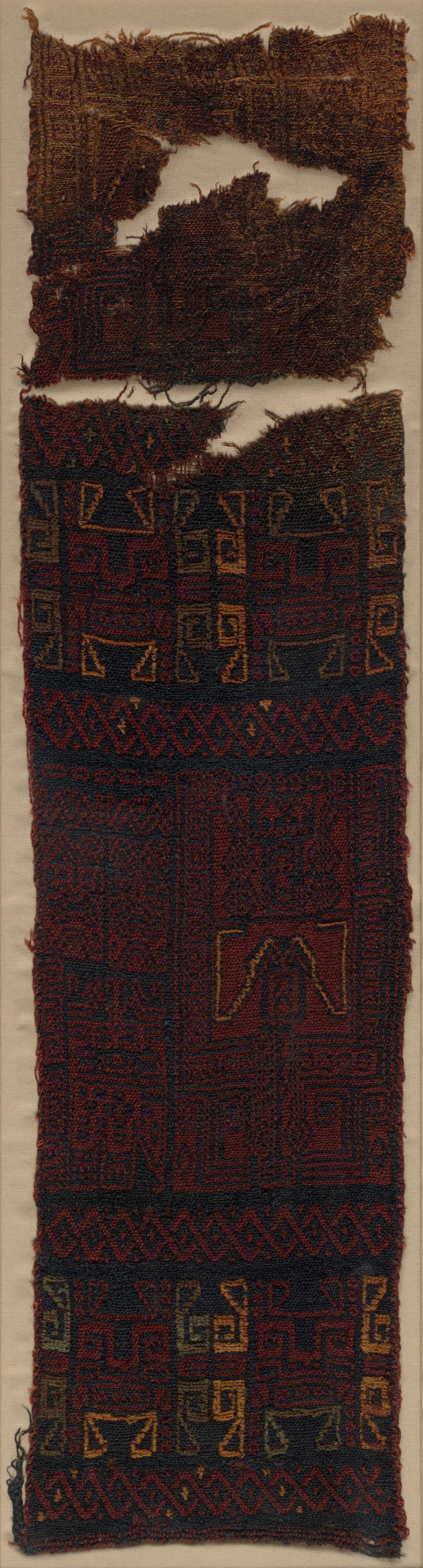
Deconstructing the Divine: An Avant-Garde Analysis of the Paracas Textile Fragment
At Zoey Fashion Lab, we do not merely observe artifacts; we dissect them, interrogating their materiality to unearth the radical potential embedded within their threads. The textile fragment before us—a double-cloth panel from the Paracas culture of Peru’s South Coast, likely the Yauca Valley—serves not as a relic of a distant past, but as a blueprint for a future of fashion that is both deeply rooted and violently innovative. This analysis, framed within our avant-garde methodology, will deconstruct the fragment’s technical, iconographic, and symbolic strata, revealing how its interlace patterns, frontal deity heads, and felines prefigure a contemporary language of deconstruction, power, and hybridity.
Technical Subversion: Double-Cloth as Structural Dissonance
The fragment’s technical foundation—camelid fiber double-cloth with structural embroidery—is not a quaint craft but a sophisticated act of structural subversion. Double-cloth, a technique where two independently woven layers are interlocked to create a single fabric, inherently embodies duality and tension. In the context of avant-garde fashion, this is a precursor to deconstructivist practices. The warp and weft do not simply coexist; they contest, creating a surface that is simultaneously front and back, figure and ground. The structural embroidery, applied after weaving, further disrupts this binary. It is not decorative embroidery in the conventional sense; it is a forceful intervention, a scar or a suture that reinforces certain areas while destabilizing others. This echoes the work of designers like Rei Kawakubo, who famously uses seams as visible, aggressive markers of construction. For Zoey Fashion Lab, this fragment teaches us that construction is not a concealment of process but an articulation of conflict. The camelid fiber itself—lustrous, strong, and warm—provides a tactile contrast to the geometric precision of the weave, introducing an organic, almost animalistic element that resists the rigidity of the pattern. This is a material manifesto: the body of the garment is a site of negotiation between control and chaos.
Iconographic Anarchy: Frontal Deity Heads and the Gaze of Power
The frontal deity heads that dominate the fragment’s composition are not placid icons of worship; they are confrontational, staring directly at the viewer with an unsettling, hypnotic intensity. In the Paracas worldview, these heads likely represent a central cosmological figure, possibly the Staff God or a feline deity, embodying authority over the natural and supernatural realms. However, from an avant-garde perspective, this frontal gaze is a weapon. It is a direct challenge to the passive role of the observer. In fashion, the garment’s “face” is often the wearer’s own. Here, the textile imposes its own face, a third presence that mediates between the body and the world. This prefigures the work of contemporary artists like Cindy Sherman, who uses masks and prosthetics to disrupt identity. In a Zoey Fashion Lab garment, such a motif would be translated into oversized, appliquéd eyes or repetitive, screen-printed visages that fragment the wearer’s silhouette, creating a multiplicity of identities. The heads are not merely repeated; they are arranged in a grid that suggests infinite replication, a proto-industrial logic that the avant-garde can repurpose to critique mass production and the commodification of the sacred.
Feline Ferocity and the Untamed Body
Flanking these deity heads are felines—likely jaguars or pumas—depicted in profile, their bodies elongated and intertwined with the geometric interlace. In Andean cosmology, the feline is a symbol of the underworld, of night, and of shamanic transformation. It is a creature of raw power, untamed and dangerous. For the avant-garde, the feline represents the unruly body that refuses to be corseted by societal norms. The way these felines are woven into the interlace pattern is crucial; they are not separate from the structure but are part of it. Their tails, limbs, and whiskers become lines that merge with the geometric bands, suggesting a fluid boundary between the organic and the abstract. This is a direct precursor to the biomorphic forms found in the work of Elsa Schiaparelli or, more recently, Iris van Herpen. The feline’s presence challenges the static, hierarchical composition. It is a disruptive force, a reminder that beneath the ordered surface of civilization lies a primal energy. In our deconstruction, we would extract this feline motif and magnify it, allowing it to tear through the fabric’s grid, creating rips, tears, and three-dimensional appendages that mimic claws and tails. The garment becomes a second skin that is both protective and predatory.
Interlace as Infinite Loop: The Fabric of Entanglement
The interlace pattern that binds the entire composition is not mere decoration; it is a philosophical statement. These interlocking bands, often referred to as “step-fret” or “meander” patterns, create a visual infinity, a labyrinth with no beginning or end. In the context of the Paracas, this likely represented the cyclical nature of time, the interconnectedness of all things, or the binding of the cosmos. For the avant-garde, the interlace is a metaphor for entanglement—the complex, inescapable web of history, culture, and identity. It is a pattern that resists linearity, just as deconstructivist fashion resists the conventional narrative of a garment from sketch to finished product. The interlace can be seen as a precursor to the digital code, a binary system of on/off, warp/weft that generates infinite complexity. In a Zoey Fashion Lab collection, this pattern would be translated into laser-cut leather overlays, chainmail-like metal meshes, or even digital prints that distort and pixelate when viewed from different angles. The interlace becomes a structural principle for creating garments that are never static, that shift and reform as the wearer moves. It is a fabric of pure potentiality, where every thread is a decision, and every intersection is a point of conflict or harmony.
Archive Resonance: A Dialogue Across Centuries
As the reference text suggests, objects from the 16th to 17th centuries are “silent witnesses” to cultural collision. This Paracas fragment, likely created centuries earlier, is no exception. It bears the marks of its own history: the colors, now muted, were once vibrant with cochineal, indigo, and other natural dyes; the fibers carry the memory of the animals that produced them. Yet, for Zoey Fashion Lab, this archive is not a tomb. It is a resonance chamber. We do not seek to preserve or replicate; we seek to amplify. The frontal deity heads, the felines, the interlace—these are not symbols to be decoded and filed away. They are vectors of energy that can be re-energized through contemporary materials and techniques. Our avant-garde practice involves a violent act of translation: we cut, we splice, we layer, and we distort. We take the double-cloth structure and reimagine it as a bonded neoprene, or we extract the interlace pattern and render it as a 3D-printed exoskeleton. The goal is not to create a costume that mimics the past, but to create a garment that embodies the same tensions—between order and chaos, the divine and the animal, the geometric and the organic—in a form that speaks to the present. This fragment is not a dead artifact; it is a living text, and we are its most radical readers.
Conclusion: A Blueprint for the Future
In conclusion, this Paracas textile fragment is a masterclass in avant-garde principles. Its technical complexity (double-cloth with structural embroidery) prefigures deconstructivist construction. Its iconography (frontal deity heads and felines) offers a vocabulary of power and disruption. Its pattern (interlace) provides a model for infinite, non-linear entanglement. For Zoey Fashion Lab, this is not an object of study but a generative seed. It challenges us to create garments that are not passive coverings but active agents of transformation. The fragment whispers of a world where the sacred is woven into the everyday, where the animal and the divine coexist in the same thread, and where the fabric itself is a battlefield. Our task is to listen to that whisper and amplify it into a roar, using the tools of the avant-garde—deconstruction, hybridity, and radical materiality—to create a fashion that is as ancient as it is futuristic. The Paracas culture is gone, but its textile logic endures, waiting to be reanimated in a new form. At Zoey Fashion Lab, we are that reanimation.