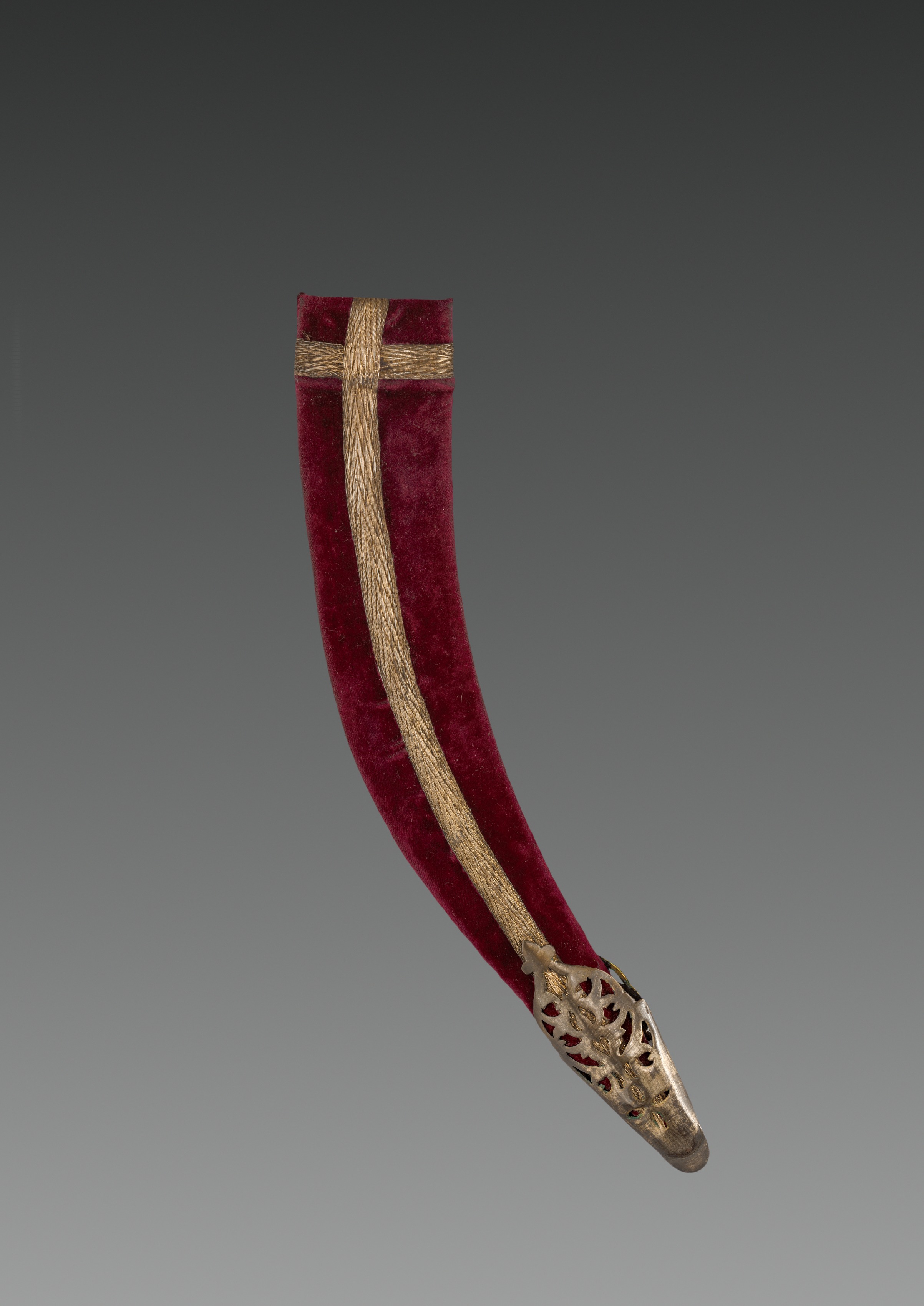
Executive Analysis: The Dagger in Red Velvet Case
Zoey Fashion Lab is pleased to present this technical and stylistic deconstruction of a singular artifact: the Dagger in Red Velvet Case, sourced from India. This object, while ostensibly a weapon or ceremonial tool, operates as a profound New DNA Strand within the avant-garde fashion lexicon. Its construction—a wood sheath enveloped in crimson velvet and adorned with metallic thread—transcends its functional origins to become a textural and symbolic blueprint for deconstructive design. This analysis will dissect its materiality, cultural resonance, and potential as a generative pattern for future collections.
Material Deconstruction: The Sheath as Canvas
Wood Core: Structural Integrity and Organic Foundation
The sheath’s internal structure is carved from wood, a material that grounds the piece in organic tactility. In avant-garde fashion, wood is rarely used directly, but its presence here suggests a foundational rigidity. This core can be interpreted as a skeletal framework—the unseen architecture that supports the external narrative. For Zoey Fashion Lab, this translates to exploring hidden structural elements in garments: boning, corsetry, or internal scaffolding that contradicts the softness of the outer fabric. The wood’s grain, though concealed by velvet, implies a natural, unyielding backbone, challenging the wearer to consider the tension between inner strength and outer ornamentation.
Red Velvet: Chromatic and Textural Power
The velvet covering is the sheath’s primary visual and tactile language. Its deep red hue is not merely decorative; it is a chromatic statement of passion, danger, and royalty. Velvet itself is a fabric of luxury and depth, absorbing light while reflecting a subtle sheen. In the context of a weapon, this soft, plush covering creates a paradox of protection and threat. For fashion, red velvet can be used to subvert expectations—wrapping a traditionally hard, metallic form in a material associated with comfort and opulence. The fabric’s nap creates directional texture, which can be manipulated in garment construction to produce dynamic light-play and a sense of movement, even in static pieces. This aligns with the Lab’s focus on sensory dissonance—where touch and sight contradict each other.
Metallic Thread: The Conductive Line
The metallic thread woven into the velvet is the sheath’s neural network. It introduces a cold, reflective element against the warm, matte velvet. This thread is not merely decorative; it acts as a conductive line, suggesting connectivity, energy, and precision. In avant-garde design, metallic threads can be used to create embroidered circuits or intricate patterns that mimic the dagger’s original purpose—to pierce, to cut, to define boundaries. The thread’s linear quality offers a blueprint for deconstructed seams or exposed stitching, turning the garment’s construction into a visible, integral part of its aesthetic. This technique invites the wearer to see the garment as a living diagram, where every line has intent.
Cultural and Symbolic Resonance: India’s Dagger Heritage
From Weapon to Adornment
Indian daggers, such as the katar or pesh-kabz, have historically been symbols of status, martial prowess, and ritual significance. By encasing this weapon in velvet, the original violent function is neutralized and transformed into an object of contemplation. For Zoey Fashion Lab, this represents a core avant-garde principle: the recontextualization of the functional. A garment can be a “weapon” in its ability to challenge social norms, to armor the wearer, or to expose vulnerability. The red velvet case becomes a metaphor for the fashion industry’s ability to take raw, aggressive elements—sharp silhouettes, harsh cuts, rigid structures—and soften them through luxurious materials, creating a dialogue between aggression and elegance.
The New DNA Strand: A Blueprint for Deconstruction
The reference to a New DNA Strand is critical. This object is not a finished piece; it is a genetic code for future design. The sheath’s combination of wood, velvet, and metallic thread can be seen as a triple helix of materiality, color, and line. In practice, this means deconstructing a garment into its core components: a structural base (like the wood), a sensory layer (the velvet), and a connective element (the metallic thread). For example, a coat could feature a rigid internal frame (wood-inspired) covered in a soft, blood-red velvet exterior, with metallic embroidery tracing the seams like a thread of consciousness. This approach encourages modular design, where each element can be separated, recombined, or left exposed to reveal the garment’s “genetic” makeup.
Avant-Garde Application: Translating the Dagger to Fashion
Silhouette and Form: The Sheath as Garment
The sheath’s long, narrow, and tapered shape directly suggests a columnar or mermaid silhouette. In avant-garde fashion, this form can be exaggerated or distorted. Consider a gown that mimics the sheath’s protective nature—tightly encasing the body from neck to floor, with a train that unfurls like a velvet ribbon. The metallic thread can be used to create a spine-like embroidery down the back, echoing the dagger’s central ridge. Alternatively, the sheath can be deconstructed into multiple panels, each representing a fragment of the original, creating a layered, armor-like effect that is both protective and revealing.
Color and Contrast: The Red Spectrum
Red, in this context, is not a single shade but a spectrum. The velvet’s depth can be translated through dye techniques such as ombre, burnout, or devoré to create areas of transparency and opacity. The metallic thread introduces gold, silver, or copper tones, which can be used to create chromatic tension. For Zoey Fashion Lab, this palette suggests a collection centered on emotional intensity—where red symbolizes both lifeblood and violence, and metallic accents represent the cold logic of design. This duality is essential for avant-garde work, which thrives on contradiction.
Texture and Touch: The Sensory Experience
The velvet’s plushness invites touch, while the metallic thread’s sharpness resists it. This tactile dichotomy is a powerful tool in fashion. Garments can be designed with zones of softness and zones of rigidity, encouraging the wearer and viewer to engage with the piece on a physical level. For instance, a sleeve might be entirely velvet, while the cuff is embroidered with metallic thread that feels cool and abrasive against the skin. This creates a wearable experience that is both comfortable and unsettling, aligning with the avant-garde goal of challenging the wearer’s expectations.
Conclusion: The Dagger as a Generative Artifact
The Dagger in Red Velvet Case from India is far more than a decorative object. It is a New DNA Strand that encodes a methodology for deconstruction: wood as structure, velvet as sensation, metallic thread as connection. For Zoey Fashion Lab, this artifact serves as a masterclass in material paradox, cultural transformation, and avant-garde expression. By dissecting its components and reimagining them in garment form, we can create pieces that are not merely clothing but wearable statements of tension, history, and innovation. The dagger’s legacy is not in its blade but in the velvet that sheathes it, and in the metallic lines that trace a path toward the future of fashion.