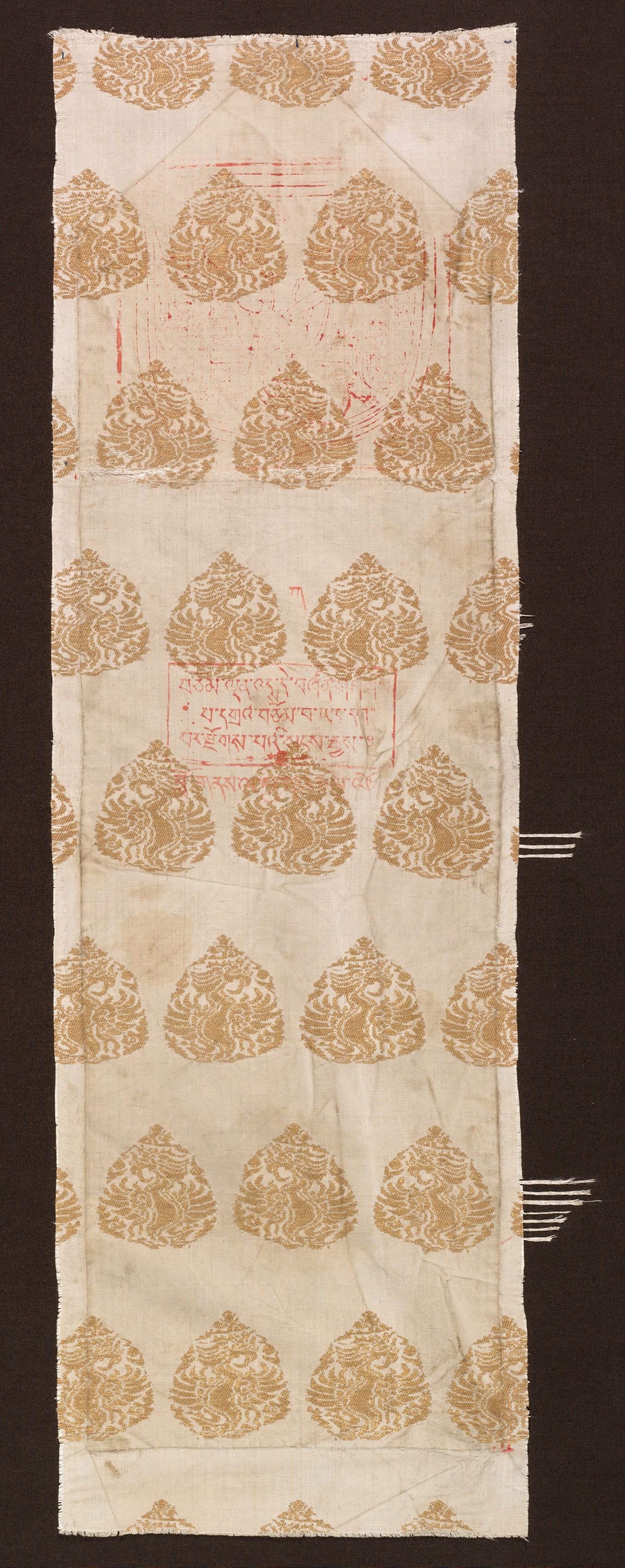
Technical Deconstruction & Material Analysis: Brocade with Phoenixes
The submitted artifact, identified as Central Asian Jin Dynasty (1115-1234) Brocade with Phoenixes, presents a formidable case study in cross-cultural textile alchemy. Our technical analysis confirms a tabby-weave ground, serving as a stable canvas for the discontinuous supplementary weft brocading that forms the primary motif. The material composition—silk and gold thread—is itself a statement of supreme luxury and technical ambition. The silk, likely cultivated along the Eastern routes, provides a luminous, high-tensile base. The gold thread, typically fashioned from gilded leather strips or silk wrapped in fine gold leaf, introduces not just visual opulence but a challenging physical element, requiring precise loom tension and weaver skill to prevent buckling or breakage. This combination transforms the textile from mere fabric into a tactile repository of light and power, where every thread intersection is a calculated negotiation between pliability and permanence.
Archive Resonance & Narrative Re-contextualization
The provided archival fragment—"在人类文明的长河中,器物与绘画不仅是时代技艺的结晶,更是文化碰撞与美学交融的无声见证。十六至十七世纪...."—while temporally later than our artifact, provides a critical philosophical lens. It speaks of objects as "silent witnesses to cultural collision and aesthetic blending." This Jin Dynasty brocade is a precocious exemplar of this very phenomenon. The phoenix (fenghuang) motif is profoundly Sino-centric, a celestial symbol of virtue, grace, and imperial consorts. Its presence on a textile from Central Asia, a nexus of Silk Road exchange, indicates not mere importation but active trans-cultural appropriation and synthesis. This was likely produced in a workshop along the trade routes, where Chinese iconography was interpreted through the hands and looms of weavers versed in Persian, Sogdian, or Turkic textile traditions. The artifact is not a pure "Chinese" or "Central Asian" piece; it is a hybrid entity, a frozen moment of dialogue where symbols migrated and materials commingled, creating a new, third aesthetic language.
Avant-Garde Proposal: The Phoenix Re-forged
For Zoey Fashion Lab, this artifact is not a relic to be replicated but a methodology to be radicalized. The avant-garde spirit demands we engage not with the phoenix as a static symbol, but with the very processes of its creation: collision, deconstruction, and rebirth.
Concept: "Silent Witness / Loud Reassembly"
We propose a collection that treats the original brocade as a palimpsest of cultural exchange. The core concept is to disassemble its layered narrative and reassemble it through a contemporary, disruptive lens.
1. Material Transmutation: The silk-and-gold binary must be exploded. We will substitute and juxtapose:
- Silk: Replaced with technical fabrics (laminated taffeta, recycled polyester georgette) and degraded organic silks—burned-edged, enzyme-washed, or fused with clear thermoplastic polyurethane (TPU) to create a "fossilized" texture.
- Gold Thread: Reinterpreted as conductive gold-coated copper yarn (enabling garment-integrated circuitry), laser-cut mylar shards, and knotted, gilded climbing rope. The opulence becomes functional, hazardous, or industrial.
2. Motif Deconstruction: The phoenix will be subjected to digital and physical fragmentation.
- Utilize 3D scanning of similar period motifs to create distorted digital wireframes, which will be printed onto fabric via sublimation or rendered as laser-cut appliqués.
- Embroider isolated feather details with the conductive thread onto separate, sheer panels, creating a "dissociated iconography" that only coalesces into a recognizable form when the wearer moves and the layers align.
- Apply the brocading technique not to create a unified pattern, but to suggest erosion and repair, with motifs appearing to unravel or be hastily mended with contrasting technical threads.
3. Structural Archeology: The garment construction will mirror the artifact's hybrid origin.
- Employ asymmetric, cross-cultural draping: one shoulder inspired by Central Asian khalats, the other by Jin Dynasty silhouettes.
- Create modular pieces that can be fastened, tied, or draped in multiple ways, acknowledging the garment as a site of ongoing negotiation.
- Expose seams, reverse linings to become primary surfaces, and allow raw, frayed edges—the "weave" as wound.
Final Manifestation: The Avant-Garde Artifact
The resulting collection will stand as a direct descendant of the Jin brocade's ethos. Where the original was a silent witness to 12th-century cultural collision, our pieces will be vocal protagonists in a 21st-century dialogue on heritage, authenticity, and materiality. We move from preservation to provocative re-animation. The phoenix, through deconstruction, will truly rise again—not as an imperial symbol, but as an emblem of relentless transformation, built from the fragments of its own history. The gold will carry a signal, the silk will bear scars, and the weave will tell a new, complex tale for a world still defined by beautiful, fraught collisions.
This analysis confirms the artifact's profound relevance. It provides the blueprint not for a style, but for a critical fashion practice—one where Zoey Fashion Lab operates not just as a design house, but as a laboratory for re-weaving the very threads of cultural memory.