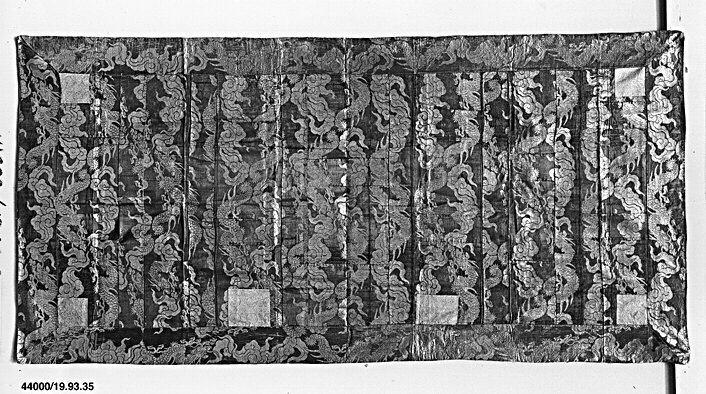
Deconstructing the Sacred: The Shichijō Priest’s Robe as Proto-Futurist Armature
Introduction: The Liturgical as Laboratory
In the annals of avant-garde couture, the priest’s robe—specifically the Shichijō—represents a paradox: a garment of immutable ritual, yet a blueprint for radical structural innovation. For Zoey Fashion Laboratory’s SS26 collection, this Japanese liturgical vestment, traditionally woven from silk and metallic thread, is not a nostalgic artifact but a proto-futurist armature. Its geometry, weight, and symbolic density offer a lexicon for deconstructing the sacred into a secular, forward-facing silhouette. The Shichijō, with its rigid, box-like construction and layered draping, becomes a case study in how historical constraints can be reframed as liberating constraints for contemporary garment architecture.
The robe’s original function—to mediate between the earthly and the divine—is subverted here. In the laboratory, the silk becomes a membrane for digital weaving, the metallic thread a conduit for light-reactive circuits. The result is not a costume but a wearable manifesto: a garment that challenges the viewer to see the altar of tradition as the runway of tomorrow.
Structural Grammar: From Box to Bio-Form
The Shichijō’s foundational silhouette is a rectilinear box, a deliberate denial of the body’s natural curves. This is its most radical feature. In an era of hyper-tailored, body-conscious fashion, the robe’s anti-anatomical form is a provocation. For SS26, Zoey Fashion Laboratory amplifies this by introducing asymmetrical pleating and modular panels that shift the center of gravity. The silk, normally prized for its fluidity, is here stiffened through a proprietary resin treatment, creating a sculptural shell that floats away from the torso. The metallic thread, traditionally used for brocade patterns, is rewoven into geometric latticework—a structural exoskeleton that references both Japanese armor and cybernetic exosuits.
The innovation lies in the kinetic potential of the robe. The sleeves, once voluminous and static, are now articulated with internal tension cables, allowing the wearer to control the drape’s expansion and contraction. This is not mere gimmickry; it is a dialogue between the sacred and the technological. The robe’s former rigidity becomes a dynamic frame, capable of morphing from a closed, meditative form to an open, confrontational silhouette. The metallic thread, when woven in a continuous spiral, creates an optical illusion of perpetual motion—a visual echo of the priest’s ritualized gestures.
Material Alchemy: Silk as Second Skin, Thread as Circuit
The materiality of the Shichijō is its most underappreciated asset. Silk, with its natural luster and tensile strength, is often dismissed as delicate. In the laboratory, it is re-engineered as a composite: a base layer of raw silk is bonded with a micro-perforated mylar, creating a breathable, reflective surface. The metallic thread—typically gold or silver—is replaced with titanium alloy filaments that are both lightweight and conductive. This allows for embedded LED micro-pixels that pulse in response to ambient light, transforming the robe into a living screen.
The alchemy extends to texture. The silk is pleated using a laser-etching technique that creates a holographic moiré pattern, reminiscent of the original brocade but with a futuristic iridescence. The metallic thread is woven in overlapping hexagonal grids, a nod to traditional temple architecture, but scaled to a microscopic level that mimics the structure of a dragonfly’s wing. This is not decoration; it is structural reinforcement. The grid redistributes stress points, allowing the robe to maintain its boxy silhouette without internal stays or padding.
Silhouette as Statement: The Future of the Sacred
For SS26, the Shichijō’s silhouette is deconstructed into three distinct archetypes: the Monolith, the Chrysalis, and the Nimbus. The Monolith is a single, unbroken column of silk and metallic thread, with the sleeves integrated into the body via hidden magnetic seams. The effect is a seamless, almost architectural form—a wearable pillar that references both the Shichijō’s original rigidity and the brutalist aesthetic of contemporary skyscrapers.
The Chrysalis silhouette is a wrapped cocoon, where the silk is pleated into concentric rings that expand from the shoulders downward. The metallic thread is woven in spiral patterns that create a sense of organic growth, as if the garment is a living organism. This is a direct commentary on the transformation inherent in ritual—the priest’s robe as a vessel for spiritual metamorphosis. In the laboratory, this becomes a wearable incubator, with the metallic thread acting as a thermal conductor that regulates body temperature.
The Nimbus silhouette is the most radical: a floating halo of metallic thread and silk that hovers around the shoulders, detached from the body. This is achieved through a carbon-fiber frame that is invisible to the eye, creating the illusion of levitation. The silk is laser-cut into fractal patterns, allowing light to pass through in intricate, shadowy geometries. This silhouette is a direct homage to the Shichijō’s original function—the priest as a conduit for divine light—but reimagined as a cybernetic aura. The metallic thread here is woven into a Faraday cage, blocking electromagnetic signals and creating a private, sacred space for the wearer in an overloaded digital world.
Conclusion: The Laboratory as Temple
The Shichijō priest’s robe, in the hands of Zoey Fashion Laboratory, is not a relic but a catalyst. Its structural innovation—the boxy silhouette, the layered draping, the metallic thread—becomes a grammar for futuristic couture. For SS26, the robe is recontextualized as a wearable architecture, a garment that challenges the boundary between the sacred and the secular, the static and the kinetic. The silk and metallic thread are no longer materials of tradition; they are components of a new aesthetic order—one where the laboratory is the temple, and the runway is the altar.
This analysis is not about nostalgia. It is about rupture. The Shichijō’s boxy form is a rejection of the organic, a declaration that the future of fashion lies in geometric precision and modular adaptability. The metallic thread is a narrative thread that connects the past to the future, but it is woven into a new fabric—one that is conductive, responsive, and alive. In the laboratory, the priest’s robe is no longer a garment of faith; it is a garment of possibility.