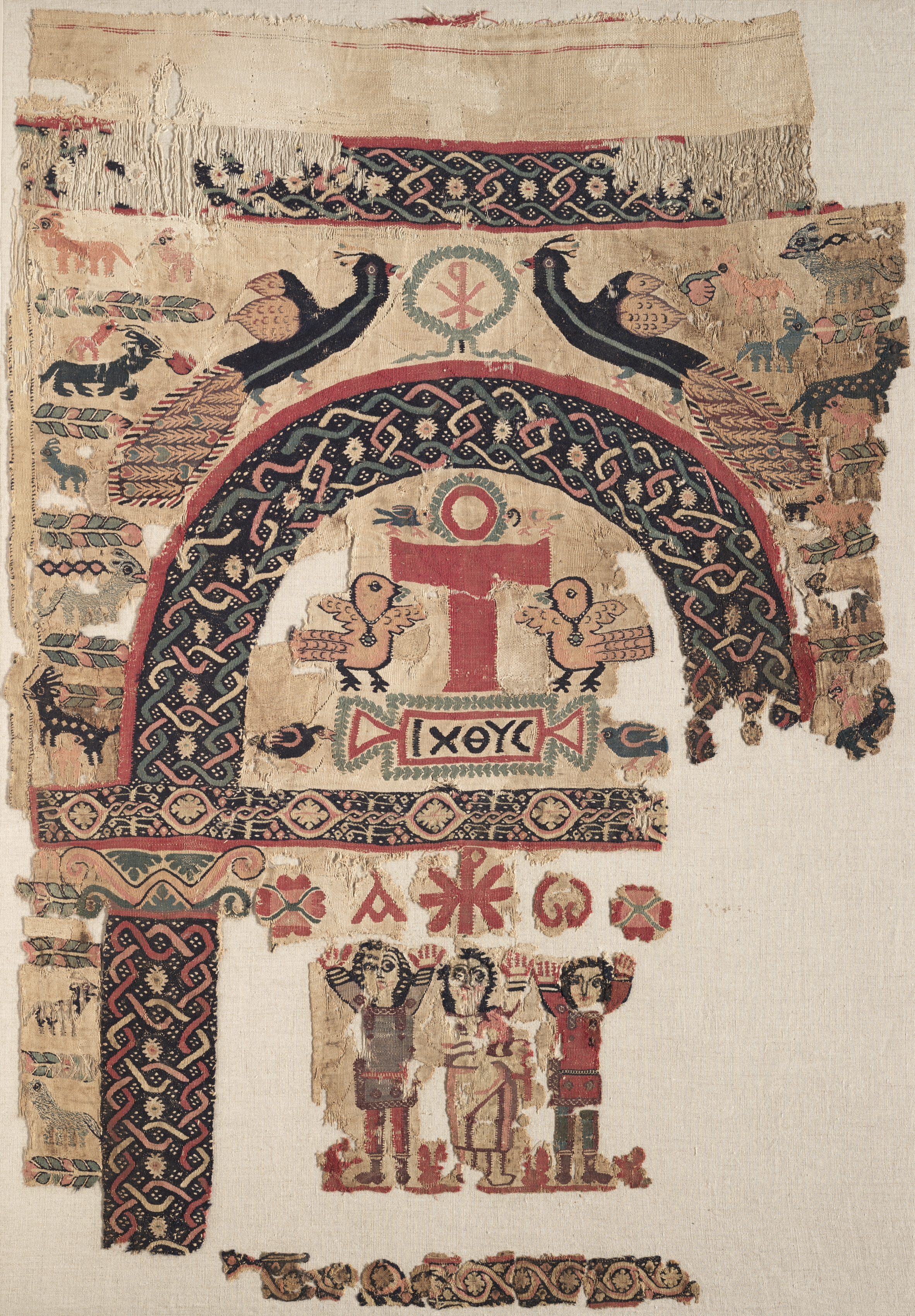
Fabric Deconstruction Analysis: Hanging with Christian Images
Provenance and Historical Context
This textile, originating from Egypt during the Byzantine period (circa 4th–7th century CE), represents a pivotal moment in the cultural and religious transformation of the Mediterranean world. The Hanging with Christian Images is a rare surviving artifact that bridges late antique pagan traditions and the emerging Christian iconography of the Eastern Roman Empire. Egypt, under Byzantine rule, was a melting pot of Coptic, Hellenistic, and Roman influences, and this piece reflects that synthesis. The use of dyed wool and undyed linen, executed in a combination of plain weave (tabby) and inwoven tapestry weave, aligns with the technical sophistication of Coptic textile production. These textiles were often used as funerary shrouds, wall hangings, or liturgical vestments, imbuing them with both spiritual and domestic significance.
The Archive Resonance reference to “器物与绘画” (artifacts and paintings) as witnesses to cultural collision and aesthetic fusion is particularly apt here. This hanging is not merely a decorative object; it is a document of how Christian motifs were adapted within a region steeped in Pharaonic, Greek, and Roman visual languages. The Byzantine period in Egypt saw the gradual shift from polytheistic imagery to Christian symbolism, often reusing older weaving techniques and patterns to convey new theological narratives. For Zoey Fashion Lab, this artifact serves as a foundational text for deconstructing how sacred imagery can be translated into avant-garde fashion, where historical weight meets contemporary disruption.
Technical Analysis: Weave, Material, and Craft
The construction of this hanging is a masterclass in textile engineering. The plain weave (tabby) forms the base structure, providing a stable, grid-like foundation. This is the simplest and most ancient weaving technique, where weft threads pass alternately over and under warp threads. However, the innovation lies in the inwoven tapestry weave, a technique that allows for intricate, color-blocked imagery. In tapestry weaving, discontinuous wefts are used to create distinct areas of color and pattern, effectively “painting” with thread. The undyed linen warp provides a neutral, earthy backdrop, while the dyed wool wefts introduce vibrant hues—likely derived from madder (red), woad (blue), and weld (yellow)—that would have been symbolically charged in the Christian context.
The juxtaposition of materials is deliberate: linen, a fiber associated with purity and simplicity in early Christian thought, contrasts with the luxurious, warm texture of wool. This duality echoes the theological tension between the material and the divine. The tapestry weave enables the depiction of figures, halos, and cross motifs with a precision that mimics mosaic or fresco work, yet retains the pliability of cloth. For an avant-garde fashion context, this technical complexity offers a blueprint for deconstructive layering—where the base fabric (tabby) becomes the “canvas” and the tapestry inserts become “interruptions” of pattern and narrative. Zoey Fashion Lab can reinterpret this as a method for embedding visual stories within garments, using contrasting weaves to create texture and depth that challenge the uniformity of modern fast fashion.
Iconographic and Symbolic Deconstruction
The Christian images on this hanging are not merely decorative; they are encoded with theological and political messages. Common motifs from Byzantine Egyptian textiles include the orans figure (a praying figure with raised arms), the Chi-Rho monogram (☧), and scenes from the life of Christ or saints. These images served as both devotional aids and markers of identity for a Christian community navigating a complex religious landscape. The stylization of figures—often frontal, with large eyes and simplified drapery—reflects the shift from Hellenistic naturalism to Byzantine abstraction, prioritizing spiritual presence over anatomical realism.
From an avant-garde perspective, these images can be fragmented and recontextualized. The hanging’s original function as a boundary between sacred and profane space (e.g., a church or tomb) invites a fashion interpretation that plays with thresholds—between the body and the garment, between the seen and the unseen. The Christian iconography, when removed from its liturgical context, becomes a subversive statement: a critique of institutionalized religion or a reclamation of spiritual symbolism in a secular age. Zoey Fashion Lab could explore this by isolating individual motifs (e.g., a single halo or cross) and reweaving them into unexpected placements, such as the hem of a deconstructed dress or the lining of an asymmetrical jacket. This approach honors the artifact’s origins while embracing the dissonance of contemporary fashion.
Avant-Garde Interpretation for Zoey Fashion Lab
The Hanging with Christian Images is a rich source of inspiration for an avant-garde collection that deconstructs the boundaries between art, history, and wearable design. The following strategies can be derived from this analysis:
1. Weave as Narrative: The combination of tabby and tapestry weave can be replicated using modern looms or hand-weaving techniques. Zoey Fashion Lab can design garments where the base fabric (tabby) represents the mundane, and the tapestry inserts act as “ruptures” of sacred or historical narrative. For example, a minimalist wool coat could feature tapestry panels at the shoulders or cuffs, depicting abstracted Christian symbols in high-contrast colors. This creates a dialogue between the ordinary and the extraordinary, echoing the hanging’s original function as a sacred object in a domestic space.
2. Material Dissonance: The use of undyed linen and dyed wool can be expanded to include modern fibers like recycled polyester or bio-engineered silk, creating a tension between ancient craft and futuristic sustainability. The undyed elements could be left raw and unprocessed, while the dyed sections use natural pigments or even digital printing to mimic the irregularity of ancient dyes. This juxtaposition challenges the viewer to reconsider the value of “authenticity” in fashion.
3. Iconographic Fragmentation: The Christian images should not be replicated literally but rather deconstructed into abstract shapes. A halo might become a circular cutout in a leather bodice; a cross might be reduced to intersecting seams. This process of abstraction allows the garments to operate on multiple levels: as wearable art, as historical commentary, and as avant-garde statements that resist easy interpretation. The goal is to evoke the spiritual resonance of the original without being didactic.
4. Threshold Garments: Inspired by the hanging’s role as a boundary object, Zoey Fashion Lab can design pieces that blur the line between clothing and architecture. For instance, a cape or shawl that incorporates tapestry panels could be worn as a garment or displayed as a hanging. This multifunctionality challenges the consumerist notion of fashion as disposable, instead positioning each piece as an artifact in its own right.
Conclusion: From Archive to Avant-Garde
The Hanging with Christian Images is more than a historical textile; it is a manifesto for how ancient techniques and symbols can be revitalized in a contemporary context. Zoey Fashion Lab, as a leader in deconstructive fashion, can draw from this artifact’s technical mastery, its cultural hybridity, and its spiritual depth to create garments that are both intellectually rigorous and visually arresting. By deconstructing the weave, the imagery, and the materiality of this Byzantine piece, the Lab can produce a collection that resonates with the Archive Resonance concept—where the past is not preserved in amber but is actively reimagined as a catalyst for future innovation. The result will be fashion that is not merely worn but experienced: a fabric deconstruction that speaks to the eternal human desire to clothe the body in meaning.