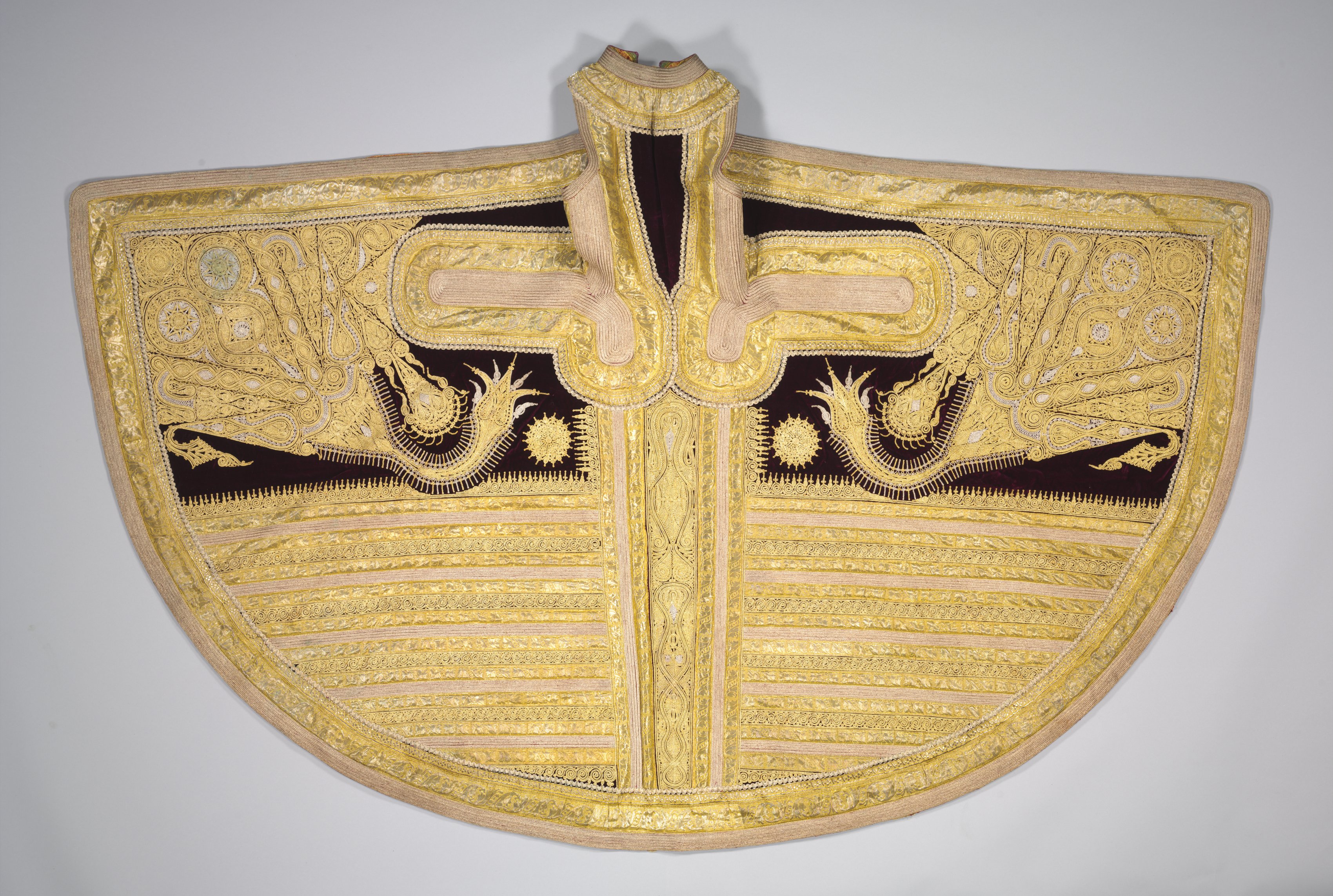
Deconstructing the Archive: The Gold-Thread Garment as Avant-Garde Artifact
As Chief Fabric Deconstructionist for Zoey Fashion Lab, I present a technical and conceptual analysis of a late 19th-century gold-thread embroidered garment from the Balkan region—specifically originating in Prizrend (Serbia) or Scutari (Albani). This object, composed of silk, velvet, and extensive gold- and silver-thread work (bands, cords, and couched embroidery), is not merely a historical costume. It is a resonant archive, a material document that demands to be read through the lens of the avant-garde. The reference to the Mirror with Split-Lea...—a description of a mirrored surface with gold-inlaid palmettes on one side and a stone sarcophagus with narrative relief on the other—provides the perfect conceptual key. This garment embodies a similar duality: it is both a shimmering, reflective surface of status and a heavy, narrative-laden shroud of cultural memory. Our deconstruction will extract the threads of this paradox, proposing a new, avant-garde design language from its very fibers.
I. Technical Deconstruction: The Grammar of Opulence
The garment’s technical vocabulary is one of extreme rigor and material excess. The base is a sumptuous silk velvet, likely a deep crimson, plum, or black—a dark, absorbent ground that serves as the perfect foil for the metallic threads. The embroidery is not a delicate overlay but a structural intervention. The gold and silver threads, in the form of pre-made bands and cords, are applied using the couching technique, where one thread is laid on the surface and stitched down by a finer, often invisible, thread. This creates a raised, sculptural surface that catches light in a controlled, architectural manner.
Key technical observations for our avant-garde reinterpretation:
- Material Hierarchy: The velvet (soft, absorptive, dark) is subordinate to the metal threads (hard, reflective, light). The garment’s narrative is told by the metal, not the fabric. This suggests a design principle where ornament becomes structure.
- Surface Tension: The couched embroidery creates a topographic map of tension. The gold cords are rigid, while the velvet is pliable. The garment exists in a state of perpetual material conflict—softness straining against hardness.
- Weight and Drape: The sheer weight of the metallic embroidery would have dramatically altered the garment’s drape, pulling it downward, creating a stiff, ceremonial silhouette. This is not a garment for movement, but for static, monumental presence.
- Fragility as Feature: The silver threads are tarnished, the gold is slightly abraded. This is not decay; it is the patina of time. The garment’s history is written in its surface wear, a text of ritual use and cultural passage.
II. Conceptual Resonance: The Mirror and the Sarcophagus
The reference to the Mirror with Split-Lea... is our Rosetta Stone. The garment, like the mirror, has two faces. One face is the public, reflective surface: the gold and silver embroidery, which would have dazzled in candlelight, signifying wealth, status, and connection to a powerful lineage. The split-leaf palmette motifs (a common Ottoman and Balkan decorative element) are a language of botanical perfection, of ordered, civilized nature. This is the garment as a status mirror, reflecting the idealized self of the wearer and their community.
The other face is the private, narrative surface: the heavy velvet, the weight of the embroidery, the constrained silhouette. This is the garment as a sarcophagus. It encases the woman’s body in a rigid, ornate shell, telling a story of social expectation, religious identity, and cultural preservation. The embroidery is not just decoration; it is a relief sculpture of life—a chronicle of the wearer’s place within a complex social and historical matrix. This garment holds the body as a sarcophagus holds a soul, preserving it for eternity while simultaneously burying it under the weight of its own narrative.
This duality is the core of the avant-garde potential. We must design a garment that simultaneously reflects and buries, that is both a shimmering surface and a heavy, story-laden object.
III. Avant-Garde Design Language: From Archive to Action
Our deconstruction yields a new design vocabulary for Zoey Fashion Lab. We will not merely replicate the embroidery; we will extract its principles and apply them to a contemporary, avant-garde silhouette.
Principle 1: The Exoskeleton of Narrative
The gold-thread work will be transformed from surface ornament into a structural exoskeleton. Imagine a sheer, translucent silk base (the “velvet” of memory) over which a rigid, laser-cut grid of brass or gold-anodized aluminum is attached. This exoskeleton is not sewn but clipped, riveted, and hinged, allowing for modular assembly. The “embroidery” becomes a wearable architecture—a cage that both displays and constrains the body. The split-leaf motif is abstracted into a repeating, geometric, almost fractal pattern, referencing the original while stripping it of its literal botanical form.
Principle 2: The Patina of Time as Design Element
We will embrace the tarnished silver and abraded gold. The new garment will be constructed using pre-oxidized metals and chemically treated fabrics. The base silk will be dyed with a gradient from deep, absorbent black (the velvet ground) to a faded, archival beige (the aged silk). The metal elements will be deliberately distressed, not to look “vintage,” but to visualize the passage of time as a design feature. This is not nostalgia; it is the materialization of history as a present-tense, active force.
Principle 3: The Duality of Surface and Depth
The garment will have two distinct “faces.” The front will be a highly reflective, polished surface—a mirror of gold and silver—using polished metal panels and mirrored acrylic. The back will be a sarcophagus of narrative: a heavy, sculpted, matte-black polymer backplate, onto which the abstracted split-leaf pattern is laser-engraved as a deep, shadowy relief. The wearer becomes a living artifact, presenting one face of dazzling reflection to the world while carrying the weight of a hidden, inscribed history on their back.
Principle 4: The Static Silhouette, Reimagined
The original garment’s ceremonial stillness will be honored through a rigid, architectural silhouette. The garment will be a sculpted, almost armor-like piece: a high, structured collar, broad, defined shoulders, and a long, columnar skirt that flares slightly at the hem. Movement is not the goal; presence is. The wearer becomes a monument, a walking archive, a living mirror-sarcophagus.
IV. Conclusion: The Garment as Archive Resonance
The gold-thread embroidered garment from Prizrend or Scutari is not a relic of the past. It is a resonant frequency—a vibration of cultural memory, material mastery, and social narrative that continues to echo. By deconstructing it through the lens of the Mirror with Split-Lea..., we have unlocked its avant-garde potential. Zoey Fashion Lab will not recreate this garment. We will re-sonate with it. We will produce a collection that is both a mirror reflecting the dazzling surface of historical opulence and a sarcophagus carrying the heavy, intricate narrative of a woman’s life. This is the future of fashion: not the erasure of the archive, but its radical, material activation. The gold thread is not dead; it is waiting to be couched into a new, more complex story.