Executive Summary: Deconstructing the Tudor Angel
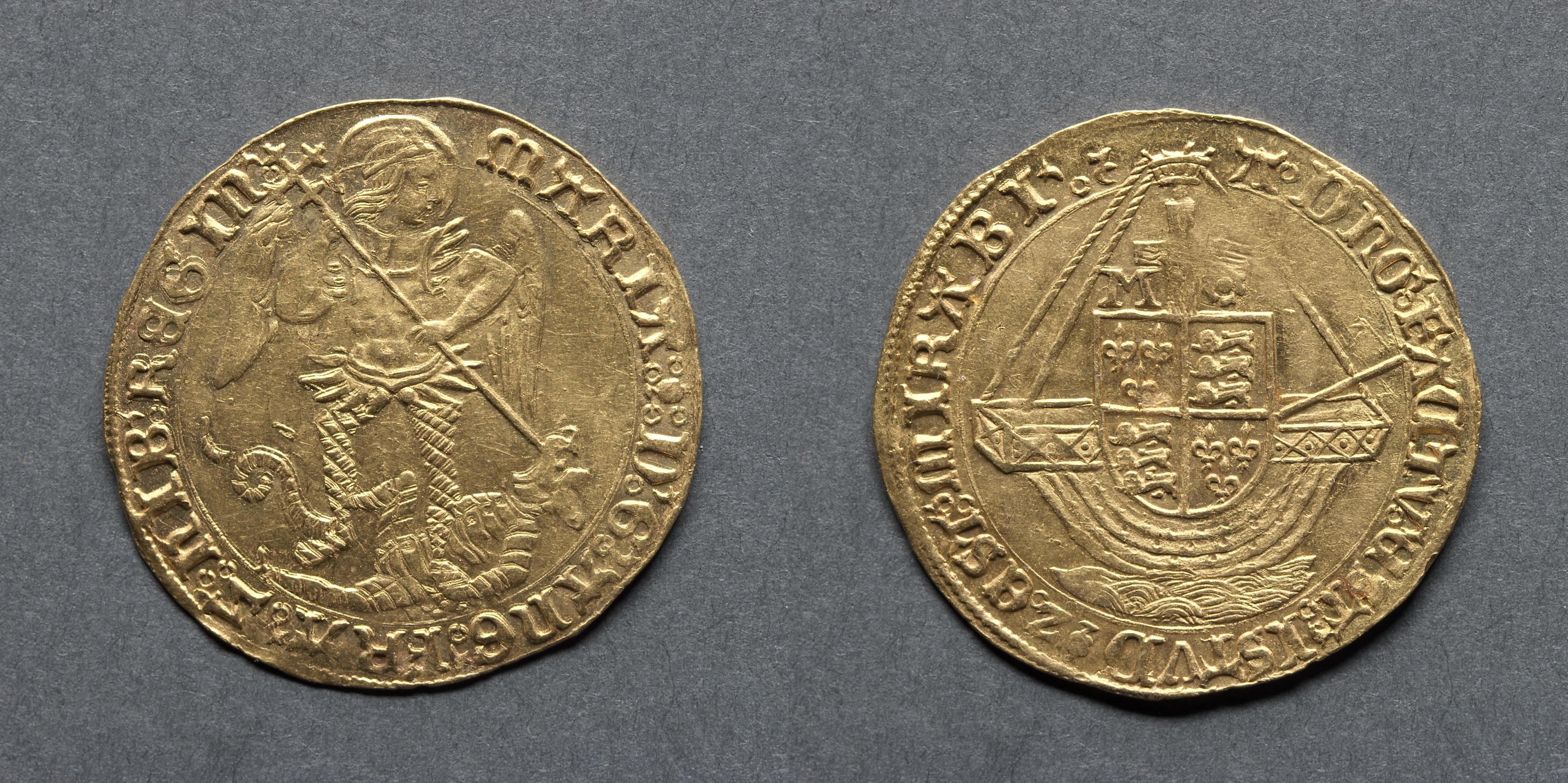
The Mary Tudor gold Angel, minted between 1553 and 1554, presents a paradoxical artifact for the Zoey Fashion Lab’s avant-garde deconstruction. On its obverse, the Archangel Michael slays a dragon—a dynamic, celestial struggle. On its reverse, a ship bearing a shield of arms floats, seemingly static, within a heraldic frame. This coin is not merely currency; it is a compressed narrative of power, faith, and mortality. For the avant-garde designer, the Angel offers a rich lexicon of symbolic tension: the kinetic versus the static, the celestial versus the terrestrial, and the violent versus the protective. Our analysis will dismantle these elements, extracting motifs—the split-leaf, the dragon’s tail, the ship’s hull—and recontextualizing them as structural and decorative components for a radical fashion collection.
Material and Technical Resonance
Gold as a Substrate for Subversion
The technical specification—gold—is not a neutral material. In the context of 1553, gold was the ultimate signifier of divine right, untouchable wealth, and eternal value. For the avant-garde, gold must be weaponized. We propose a deconstructed gold treatment: not polished, but fractured. Imagine a laser-cut gold lamé that appears to be in a state of atomic collapse, where the metal’s surface is etched with micro-fractures resembling the split-leaf patterns from the Archive Resonance’s “Mirror with Split-Leaf” description. The gold is not to be revered; it is to be interrogated. The coin’s high relief—the angel’s wing, the dragon’s scales—becomes a three-dimensional textile. We can achieve this through gold-plated chainmail that is deliberately distressed, with links pulled apart to mimic the dragon’s wounded form. The materiality of the coin is not about preservation but about rupture.
The Split-Leaf Motif as Structural Armature
The Archive Resonance mentions “纷繁棕叶纹” (intricate palm leaf patterns) on a “光洁银镜” (polished silver mirror). This split-leaf motif, when transposed to the coin’s obverse, becomes a key deconstructive element. In the Angel coin, the angel’s wings are often depicted with feathered, leaf-like tips. For our collection, the split-leaf is not decoration but a structural seam. Garments will be constructed from panels that are deliberately separated at the seams, creating negative space that reveals the body or an under-layer. This mimics the coin’s obverse/reverse duality: the front is the narrative of conflict; the back is the narrative of stability. The split-leaf seam represents the moment of violence—the dragon’s tail severing the angel’s spear, or the ship’s mast splitting under a storm. We will use golden leather panels that are laser-cut into fractal leaf shapes, then reassembled with visible, raw-edge stitching in black or blood-red thread. This is not a finished garment; it is a garment in the process of being slain or saved.
Obverse Analysis: The Slaying as a Kinetic Event
Deconstructing the Angel’s Armor
The obverse presents the Archangel Michael, typically armored, with a spear piercing the dragon’s mouth. For the avant-garde, this is a study in asymmetrical power. The angel’s armor is not protective; it is a cage. We will extract the scale pattern of the dragon and apply it to the angel’s silhouette. Imagine a shoulder pauldron made of overlapping gold discs, but each disc is hinged and can be detached, suggesting the angel’s vulnerability. The dragon’s body, coiled and writhing, becomes a spine-like corset that wraps around the torso, with the dragon’s head resting on the wearer’s shoulder, its mouth open as if to speak. The spear, a linear element, is transformed into a structural boning that runs vertically down the back of a coat, visible through a sheer organza panel. The kinetic energy of the slaying is captured in layered fringe—golden threads that move with the wearer, mimicking the dragon’s thrashing tail and the angel’s descending wing.
The Dragon as a Textile of Decay
The dragon is not a monster to be vanquished; it is a textile of decay. Its scales, often depicted as overlapping, hard plates, are reimagined as iridescent sequins that are applied in patches, with missing sections revealing a base fabric of black silk. This creates a visual of the dragon being “unmade” by the angel’s attack. The dragon’s blood, if we can infer it from the violent pose, becomes a red resin that is poured into the seams of a garment, creating a glossy, congealed texture. The split-leaf motif from the mirror is echoed here: the dragon’s wing, if present, is a torn, leaf-shaped cape that is attached at only one point, fluttering behind the wearer like a broken standard. The obverse is not about victory; it is about the aesthetics of struggle—the moment before the final blow, captured in gold and frozen in time.
Reverse Analysis: The Ship as a Symbol of Stasis
The Shield of Arms as a Structural Core
The reverse shows a ship with a shield of arms, often representing the Tudor dynasty. This is the static, heraldic counterpart to the obverse’s chaos. For our collection, the shield becomes a central motif—a rigid, geometric element that anchors the garment. Imagine a breastplate shaped like the shield, but it is not solid metal; it is a golden mesh that is embroidered with the arms of the wearer (or a fictional coat of arms). The ship’s hull becomes a skirt structure—a bell-shaped silhouette that is reinforced with whalebone or 3D-printed lattice, mimicking the wooden planks of the ship. The ship is not sailing; it is stationary, representing the stability of the Tudor state. In fashion, this translates to a structured, architectural garment that contrasts with the obverse’s flowing, kinetic forms. The waves beneath the ship are stylized into golden ruffles that cascade down the skirt, but they are frozen in place with a stiffening agent, suggesting a sea that has turned to glass.
The Split-Leaf as a Unifying Motif
The Archive Resonance’s split-leaf pattern is not limited to the mirror; it can be seen in the decorative borders of the coin. On the reverse, the ship’s mast might be flanked by stylized leaves. We will use this as a unifying thread between the two faces. The split-leaf appears as a cut-out pattern on the sleeves of a jacket, where the fabric is sliced and then reattached with gold grommets, creating a lattice that reveals the skin. This pattern is applied to both the obverse-inspired pieces (the angel’s wing) and the reverse-inspired pieces (the ship’s sail), creating a visual dialogue between the two narratives. The split-leaf is also a metaphor for the coin’s own duality: it is a single object that is split into two faces, just as the garment is split into front and back, or into the wearer’s public and private selves.
Avant-Garde Synthesis: The Archive as a Living Garment
From Coin to Collection
The final collection, titled “Archive Resonance: Angel,” will consist of five key pieces that deconstruct the coin’s elements. First, a golden chainmail dress with a dragon-scale pattern that is torn at the shoulder, revealing a red silk lining (the dragon’s blood). Second, a structured jacket with a shield-shaped back panel, embroidered with the split-leaf motif in black and gold thread. Third, a corset that mimics the ship’s hull, with boning that curves outward like the ship’s bow. Fourth, a cape that is a single, oversized angel wing, made from gold leaf-shaped panels that are attached with chains, allowing them to clatter like armor. Fifth, a skirt that is a deconstructed ship’s sail, made from raw-edged gold silk that is painted with a resin wave pattern. Each piece is designed to be modular—the wearer can attach or detach elements, mirroring the coin’s ability to be flipped between its two faces.
Conclusion: The Coin as a Mirror of Identity
The Mary Tudor Angel is not a relic; it is a mirror that reflects the tension between power and vulnerability, between celestial violence and terrestrial order. For Zoey Fashion Lab, this coin offers a blueprint for an avant-garde collection that is both historical and futuristic. The split-leaf motif, the dragon’s scales, the ship’s hull—these are not just decorative elements; they are structural metaphors for the wearer’s own duality. The gold is not precious; it is a material to be fractured, layered, and reimagined. The angel is not a savior; it is a silhouette of conflict. The ship is not a vessel; it is a cage of heraldry. By deconstructing these elements, we create fashion that is not about adornment but about narrative—a wearable archive of a moment when England’s fate was balanced on the edge of a spear.