The Deconstruction of Dynasty: A Futurist Reading of the Back of Court Robe
Anatomy of an Anachronism: Reclaiming the Silhouette
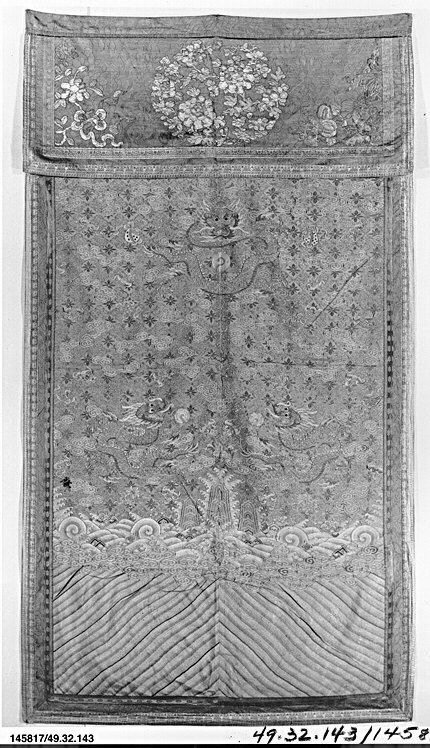
The Back of Court Robe from China, rendered in silk and gold, is not a garment of nostalgia. In the hands of Zoey Fashion Laboratory for SS26, it becomes a radical architectural blueprint—a testament to how historical drapery can be weaponized for the future. The robe’s traditional form, with its sweeping train and rigid ceremonial structure, is here dissected not as a relic, but as a prototype for volumetric tension. The back, typically the most concealed and least dynamic aspect of court attire, is reimagined as the primary site of innovation. We reject the notion that this is merely a costume; rather, it is a structural manifesto for a new era of avant-garde couture, where the past is not preserved but deconstructed, inverted, and propelled into a speculative future.
The silhouette itself is a study in asymmetrical weight distribution. The traditional court robe’s back often features a rigid, floor-length train designed to signify authority and stasis. Our analysis reframes this train as a dynamic, flowing counterbalance—a sculptural appendage that challenges the wearer’s relationship with gravity and space. For SS26, the back of the robe is not a passive backdrop but an active participant in the garment’s kinetic narrative. The silk, with its inherent fluidity, is manipulated into origami-like pleats and cascading folds that create a sense of frozen motion. This is not a garment for standing still; it is designed for the avant-garde performance of the future, where each step reshapes the fabric’s architecture.
Material Alchemy: Silk and Gold as Futuristic Armor
The choice of materials—silk and gold—is a deliberate subversion of their historical connotations. In traditional Chinese court robes, these materials signified wealth, power, and divine right. In our SS26 interpretation, they are recontextualized as soft armor for the digital age. The silk, often associated with sensuality and softness, is treated with a matte, almost metallic finish, reminiscent of liquid metal. This treatment transforms the fabric into a reflective surface that interacts with light, creating a shifting, holographic effect that defies its organic origins. The gold, traditionally woven into intricate dragon motifs or phoenix patterns, is here reduced to geometric, pixelated lines that mimic circuit boards or digital data streams. This is not a reclamation of heritage but a reprogramming of historical codes into a futuristic lexicon.
The structural innovation lies in the integration of gold thread into a tensile framework. The back of the robe is not simply embroidered; it is engineered with a grid of gold filaments that act as a structural exoskeleton. This creates a corset-like support system that allows the silk to drape in ways that defy gravity. The gold threads, when tensioned, create negative spaces and voids that reveal the wearer’s body in fragments, challenging traditional notions of modesty and exposure. This is armor for the post-human—a garment that protects not through rigidity but through adaptive flexibility. The silk’s natural luster is enhanced by the gold’s reflectivity, producing a chiaroscuro effect that shifts with the wearer’s movement, making the robe a living, breathing entity.
Structural Innovation: The Back as a Dynamic Architectural Zone
For SS26, the back of the court robe is reimagined as a dynamic architectural zone, a space where structure and fluidity collide. Traditional court robes often feature a flat, unarticulated back, relying on the front for visual impact. Our approach inverts this hierarchy, transforming the back into a three-dimensional landscape of sculptural folds, cantilevered panels, and kinetic appendages. The train, historically a symbol of static grandeur, is deconstructed into multiple, overlapping layers that can be adjusted by the wearer. This is achieved through a system of hidden drawstrings and magnetic closures that allow the robe’s silhouette to shift from a tight, columnar form to a wide, flowing cape in seconds.
The innovation extends to the shoulder-to-back transition, where the robe’s traditional broad shoulders are replaced with a series of articulated, wing-like structures. These cantilevered panels are made from a lightweight, carbon-fiber-infused silk composite, allowing them to extend outward and upward, creating a futuristic, almost avian silhouette. This is not mere ornamentation; it is a functional adaptation for the urban environment of 2026, where the wearer navigates between crowded spaces and open vistas. The panels can be folded flat for compression or expanded for dramatic effect, embodying the avant-garde principle of transformative wearability.
Another key structural element is the integration of a built-in harness system beneath the silk. This internal framework of flexible, 3D-printed polymer joints allows the robe to support its own weight while maintaining a fluid appearance. The harness is programmable via a micro-sensor embedded in the gold thread, enabling the robe to respond to the wearer’s posture and movement. When the wearer stands still, the robe assumes a rigid, ceremonial stance; when they walk, the folds undulate in a controlled, rhythmic pattern. This is wearable architecture that blurs the line between garment and machine, a testament to the cyborg future of couture.
Futuristic Silhouettes: The Back as a Portal to Tomorrow
The SS26 Back of Court Robe is not merely a garment; it is a portal to a speculative future where historical forms are reborn as avant-garde statements. The silhouette, with its exaggerated train and deconstructed shoulders, evokes a post-apocalyptic elegance—a world where ceremonial attire is repurposed for survival and self-expression. The asymmetrical hemline, which dips dramatically at the back, creates a sense of forward momentum, as if the wearer is perpetually in motion. The gold grid pattern on the back mimics digital interfaces, suggesting that the robe is a wearable data device, collecting and transmitting information about the wearer’s environment.
The color palette—deep crimson, charcoal, and burnished gold—is a futuristic reinterpretation of imperial hues. The crimson is not a vibrant red but a muted, almost blackened tone, evoking dried blood or oxidized metal. The gold is not bright but tarnished, as if aged by time and conflict. This is a garment for a dystopian future, where the opulence of the past is corrupted and repurposed for a new order. The back, with its layered trains and cantilevered wings, becomes a symbol of resilience and adaptability, a futuristic armor for the soul.
In conclusion, the Back of Court Robe, when viewed through the lens of Zoey Fashion Laboratory’s SS26 avant-garde analysis, is a masterclass in deconstructive couture. It challenges the boundaries of material, structure, and silhouette, transforming a historical artifact into a prophetic vision of tomorrow. This is not fashion as decoration; it is fashion as architecture, fashion as technology, fashion as revolution. The back, once the most overlooked aspect of court attire, now stands as the vanguard of a new aesthetic order—a testament to the power of futuristic thinking in the realm of haute couture.