Initial Assessment: The Velvet Fragment as a Deconstructive Catalyst
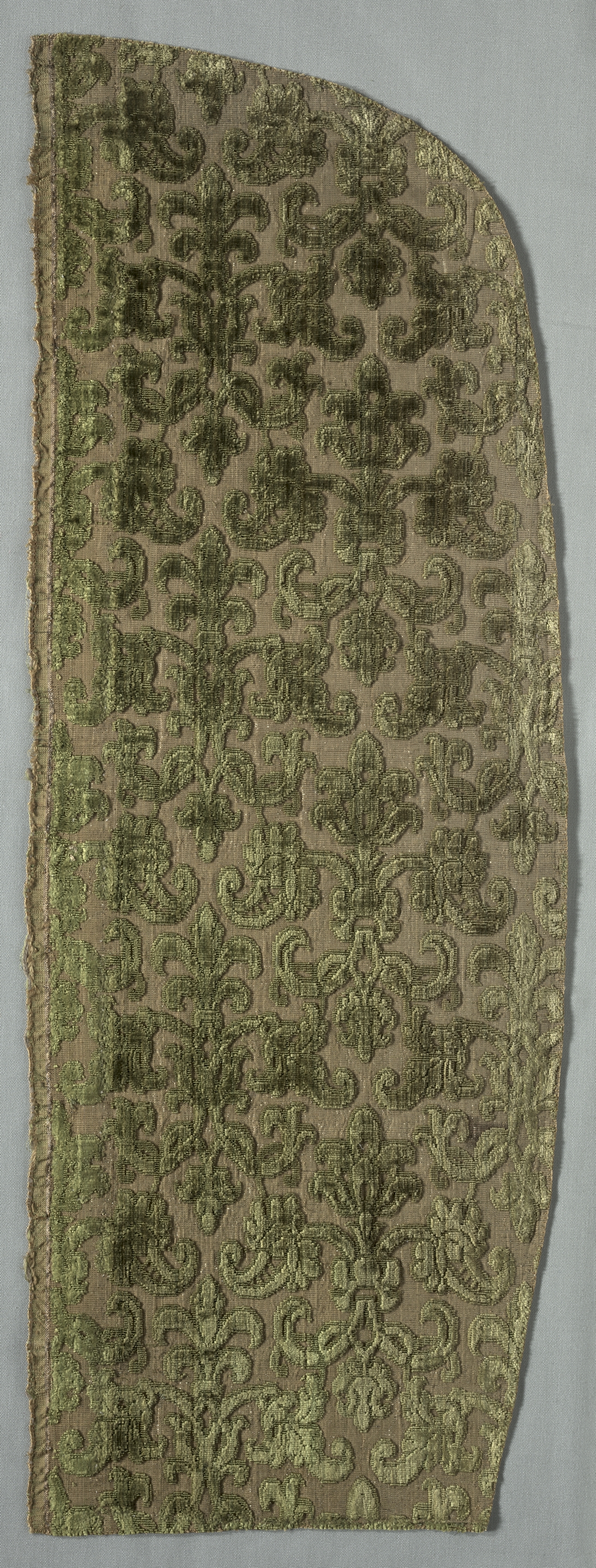
At Zoey Fashion Lab, the Velvet Fragment—a remnant of Italian textile craftsmanship from the early 17th century—presents a unique opportunity for deconstructive analysis. This fragment, identified as a velvet weave originating from Italy circa 1600–1620, is not merely a historical artifact but a New DNA Strand for avant-garde fashion. Its physical properties, cultural context, and technical composition offer a blueprint for reimagining luxury, texture, and form in contemporary design. As Chief Fabric Deconstructionist, I approach this fragment as a living material, one that challenges conventional notions of decay, preservation, and reinvention.
Technical Deconstruction: The Velvet Weave and Its Structural DNA
The fragment’s velvet construction—characterized by a dense pile of silk fibers woven over a foundation of linen or cotton—reveals a sophisticated interplay of light absorption and reflection. In early 17th-century Italy, velvet was a symbol of aristocratic power, often dyed with costly natural pigments like cochineal for crimson or woad for indigo. The fragment’s surviving color palette, though faded, suggests a deep burgundy or aubergine, achieved through multiple dye baths. This technical complexity is the New DNA Strand we extract: the pile height (approximately 2–3 mm), the warp-to-weft ratio (typically 2:1 for luxury velvets), and the subtle irregularities in the weave that indicate handcrafting. These details are not flaws but markers of human intervention—a counterpoint to modern machine-perfect textiles.
Deconstructing the fragment’s structural DNA involves analyzing its tensile strength and fray patterns. The edges, worn and unraveled, reveal the original selvage construction—a double-warp technique that prevented unravelling during the fabric’s lifetime. This technical feature is a design provocation: how can we replicate this structural integrity in a deconstructed, avant-garde garment? The fragment’s pile loss, where the silk loops have been abraded to expose the ground weave, offers a narrative of wear—a chronological map that can be translated into intentional distressing or layered transparency in new designs.
Cultural and Historical Context: The Fragment as a Temporal Marker
Velvet in early 17th-century Italy was more than a fabric; it was a political and religious statement. Produced in cities like Venice, Genoa, and Florence, velvet adorned ecclesiastical vestments, courtly robes, and ceremonial banners. This fragment, likely from a chasuble or a noblewoman’s gown, carries the weight of ritualistic significance. For Zoey Fashion Lab, this historical weight is a resource, not a burden. The fragment’s association with opulence and power can be subverted in an avant-garde context: we can use its visual language to critique contemporary luxury, or we can celebrate its tactile richness as a form of material memory.
The fragment’s provenance—Italy, early 17th century—also places it within the Baroque period, an era defined by dramatic contrasts of light and shadow, excess, and emotional intensity. This aesthetic aligns perfectly with avant-garde fashion’s love for the theatrical and the grotesque. The fragment’s surviving pile, though worn, still holds a deep, almost liquid sheen when light hits it at an angle. This optical effect is a design directive: we can amplify it through modern finishing techniques, such as laser-cut pile manipulation or metallic thread integration, to create garments that seem to breathe and shift with the wearer’s movement.
Deconstructive Methodology: Extracting the New DNA Strand
In the lab, we treat the Velvet Fragment as a genetic blueprint. The process begins with microscopic analysis of the fiber composition. The silk fibers, though degraded, retain a natural protein structure that can be re-sequenced—not literally, but conceptually. We map the fragment’s textural gradients: areas of high pile density versus worn patches, the transition from intact weave to frayed edge, the subtle sheen variations caused by centuries of handling. These gradients become the New DNA Strand—a set of design parameters that inform everything from fabric choice to silhouette.
For example, the fragment’s frayed edges suggest a deconstructed hemline in a final garment. We can reproduce this by using a cut-and-sew technique that mimics the fragment’s natural disintegration, or by integrating raw-edge velvet panels into a structured base. The fragment’s pile loss, which creates a mottled effect, can be replicated through chemical etching or burnout printing, where a pattern is dissolved to reveal a secondary layer. This technique, when applied to a modern velvet, produces a ghost-like pattern that echoes the fragment’s historical wear.
Another key extraction is the fragment’s weight and drape. Early 17th-century velvet is heavier than modern equivalents due to the denser silk pile and the use of a linen ground. This weight gives the fabric a sculptural quality—it holds folds and creates architectural shapes. For an avant-garde collection, we can engineer a new velvet that balances this historical weight with contemporary comfort, perhaps by blending silk with lightweight synthetic fibers or by using a 3D-knitted structure that mimics the pile density without the bulk.
Avant-Garde Application: From Fragment to Garment
The Velvet Fragment’s New DNA Strand is not meant to be replicated exactly but reinterpreted. In an avant-garde context, the fragment’s decay becomes a design feature: we can create garments that appear to be in a state of becoming or unbecoming. For instance, a coat might have a fully intact velvet front, while the back is reduced to a skeletal framework of warp threads, exposing the wearer’s skin. This deconstructive asymmetry challenges the viewer’s perception of luxury and completeness.
The fragment’s color, though faded, can be reanimated through digital dyeing or photo-reactive pigments that shift under different lighting. Imagine a gown that appears dark burgundy in dim light but reveals a vibrant crimson under direct sunlight—a nod to the fragment’s original vibrancy. The fragment’s tactile memory can also be translated into textural contrasts: pairing the smooth, worn areas of the velvet with sharp, metallic accents or transparent organza panels. This juxtaposition creates a dialogue between past and future, decay and precision.
Finally, the fragment’s ritualistic origins inspire a performative dimension in the final design. Garments can be designed with integrated fastenings that echo the fragment’s original use as a liturgical vestment—perhaps hidden hooks and eyes that require a ritualistic undoing. Or, the garment’s silhouette can reference the Baroque silhouette: exaggerated shoulders, cinched waists, and flowing trains, but rendered in deconstructed, fragmented panels that reveal the underlying structure.
Conclusion: The Fragment as a Living Archive
The Velvet Fragment from early 17th-century Italy is not a relic to be preserved in a glass case. For Zoey Fashion Lab, it is a living archive—a source of New DNA Strands that can be extracted, mutated, and woven into avant-garde fashion. Its technical intricacies, historical weight, and aesthetic decay offer a deconstructive methodology that respects the past while violently reshaping it for the future. The fragment’s pile may be worn, its colors faded, but its genetic code is intact: a blueprint for garments that are both luxurious and subversive, timeless and transient. As we move forward, we will continue to deconstruct this fragment, not to destroy it, but to liberate its potential—a process that mirrors the very nature of fashion itself: a constant cycle of creation, decay, and rebirth.