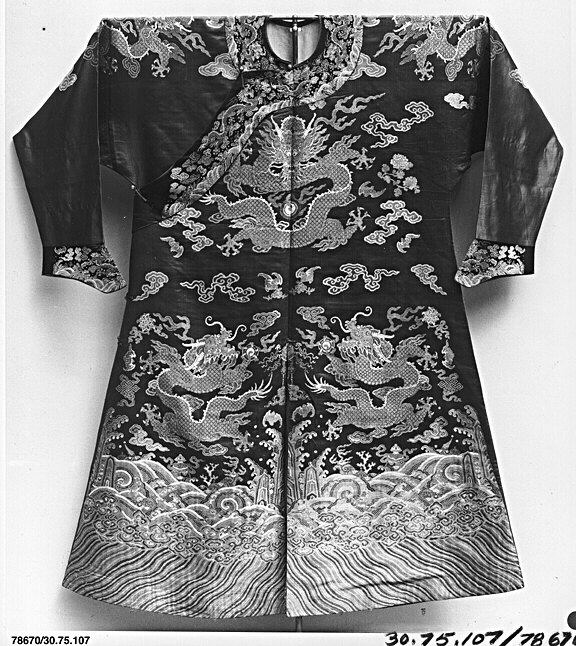
Deconstructing the Imperial Silhouette: A Futuristic Court Robe Analysis for SS26
The intersection of historical gravitas and avant-garde futurism presents a unique challenge for the contemporary couturier. Zoey Fashion Laboratory’s SS26 study of the Chinese Court Robe—a garment steeped in dynastic symbolism, rigid hierarchy, and sumptuous materiality—demands a radical departure from preservationist approaches. This analysis dissects the robe’s foundational elements—its silk and metallic thread construction, its voluminous form, and its cultural resonance—and reimagines them through a lens of structural innovation and futuristic silhouette. The objective is not to replicate history but to deconstruct its power dynamics and reconstruct them as a wearable manifesto for the next epoch of fashion.
Material as Memory: The Alchemy of Silk and Metallic Thread
The original court robe’s materiality is its most potent narrative device. Silk, a fiber synonymous with imperial luxury, and metallic thread, a symbol of celestial authority and earthly wealth, are traditionally employed to create a static, almost architectural surface. For SS26, Zoey Fashion Laboratory transforms these materials into agents of kinetic memory. The silk is not simply draped; it is deconstructed into tensile, non-woven webs that mimic digital pixelation. This is achieved through laser-cut reticulation, where the silk is perforated in algorithmic patterns, allowing light to pass through and creating a second skin of shadow. The metallic thread, instead of being woven into static dragon or phoenix motifs, is embroidered as a conductive, biomorphic nervous system across the garment’s surface. This thread is not decorative; it is structural, acting as a flexible exoskeleton that can contract or expand based on the wearer’s movement, suggesting a garment that is alive and responsive. The traditional symbolism of the robe is thus preserved in material memory but liberated from its static, hierarchical constraints.
Silhouette as System: The Collapse and Rebirth of Volume
The historical court robe is defined by its rigid, voluminous silhouette—a conical or A-line form that dictates posture and presence. For SS26, Zoey Fashion Laboratory proposes a futuristic silhouette based on modular inflation and collapse. The robe’s traditional volume is not discarded but atomized. Using a technique of sealed, air-pressurized seams, the garment can be worn in two distinct states: a fully inflated, almost spherical “imperial” mode, where the silk billows into a protective, opaque dome, and a deflated, skeletal mode, where the metallic thread exoskeleton becomes the primary structure, leaving the silk as a delicate, trailing veil. This binary system allows the wearer to toggle between presence and absence, dominance and vulnerability. The silhouette is no longer a fixed signifier of power but a dynamic interface between the body and its environment. The hemline, traditionally straight and sweeping, is reimagined as a series of asymmetrical, laser-welded pleats that create a fragmented, digital echo of the original train.
Structural Innovation: The Robe as Architectural Prosthesis
At the core of this analysis is the redefinition of structure. The court robe’s traditional construction relies on internal boning and heavy linings to maintain its shape. Zoey Fashion Laboratory replaces these with a lightweight, carbon-fiber lattice frame that is both flexible and rigid. This frame is not hidden; it is exposed and celebrated as an integral part of the design. The lattice follows the meridian lines of the historical robe’s embroidery, creating a three-dimensional map of the garment’s original symbolism. The silk panels are then attached to this frame using magnetic closures, allowing for rapid reconfiguration of the garment’s drape. The metallic thread is woven into the lattice itself, creating a conductive circuit that powers embedded micro-LEDs. These LEDs are programmed to pulse in patterns that mimic the flow of qi (life force) as depicted in classical Chinese cosmology, transforming the robe into a living, luminous entity. The collar, traditionally a high, stiff mandarin style, is reimagined as a biomorphic, 3D-printed extension of the cervical spine, using a resin infused with silk fibers. This collar can be articulated via a small motor, allowing it to rise and fall like a crest, echoing the mythical creatures that once adorned the original garment.
Deconstructive Aesthetics: The Art of Controlled Chaos
The avant-garde imperative demands a rupture with the past, yet the court robe’s cultural weight cannot be ignored. Zoey Fashion Laboratory achieves this through a deconstructive aesthetic that prioritizes process over finish. The metallic thread embroidery is intentionally left raw-edged on the interior, with loose threads trailing like digital tentacles. The silk is distressed using a micro-abrasion technique that creates a patina of wear, suggesting the garment has traveled through time. The carbon-fiber lattice is left in its industrial, unpolished state, contrasting sharply with the silk’s luxury. This is not a negation of the robe’s beauty but a recontextualization of its value. The traditional motifs—dragons, clouds, waves—are not erased but fragmented and reassembled into abstract, geometric compositions. A dragon’s claw becomes a sharp, angular shoulder pad; a wave pattern becomes a series of undulating, laser-cut scales that move with the body. The result is a garment that honors its origins while declaring its independence, a provocation to the wearer to embody both history and future.
Contextual Futurism: The SS26 Manifesto
In the context of SS26, this court robe is not a costume but a prototype for a new wearable architecture. It challenges the fashion industry to move beyond nostalgia and toward a dialogue with technology and material science. The robe’s ability to shift between inflation and deflation, its integration of conductive threads and LED systems, and its modular construction all point toward a future where clothing is not passive but interactive. The garment becomes a second skin that mediates the wearer’s relationship with power, identity, and the digital realm. The historical court robe was a tool of imperial control; this futuristic iteration is a tool of personal agency. It asks the wearer: What does power look like when it is no longer fixed but fluid? When volume is not a statement of authority but a choice? Zoey Fashion Laboratory’s SS26 analysis answers these questions with a garment that is at once a deconstruction of the past and a blueprint for the future. It is a manifesto for a new avant-garde, one that uses the most ancient of materials to construct the most radical of silhouettes, proving that true innovation lies not in forgetting history but in reimagining its possibilities.