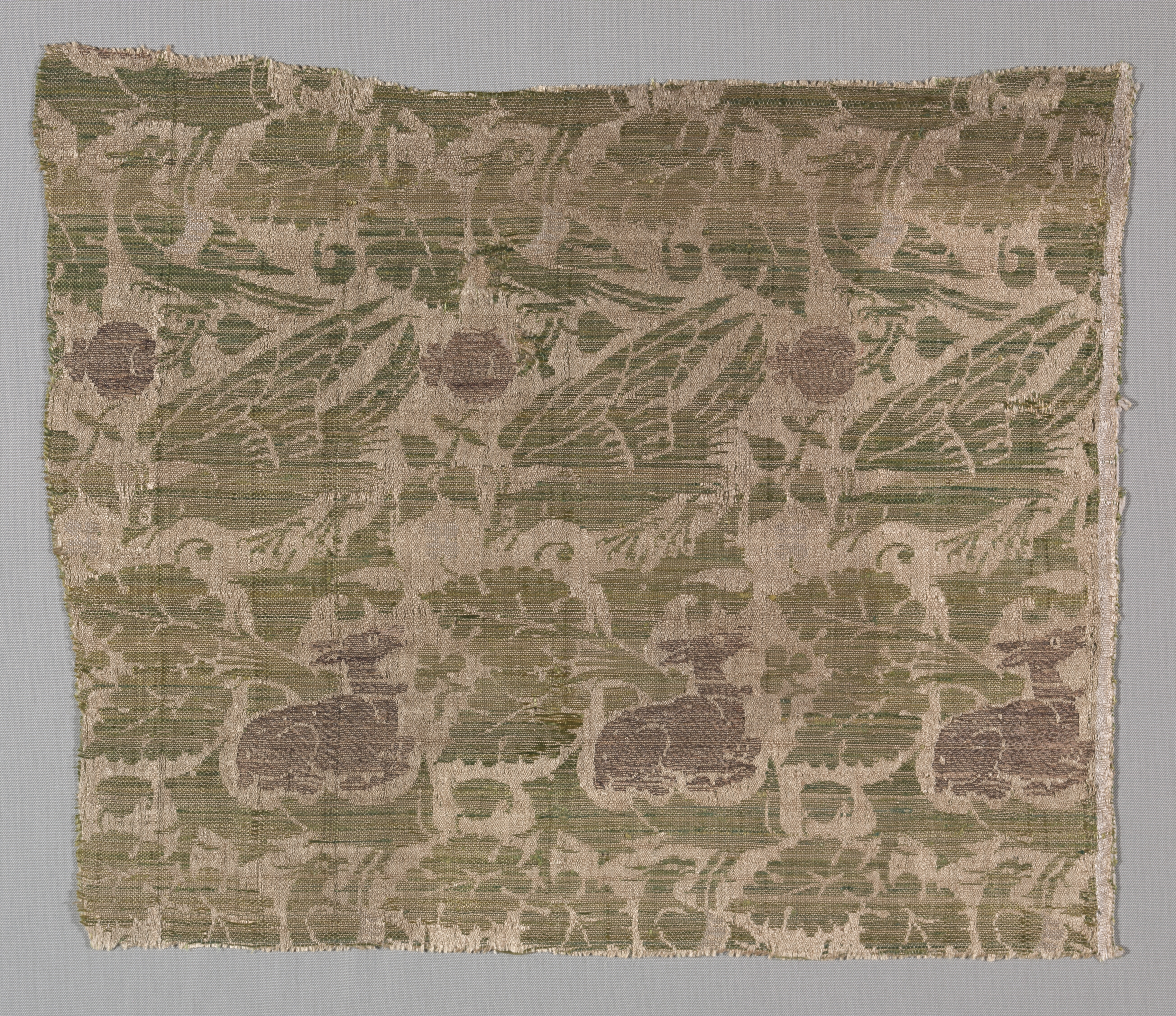
Deconstructing the Opulent Past: A Technical and Aesthetic Analysis of a 15th-Century Italian Silk and Gold Lampas
At Zoey Fashion Lab, we operate at the intersection of historical reverence and radical innovation. Our role as Chief Fabric Deconstructionist is to dissect not only the physical threads of antique textiles but also the cultural and aesthetic DNA they carry. Today, we turn our focus to a masterpiece of Italian craftsmanship: a 15th-century silk and gold textile woven in the complex lampas technique. This artifact is more than a relic; it is a resonant archive of power, trade, and aesthetic ambition. Our analysis will strip it down to its technical core and then reconstruct its potential within an avant-garde context, guided by the poetic principle of Archive Resonance—the belief that objects and paintings from the 16th to 17th centuries are silent witnesses to cultural collision and aesthetic fusion, which we can amplify for contemporary expression.
Technical Deconstruction: The Lampas Weave and Material Alchemy
The foundation of this textile’s opulence lies in its weave structure. The lampas technique, a sophisticated method perfected in the Italian Renaissance, involves a compound weave with two distinct warp and weft systems. The ground weave, typically a durable silk tabby or twill, provides the structural integrity. The pattern weave, often a supplementary weft of silk or, in this case, precious metal thread, floats across the surface to create the design. This is not a simple brocade; lampas allows for intricate, multi-colored patterns to be woven simultaneously with the ground, resulting in a fabric that is both structurally sound and visually sumptuous.
The materials themselves are a testament to the era’s global trade networks. The silk—likely a high-twist, reeled filament from mulberry silkworms—was imported from the East, specifically China via the Silk Road, or later cultivated in Italy’s own burgeoning silk industries in Lucca, Florence, and Venice. Its smooth, lustrous surface reflects light with a liquid quality, a property that gold thread dramatically amplifies. The gold thread is not solid metal but a composite: a thin strip of gilded silver or gold leaf wound around a silk or linen core. This technique, known as filé, allowed for flexibility while maintaining the illusion of solid gold. The interplay between the matte, velvety silk and the glittering, rigid metal creates a dynamic textural contrast that is both tactile and visual.
From a structural perspective, the lampas weave presents a dual challenge: the gold thread, being inelastic and brittle, requires careful tension control to avoid breakage, while the silk must be woven with precision to prevent distortion. The result is a fabric that is both heavy and delicate, a paradox that mirrors the social status of its original owners—aristocrats and clergy who used such textiles for vestments, altar cloths, and ceremonial garments. The pattern, often featuring pomegranates, acanthus leaves, or heraldic animals, is a narrative of power and piety, woven into the very warp and weft of the fabric.
Archive Resonance: The Silent Witness of Cultural Collision
To understand this textile fully, we must embrace the concept of Archive Resonance. As the reference states, “在人类文明的长河中,器物与绘画不仅是时代技艺的结晶,更是文化碰撞与美学交融的无声见证。” (In the long river of human civilization, objects and paintings are not only the crystallization of the era's techniques, but also the silent witnesses of cultural collision and aesthetic fusion.) This 15th-century Italian silk and gold lampas is a perfect example. Its silk came from the East, its gold from the New World or Africa, its weaving technique from the Islamic world (via Spain and Sicily), and its iconography from classical antiquity and Christian symbolism. It is a silent document of the Mediterranean as a crucible of exchange, where trade, conquest, and diplomacy wove together disparate traditions.
The 16th to 17th centuries, as referenced, were a period of intensified global contact. This textile, though made in the 15th century, belongs to that continuum. It speaks of the aesthetic fusion between the intricate, geometric patterns of Islamic art and the naturalistic, volumetric forms of the Italian Renaissance. The gold thread, once a symbol of divine light in Byzantine icons, becomes here a marker of secular wealth and princely power. The fabric is not merely decorative; it is a political statement, a materialization of the patron’s ability to command resources from across the known world.
Avant-Garde Reconstruction: Deconstructing Opulence for Contemporary Expression
At Zoey Fashion Lab, we do not preserve these textiles in glass cases. We deconstruct them to liberate their latent energy. The avant-garde approach demands that we sever the historical context and re-contextualize the material’s essence for a new narrative. Here is how we would proceed:
1. Material Re-engineering: The gold thread, once a symbol of static wealth, can be transformed into a fluid, kinetic element. By chemically stripping the gilding from the core, we can create a fragile, shimmering skeleton. Alternatively, we might weave the gold thread into a transparent, laser-cut polymer matrix, allowing it to float freely, breaking the rigid pattern of the lampas. The silk, too, can be deconstructed. Using enzymatic treatments, we can selectively dissolve the sericin (the gum that binds silk fibers), creating areas of extreme softness and transparency, contrasting with the original density.
2. Pattern Disruption: The heraldic and botanical motifs of the original can be digitally scanned and then algorithmically distorted. A pomegranate, once a symbol of fertility and resurrection, can be fragmented into a pixelated, glitch-like pattern, referencing the digital age’s own form of cultural collision. We might overlay the pattern with a second, invisible UV-reactive ink that only reveals itself under blacklight, creating a hidden layer of meaning—a secret history within the fabric.
3. Structural Subversion: The lampas weave’s inherent duality—ground and pattern—can be exploited. We can weave a garment where the ground is left raw, unfinished, and the pattern is cut away, leaving only the gold thread skeleton. This creates a garment that is both armor and lace, a metaphor for the fragility of power. Alternatively, we can reverse the weave, making the gold thread the ground and the silk the pattern, inverting the hierarchy of materials.
4. Performance and Wearability: The final avant-garde piece is not a static garment but a performative object. Imagine a coat made from this deconstructed lampas, but with the gold thread woven into a conductive circuit. When the wearer moves, the gold threads connect and disconnect, triggering small LED lights embedded in the silk. The garment becomes a living archive, illuminating the hidden pathways of trade and power that the original textile once represented. The wearer, in turn, becomes a living witness to the cultural collision, embodying the resonance of the past in the present.
Conclusion: The Avant-Garde as a Form of Historical Dialogue
This 15th-century Italian silk and gold lampas is not a dead object. It is a reservoir of techniques, materials, and meanings that are waiting to be reactivated. Through the lens of Archive Resonance, we see it as a silent witness to the cultural collisions and aesthetic fusions that shaped the modern world. Our avant-garde deconstruction does not destroy this history; it amplifies it. By re-engineering the materials, disrupting the patterns, and subverting the structure, we create a dialogue between the past and the present. The result is a garment that is both a critique of historical opulence and a celebration of its material genius—a truly radical reimagining for Zoey Fashion Lab.