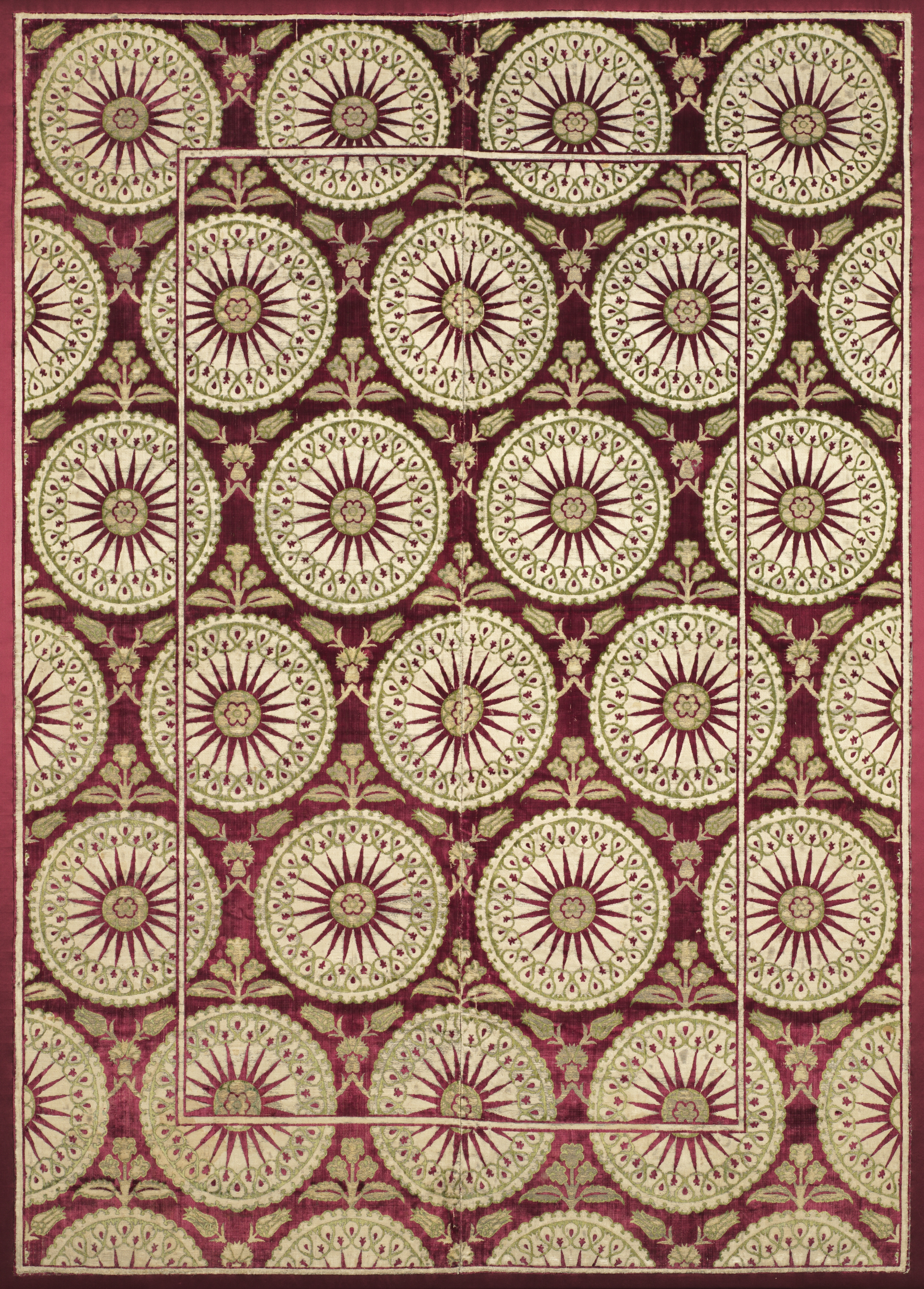
Deconstruction Analysis: Brocaded Velvet Cover with Sunbursts (Turkey, 16th–17th Century)
As Chief Fabric Deconstructionist for Zoey Fashion Lab, I present this analysis of a rare Ottoman brocaded velvet cover, likely originating from Istanbul or Bursa, dating to the 16th or 17th century. This artifact—a textile of silk, gilt- and silver-metal thread, and cotton—embodies a moment of profound cultural synthesis. Its technical complexity and symbolic vocabulary offer a rich lexicon for avant-garde fashion design, where historical resonance is deconstructed into radical, contemporary forms. The reference to Archive Resonance—the notion that objects and paintings bear silent witness to cultural collision and aesthetic evolution—guides this investigation.
Technical Deconstruction: Materiality and Structure
The foundation of this textile is a voided velvet, where silk pile is selectively cut to create a pattern against a ground of silk or cotton. The brocading technique introduces supplementary wefts of gilt- and silver-metal thread, wrapped around a silk or cotton core. This is not mere decoration; it is a structural dialogue. The metal threads, applied in discontinuous sections, create raised, reflective surfaces that catch light with movement, while the cotton—often used in the warp or as a stabilizing element—adds a matte, grounding counterpoint. From an avant-garde perspective, this interplay of luster and opacity, of rigid metallic filament and soft, pliable silk, is a blueprint for fabric engineering. The metal threads, prone to tarnishing and fracture, introduce an element of controlled decay, a temporal quality that resonates with the concept of wabi-sabi or the beauty of impermanence. For Zoey Fashion Lab, this suggests a design strategy where luxury is not pristine but layered with history, where gilt threads might be intentionally distressed or woven into deconstructed silhouettes that expose the underlying structure—a garment that reveals its own making.
Symbolic Lexicon: The Sunburst Motif
The sunburst—a central radiating form—is a potent symbol across cultures. In the Ottoman context, it evokes celestial power, imperial authority, and the divine light of the sultan. Yet, its geometric precision also echoes the mathematical harmonies of Islamic art, where infinite repetition suggests the transcendent. For an avant-garde fashion narrative, this motif is a generative device. The sunburst can be extracted from its traditional symmetry and fragmented: a single ray becomes a shoulder pad, a radial arc becomes a sweeping train, or the entire pattern is distorted through digital manipulation to create a glitch-like, pixelated effect. The gilt thread, when woven into these forms, creates a light-responsive surface—a garment that changes appearance under different lighting conditions, from intimate candlelight to harsh studio strobes. This aligns with contemporary interests in interactive textiles and optical illusion, where the wearer becomes a moving canvas for light and shadow.
Cultural Cross-Currents: Istanbul, Bursa, and the Silk Road
The provenance—Istanbul or Bursa—places this textile at the nexus of trade and conquest. Bursa was a major silk production center, while Istanbul was the imperial court. The use of gilt- and silver-metal thread reflects influences from Safavid Persia and even Ming China, filtered through Ottoman taste. The cotton, a more humble fiber, anchors the piece in practical luxury—perhaps a ceremonial cover or a diplomatic gift. For Zoey Fashion Lab, this hybridity is a design manifesto. The avant-garde designer does not merely appropriate; they recontextualize. Consider a collection where the opulence of Ottoman brocade is paired with utilitarian streetwear fabrics: denim, nylon, or neoprene. The sunburst could be embroidered onto a hoodie using conductive thread, creating a garment that lights up with LED elements—a digital echo of the original's metallic shimmer. The cotton base of the historical piece suggests a grounding principle: even the most extravagant design must have a foundation of practicality, a nod to the everyday wearer.
Deconstructive Strategies for Avant-Garde Application
Four key strategies emerge from this analysis for Zoey Fashion Lab:
1. Structural Reversal: The historical velvet uses a cut pile for the pattern and a ground for the void. An avant-garde approach might reverse this: the sunburst is cut away entirely, leaving a skeletal lattice of metal threads and cotton. This creates a garment that is simultaneously armor and absence, a critique of opulence through transparency.
2. Material Subversion: Replace the silk pile with recycled polyester velvet, and the gilt thread with recycled copper wire. This retains the visual language while introducing a sustainable, industrial edge. The tarnishing of copper becomes a feature, not a flaw, echoing the original's aged patina.
3. Pattern Disruption: Digitally scan the sunburst motif and subject it to algorithmic distortion. The radial symmetry can be warped into a fractal or a pointillist array, then woven using a jacquard loom. The result is a ghost of the original, a memory of order within chaos.
4. Kinetic Integration: The metal threads historically were static. In a contemporary context, they can become conductive pathways for micro-sensors or shape-memory alloys. A sunburst on the back of a jacket could expand and contract in response to the wearer's heartbeat or ambient temperature, transforming the garment into a living organism.
Conclusion: The Archive as Catalyst
This Ottoman brocaded velvet cover is not a relic to be replicated but a catalyst for innovation. Its technical mastery—the marriage of silk, metal, and cotton—is a lesson in material dialogue. Its sunburst motif is a visual anchor for narratives of power, light, and transcendence. For Zoey Fashion Lab, the deconstructive process is one of critical reverence: we honor the artifact by breaking it open, extracting its DNA, and splicing it with contemporary concerns—sustainability, technology, and the body's relationship to history. The result is fashion that is not merely worn but inhabited, a wearable archive that resonates with the silent voices of the past while speaking fluently in the language of the avant-garde.