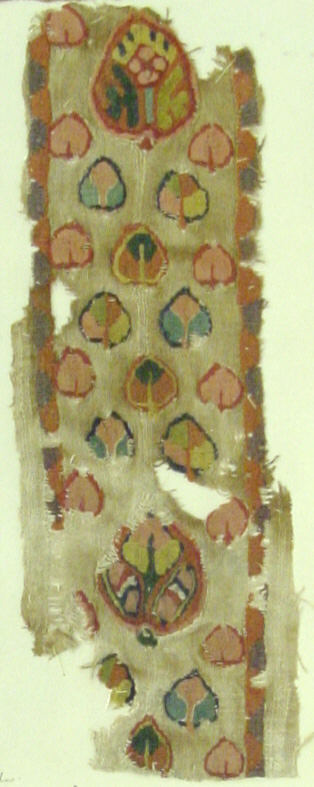
Deconstructing the Loom: The Coptic Textile Fragment as a Blueprint for SS26 Avant-Garde Architecture
In the sterile, hyper-illuminated halls of Zoey Fashion Laboratory, the past is not a relic to be preserved under glass, but a volatile catalyst for future form. Our latest subject of study—a Coptic textile fragment, a humble yet profound intersection of linen and wool, dating from the 4th to 7th centuries—has been subjected to a rigorous deconstructive analysis. This is not an exercise in historical nostalgia. It is a radical reinterpretation of the fragment’s structural DNA, its tensile logic, and its chromatic entropy, to inform the core architectural principles of our SS26 collection: “Fractured Continuum.”
The fragment, measuring a mere 20 by 15 centimeters, presents a paradox. Its warp and weft, executed in undyed linen and deep indigo wool, are not merely decorative. They are a system of load-bearing tension and organic release. The linen, a bast fiber, provides a rigid, almost skeletal framework—a grid of structural integrity. The wool, a protein fiber, introduces a pliable, volumetric softness, creating a topography of relief and recession through its twill and tapestry weaves. This binary opposition—rigidity versus fluidity, structure versus drape—is the foundational paradox we will weaponize for SS26.
I. The Tension Grid: Reimagining the Warp as Exoskeletal Armature
The Coptic weaver’s most sophisticated innovation was the manipulation of the warp. In our fragment, the linen warp threads are not uniformly spaced; they are grouped, creating zones of high tension and deliberate slack. This is not a flaw; it is a deliberate structural intervention. For SS26, we translate this into a futuristic exoskeleton that operates as a second skin. Imagine a silhouette where the garment’s primary structure is not a sewn panel, but a network of laser-cut, bio-plasticized linen strips—a warp reimagined as a three-dimensional, articulated cage.
This exoskeleton will be worn over a second layer of ultra-fine, micro-encapsulated merino wool. The wool, treated with a phase-change material, will respond to body heat, expanding and contracting to create dynamic, living volumes. The silhouette is not static; it is a kinetic architecture that breathes, shifts, and reconfigures itself as the wearer moves. The Coptic fragment’s zones of slack become negative space, allowing the wool layer to billow and collapse, creating a silhouette that is simultaneously armored and vulnerable. The shoulders, hips, and spine are the primary anchor points, echoing the fragment’s structural nodes where warp and weft intersect most densely.
II. The Weft as Volumetric Seduction: Deconstructing Drapery into Digital Topography
While the warp provides the frame, the wool weft in the Coptic fragment is the agent of texture and mass. It is not woven flat; it is manipulated into loops, floats, and cut pile, creating a micro-architecture of shadow and light. For SS26, we deconstruct this into a new form of digital drapery. Using 3D-knitting technology, we will replicate the fragment’s irregular pile, but at a macro scale. The result is a garment that appears to be woven from a single, continuous strand of wool, yet its surface is a topographical map of peaks and valleys.
This technique yields a silhouette that defies traditional tailoring. A jacket, for instance, will not have seamed sleeves. Instead, the garment will be knitted as a single, continuous form, with the sleeves emerging organically from the body, much like the wool loops emerge from the linen ground. The silhouette is amorphous yet precise, a study in controlled chaos. The Coptic fragment’s indigo dye, a fugitive color that has faded to a spectral blue-gray, inspires a new palette of chromatic erosion. We will apply this as a gradient, from deep, saturated indigo at the garment’s structural core to a ghostly, bleached white at its periphery, mimicking the fragment’s own history of light and time.
III. The Fragment as a System of Discontinuity: Negative Space and the Unfinished Edge
Perhaps the most radical lesson from the Coptic fragment is its incompleteness. The edges are raw, the weave is broken, and the pattern is interrupted. This is not a flaw; it is a statement of process. For the avant-garde, the unfinished edge is a declaration of potential. In SS26, we will embrace this as a design principle of discontinuity. Garments will be deliberately left “unfinished,” with raw, frayed edges that are not hemmed but stabilized using a transparent, heat-bonded polymer. This creates a silhouette that appears to be in a state of perpetual creation, a snapshot of a process that continues beyond the garment’s physical boundaries.
This leads to a new silhouette typology: the negative-space garment. Where the Coptic fragment has missing threads, we will have missing panels. A dress, for example, might have a full, structured bodice but a skirt that is a network of floating, unconnected ribbons of wool and linen, suspended from the waist by the exoskeletal warp. The body is not covered; it is framed, revealed through absence. The silhouette becomes a dialogue between presence and void, a futuristic echo of the fragment’s own fragmented history. The wearer is not a passive mannequin but an active participant, completing the silhouette through their own movement and form.
IV. Material Alchemy: The Linen-Wool Hybrid as a Living Membrane
The Coptic fragment’s genius lies in its material synergy. Linen and wool are not merely combined; they are integrated at a molecular level through the weaving process. For SS26, we will develop a hybrid textile that is not woven but grown. Using bio-fabrication techniques, we will cultivate a composite material where linen fibers are embedded in a mycelium matrix, and wool keratin is introduced as a secondary structural element. This creates a living membrane that is self-repairing, breathable, and responsive to humidity.
The silhouette derived from this material is biomorphic and organic. It eschews sharp, geometric lines in favor of flowing, cellular forms. A coat, for instance, might have a collar that grows into a hood, its shape determined by the moisture gradient of the wearer’s breath. The garment is not designed; it is cultivated, echoing the Coptic weaver’s own intimate relationship with their materials. The final silhouette for SS26 is a synthesis of the fragment’s structural intelligence and our technological audacity: a garment that is simultaneously ancient and futuristic, rigid and fluid, finished and forever incomplete. It is a textile fragment, not of the past, but of a future we are weaving now.