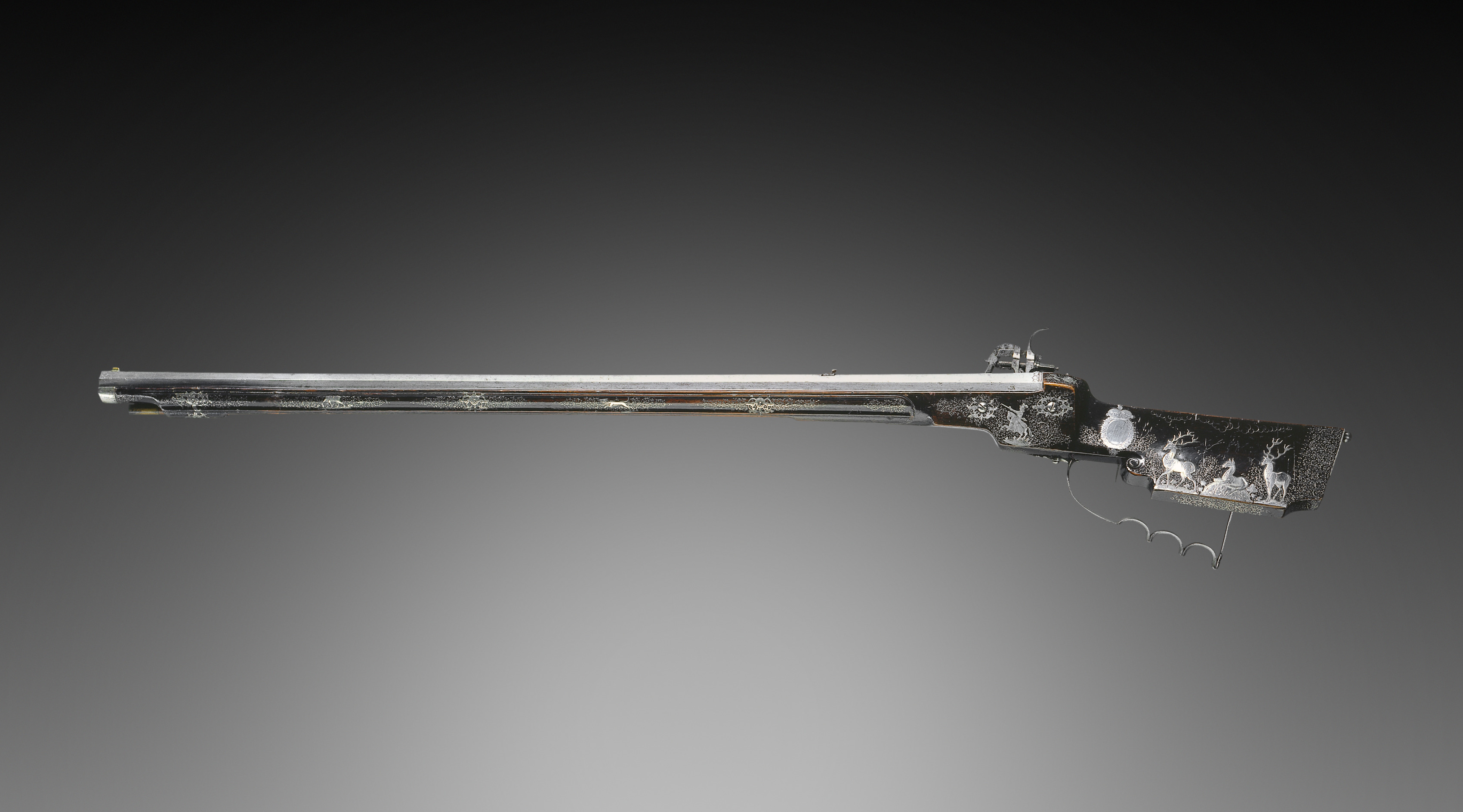
Deconstruction of the Ferlach Wheel-Lock: An Avant-Garde DNA Strand for Zoey Fashion Lab
As Chief Fabric Deconstructionist at Zoey Fashion Lab, my role is to extract the latent visual and structural DNA from historical artifacts and translate them into avant-garde textile and garment architectures. The subject of this analysis—a mid-17th century Austrian Wheel-Lock Hunting Rifle from Ferlach—presents a uniquely complex and provocative source code. Crafted from steel, varnished walnut, and embellished with silver wire inlays and appliqués, this object is not merely a weapon; it is a symphony of tension, precision, and organic decay. For Zoey Fashion Lab, this rifle becomes a new DNA strand, one that fuses the mechanical with the organic, the brutal with the ornate, to generate a collection that challenges the very definition of wearable structure.
I. The Steel Core: Forging Structural Armatures and Kinetic Silhouettes
The rifle’s steel components—the barrel, the lock plate, the wheel mechanism—are the foundation of its identity. In deconstruction, steel represents unyielding structure and controlled energy. For Zoey Fashion Lab, this translates into a study of exoskeletal garments. The barrel’s linear, polished surface suggests a rigid spine, which we can reinterpret as a central structural seam running from nape to hem. But the true avant-garde insight lies in the wheel-lock mechanism itself. This complex assembly of rotating wheel, spring, and sear is a masterpiece of kinetic tension. It is not a static object; it is a device waiting to be released.
In our textile laboratory, we will translate this into kinetic armatures. Imagine a jacket where the shoulder seam is not sewn but held together by a series of interlocking, spring-loaded steel pins, mimicking the wheel-lock’s sear. A slight twist of the wearer’s torso would release or engage these pins, allowing the garment to transform from a fitted silhouette to a voluminous, armored cape. The steel’s cold, reflective quality will be abstracted into liquid metal finishes on bonded leather or high-density nylon, creating surfaces that appear to flow yet remain rigid. The barrel’s octagonal cross-section inspires faceted, geometric paneling on sleeves and torsos, producing a sharp, architectural profile that contrasts with the softness of the body beneath.
II. The Walnut Stock: Organic Carapace and the Patina of Time
The varnished walnut stock is the rifle’s organic anchor. Its deep, lustrous brown and the subtle grain of the wood evoke a living carapace—a protective shell that has aged and absorbed the hand of its user. For Zoey Fashion Lab, this is not about literal wood veneer, but about textural translation. We will deconstruct the stock’s ergonomic curve, which fits the hunter’s cheek and shoulder, into a series of molded, padded panels. These panels, crafted from bio-resin-infused organic cotton or compressed cork, will mimic the wood’s grain and warmth while remaining lightweight and flexible.
The varnish, which has yellowed and cracked over centuries, becomes a study in controlled decay. We will develop a technique called “patina weaving,” where multiple layers of sheer silk organza are heat-set and distressed to create a cracked, ambered surface. This fabric will be used for overlays on sleeves and collars, suggesting the passage of time and the rifle’s history. The walnut’s natural contours also inspire a new approach to ergonomic tailoring. Where the stock swells to meet the hand, we will create integrated grip zones using micro-suede or silicone-impregnated jersey, allowing the garment to become an extension of the body’s natural movements—a second skin that is both protective and responsive.
III. Silver Wire and Appliqués: The Lace of Precision and the Ornamentation of Power
The silver wire inlays and appliqués on the stock are the rifle’s most overtly decorative elements. They are not random; they follow the wood’s grain and the rifle’s functional lines, creating a functional ornamentation that is both beautiful and indicative of the owner’s status. In deconstruction, these silver threads become a new embroidery language. We will not use traditional silver thread. Instead, we will develop conductive metal filaments woven into a base of black or deep charcoal crepe. These filaments will be programmed to change temperature or emit a soft, pulsing light when the wearer’s heart rate increases, echoing the latent energy of the wheel-lock mechanism.
The appliqués—often depicting hunting scenes or stylized foliage—are translated into 3D-printed metal lace and laser-cut leather filigree. These elements will be applied asymmetrically, following the garment’s structural seams rather than the body’s natural lines. For example, a silver wire scroll pattern from the rifle’s cheekpiece becomes a cascading metal lace collar that extends from the left shoulder, trailing down the arm and terminating in a sharp, claw-like cuff. This is not decoration for its own sake; it is a narrative of power and precision, a visual reminder that the wearer is both hunter and hunted, controller and controlled.
IV. The Avant-Garde Synthesis: A New DNA Strand in Motion
The true avant-garde expression of this Ferlach rifle lies in the synthesis of its three core materials—steel, walnut, silver—into a unified, kinetic garment system. This is not a collection of separate elements but a single, living organism. The steel’s rigidity is softened by the walnut’s organic warmth, which is then elevated by the silver’s delicate precision. For Zoey Fashion Lab, this synthesis manifests as a modular exoskeleton that can be worn as a full ensemble or disassembled into individual pieces.
Consider a primary piece: the “Ferlach Carapace Coat.” Its structure is a steel-inspired, faceted shell constructed from thermoformed carbon fiber and bonded with a walnut-toned, distressed resin. The coat’s interior is lined with a silver-wire-embroidered, conductive fabric that responds to pressure—a touch on the sleeve would cause the collar to rise, echoing the cocking of the rifle’s wheel. The coat’s hem is asymmetrical, mimicking the rifle’s buttstock, and is weighted with small, polished steel beads that create a subtle, percussive sound with each step—a rhythmic reminder of the mechanism’s potential energy.
A secondary piece, the “Lock Plate Bodice,” isolates the wheel-lock mechanism. It features a central, rotating steel disc (a functional brooch or clasp) that can be turned to release or secure the garment’s front closure. The bodice’s surface is a patchwork of walnut-stained leather and silver-wire appliqué, with the pattern following the lock plate’s intricate gears and springs. This piece is designed to be worn over bare skin, with the metal disc resting against the sternum—a literal heart of steel.
Finally, the “Hunting Ground Skirt” translates the rifle’s silver wire inlays into a cascading, asymmetrical skirt of layered, laser-cut suede and metal mesh. The silver wire patterns are recreated as openwork cutouts, revealing glimpses of a conductive underlayer that glows softly in low light. The skirt’s hem is uneven, mimicking the natural, organic line of the walnut stock, and is weighted with small silver beads that clink against each other—a soundscape of the hunt.
Conclusion: The Rifle as a Blueprint for Wearable Tension
The mid-17th century Ferlach Wheel-Lock Hunting Rifle is far more than a historical artifact. It is a blueprint for wearable tension—a study in how rigid structure, organic form, and precise ornamentation can coexist in a single, functional object. For Zoey Fashion Lab, this deconstruction yields a new DNA strand: one that prioritizes kinetic potential, tactile transformation, and narrative depth over mere aesthetics. The resulting garments are not costumes; they are living machines, designed to be activated by the wearer’s movement, breath, and intention. In the avant-garde spirit, we do not simply reference the past—we reanimate it, forging a future where fashion is a form of controlled, elegant power.