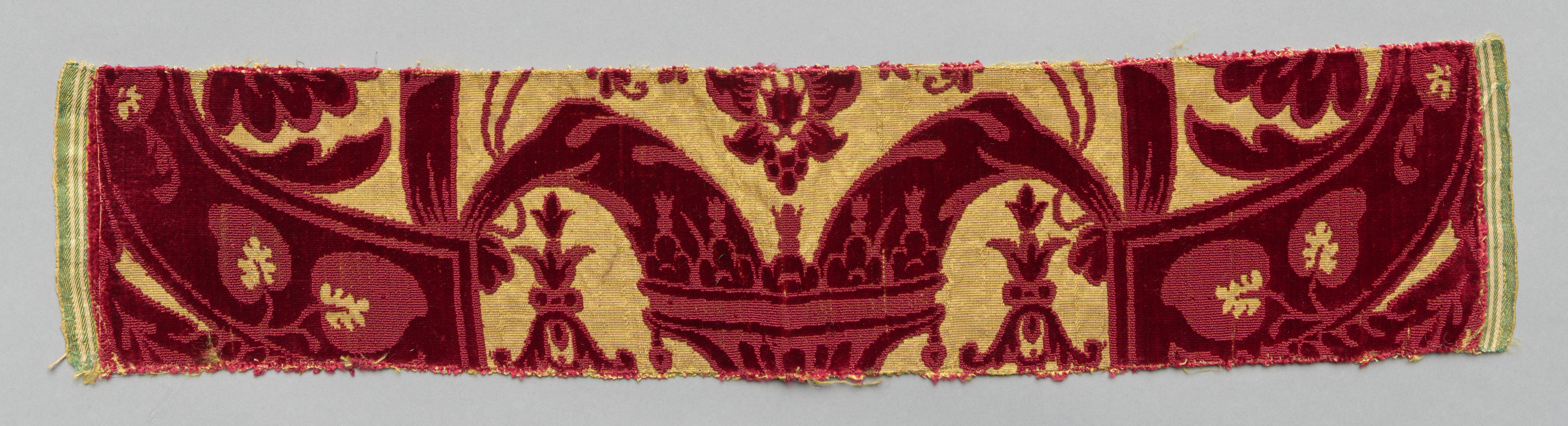
Deconstructing the Velvet Fragment: A Genoese Origin Reimagined
At Zoey Fashion Lab, the act of deconstruction is not an end but a genesis. When we receive a fragment, we do not merely see a piece of fabric; we see a coded message from the past, a strand of textile DNA that holds the potential for radical transformation. This analysis focuses on a specific velvet fragment, originating from the historic textile mills of Genoa, Italy. Our reference point is not historical reproduction but the creation of a New DNA Strand—a genetic blueprint for an avant-garde future. We are not restoring; we are mutating.
I. The Genoese Blueprint: A Legacy of Opulence and Structure
The fragment from Genoa represents a pinnacle of Renaissance textile engineering. Genoa, alongside Venice and Florence, was a powerhouse of velvet production, particularly the prized velluto a cesello (cut and uncut velvet) and velluto soprarizzo (pile-on-pile velvet). Our fragment exhibits the hallmarks of this tradition: a dense, tightly woven ground weave (typically silk or a silk-linen blend) supporting a deep, luxurious pile. The color, a deep, oxidized burgundy—almost black in shadow—speaks of a long history of natural dyeing with madder and iron mordants.
Structurally, the fragment is a study in tension. The foundation is rigid, almost architectural, while the pile is soft, yielding, and absorbent of light. This dichotomy is the first clue for our avant-garde reinterpretation. In Genoese velvet, the pile is the protagonist, a statement of wealth and tactility. For Zoey Fashion Lab, we see this as a binary code: the hard and the soft, the static and the dynamic. We are not interested in the velvet’s historical status symbol; we are interested in its structural DNA—the weave density, the pile height, the thread count. These are the variables we will manipulate.
II. The New DNA Strand: Mutating the Velvet Code
The concept of a “New DNA Strand” is central to our methodology. We treat the velvet fragment not as a finished product but as a genetic sequence that can be edited, spliced, and recombined. Our process involves three key mutations:
1. Pile Deconstruction and Reorientation: The traditional velvet pile is uniform and directional. Our intervention involves selectively cutting, shearing, and even burning the pile in non-linear patterns. We will use laser etching to create gradient zones of pile height, from full, plush velvet to a nearly bare ground weave. This creates a topographical surface, a fabric landscape that reacts to light and touch in unpredictable ways. The velvet is no longer a uniform field; it becomes a series of micro-environments.
2. Substrate Subversion: The Genoese ground weave is historically silk or linen. For our new strand, we will introduce structural hybrids. We will weave the velvet on a base of recycled metallic threads (copper, stainless steel) or even carbon fiber. This transforms the velvet from a purely soft, draped material into a semi-rigid, armored textile. The pile remains soft, but the foundation is now conductive, weight-bearing, and capable of holding its own shape. This is a direct challenge to the velvet’s historical identity as a fabric of drape and flow.
3. Chromatic Disruption: The deep burgundy of the original is a color of stability and tradition. Our new strand will introduce chromatic mutation through chemical and physical processes. We will apply localized oxidation, using iron salts to create rust-like stains that break the uniformity of the dye. We will also experiment with thermochromic dyes—pigments that change color with body heat. The velvet will become a living surface, shifting from deep crimson to a pale, ghostly pink in response to the wearer’s temperature. This is not decoration; it is a dynamic biological response embedded in the textile’s DNA.
III. Avant-Garde Application: The Fragment as a Living System
How does this mutated velvet manifest in an avant-garde garment? We envision a piece that is part sculpture, part prosthesis. The garment will not be draped but constructed—a series of rigid, geometric panels that articulate around the body. Each panel will be a fragment of the original Genoese velvet, but after our intervention, it will be a self-contained ecosystem.
Surface as Interface: The laser-etched pile zones will be mapped to the body’s pressure points. Areas of high movement (shoulders, elbows) will have the pile removed, exposing the metallic ground weave. This creates a visual and tactile contrast: the soft, historical velvet against the cold, industrial metal. The garment will record its own use through wear patterns, much like a patina forms on bronze.
Structural Memory: The carbon fiber or metallic ground weave allows the velvet to hold a shape without internal boning. The garment can be folded, crushed, and then returned to its original form. This gives the velvet a memory function—a property entirely alien to its original, pliable nature. The wearer can manipulate the silhouette in real-time, bending the panels to create new volumes.
Biological Feedback: The thermochromic dye will be applied in a pattern derived from the original fragment’s weave structure—a genetic echo. As the wearer’s body heat fluctuates, the velvet will “blush” in specific zones, revealing hidden patterns that are invisible at rest. This creates a garment that is not static but responsive, a living organism that communicates the wearer’s physiological state.
IV. Conclusion: From Fragment to Future
The Genoese velvet fragment is not a relic to be preserved; it is a starting point for a new lineage. By deconstructing its technical DNA—its pile, substrate, and color—we have engineered a mutation that retains the tactile luxury of the original while introducing properties of rigidity, conductivity, and biological responsiveness. This is not a costume or a tribute; it is a new species of textile.
For Zoey Fashion Lab, the velvet fragment becomes a prototype for the future of fashion. It demonstrates that avant-garde design is not about rejecting history but about reprogramming it. The velvet is no longer a symbol of Genoese opulence; it is a substrate for a new language of wearability—one that is architectural, interactive, and alive. This is the New DNA Strand, and it is woven from the threads of the past, but it is designed for a world that has not yet been imagined.