Deconstructing the Tabatière: An Avant-Garde Analysis of the Louis XV Snuff Box
The snuff box, or tabatière, from 18th-century France, specifically in the style of Louis XV, represents a pinnacle of Rococo craftsmanship and aristocratic indulgence. At Zoey Fashion Lab, we approach this object not merely as a historical artifact, but as a text of material culture—a repository of hidden tensions, contradictions, and proto-modernist sensibilities. When we apply the lens of our Archive Resonance reference—the poetic dichotomy of a “mirror with split-leaves” and a “stone sarcophagus”—the gold and enamel tabatière emerges as a profound avant-garde statement. It is a portable theater of life and death, surface and depth, ornament and void.
I. The Gold and Enamel Surface: The Mirror of Rococo Excess
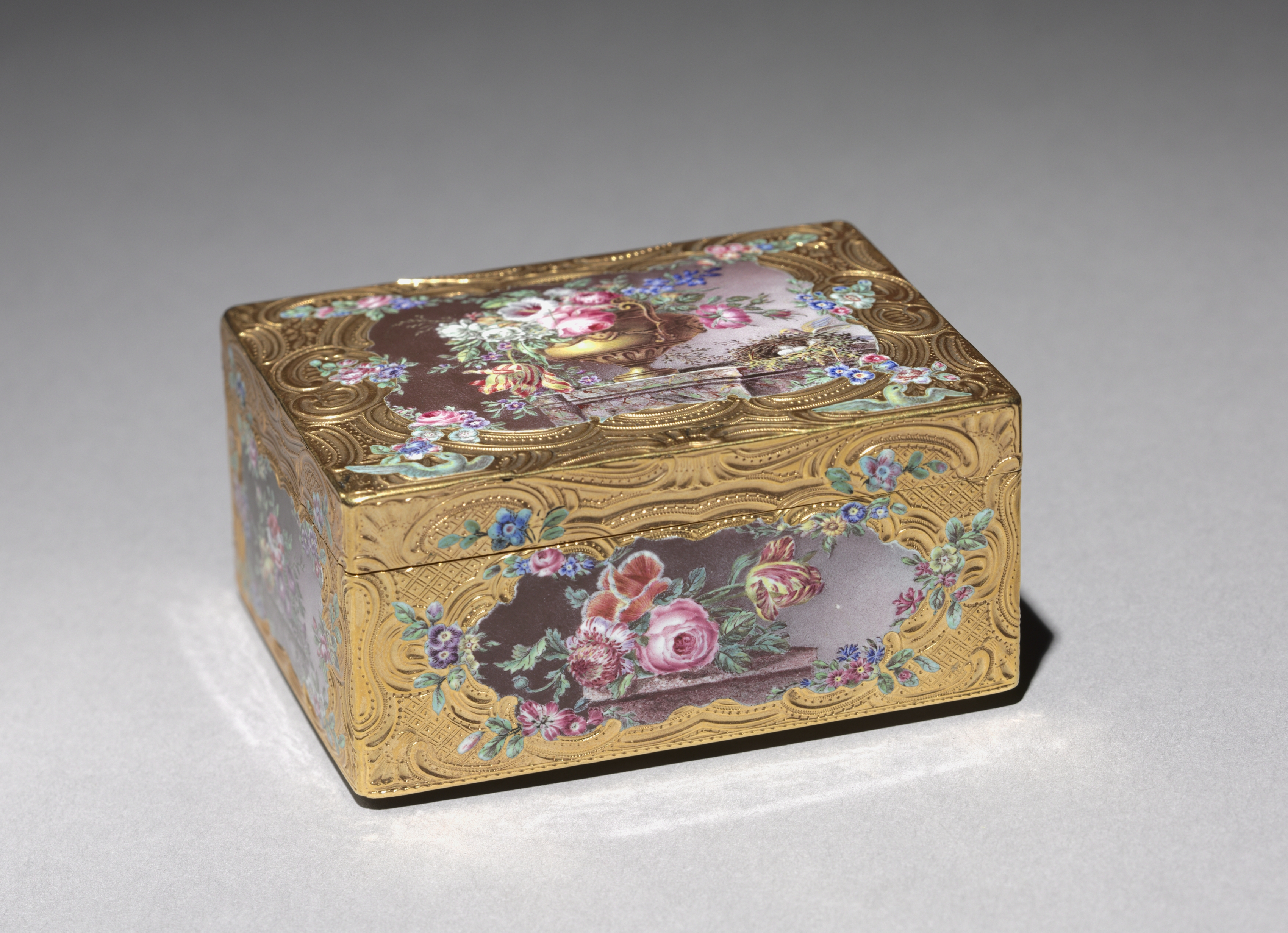
The technical execution of this snuff box—hammered gold, painted enamel, and intricate chasing—immediately signals its status as a luxury object. In the Louis XV period, the tabatière was a social instrument, a token of wit, and a marker of elite identity. Yet, from an avant-garde perspective, we must interrogate this surface. The gold, polished to a high sheen, functions as a mirror. It reflects the hand of the user, the glittering chandeliers of the salon, the powdered faces of the aristocracy. This is the “mirror with split-leaves” from our reference: a surface that is simultaneously reflective and fragmented.
The “split-leaves” are the Rococo motifs themselves—asymmetrical rocaille shells, scrolling acanthus, and delicate floral sprays. These are not organic forms; they are stylized, fractured, and recombined. The goldsmith’s chisel has violently split the natural leaf, transforming it into a decorative pattern that denies any simple representation of nature. This is a deconstruction of the botanical. The snuff box, in its technical perfection, becomes a field of rupture. The enamel, often painted with pastoral scenes or mythological vignettes, adds another layer of illusion. It is a miniature painting, a frozen moment, yet it sits atop a functional object meant to be opened, handled, sniffed, and closed. The act of opening the box is a gesture of revelation—the mirror surface gives way to the interior void.
II. The Interior Void: The Stone Sarcophagus
The second half of our Archive Resonance reference—“the stone sarcophagus with relief narrating life’s narrative”—finds its echo in the snuff box’s interior and its ultimate function. The box is a container for a substance: powdered tobacco, a stimulant, a fleeting pleasure. But the box is also a coffin for the ephemeral. The act of taking snuff is a ritual of inhalation and expiration, a microcosm of life’s breath. The gold exterior, so brilliant, so reflective, is a mask. Inside, the box is often left unadorned, a dark, cold chamber. This is the stone sarcophagus—the memento mori hidden within the Rococo frivolity.
The “relief narrating life’s narrative” is not only the exterior ornament but the very form of the box. The hinged lid, the curved edges, the clasp—these are architectural elements of a miniature tomb. The Louis XV style, with its emphasis on the décor intérieur, the intimate interior space, paradoxically creates a portable crypt. The snuff box is a device for containing death (the dried, powdered plant) while celebrating life (the social ritual). The avant-garde reading forces us to see the box as a dialectical object: its beauty is contingent on its function as a container for decay. The gold is the gilded lid of a sarcophagus; the enamel is the painted narrative of a life that has already passed.
III. The Archive Resonance: Mirror and Sarcophagus United
Our reference text, “Mirror with Split-Leaves,” is a poetic fragment that captures the essence of this dichotomy. The mirror is the surface, the split-leaves are the deconstructed ornament, and the stone sarcophagus is the interior truth. In the snuff box, these two states are not separate; they are coexistent and interdependent. The mirror cannot exist without the sarcophagus; the ornament is meaningless without the void it adorns. This is the core of the avant-garde aesthetic: the refusal to resolve contradiction. The tabatière is not a unified object; it is a site of tension between the social and the existential, the decorative and the funereal.
For Zoey Fashion Lab, this analysis informs our design philosophy. We see the snuff box as a prototype for the wearable object. It is a miniature architecture that rests in the palm, a second skin that mediates between the body and the world. The gold and enamel are not just materials; they are signifiers of a coded language. The split-leaves are a calligraphic script of excess, a Baroque horror vacui that anticipates the modernist obsession with pattern and repetition. The stone sarcophagus is the silent counterpoint, the black box of the unconscious.
IV. Technical Deconstruction: Gold as Text, Enamel as Time
From a technical standpoint, the gold of this snuff box is not a monolithic substance. It is an alloy, a combination of metals that has been beaten, chased, and polished. The goldsmith’s work is a process of subtraction—removing material to create relief, carving away to reveal form. This is a negative space technique. The enamel, conversely, is a process of addition—fusing glass to metal through heat. It is a fossilization of color, a permanent record of a moment. Together, gold and enamel create a textile of time. The gold is the warp, the structural thread; the enamel is the weft, the chromatic narrative.
The avant-garde interpretation demands we see this technicality as a performance of labor. The snuff box is a compressed history of craft, a miniature monument to human skill. Yet it is also a commodity of the elite, a fetish object that obscures the social relations of its production. The split-leaves, so delicate, so intricate, are a symptom of excess. They are the ornamental surplus that signals the owner’s distance from necessity. The stone sarcophagus, the interior void, is the material truth—the box is a container for a substance that is itself a luxury, a waste product turned into a ritual object.
V. Conclusion: The Snuff Box as Avant-Garde Prototype
In conclusion, the 18th-century French snuff box, in the style of Louis XV, is far more than a trinket of the ancien régime. Through the lens of our Archive Resonance, it becomes a radical object that anticipates the avant-garde’s fascination with the uncanny, the double, and the abject. The mirror with split-leaves is the surface of desire, the stone sarcophagus is the depth of mortality. The gold and enamel are not merely decorative; they are philosophical materials that embody the paradox of the Rococo: a culture of pleasure built on the awareness of death.
For Zoey Fashion Lab, this analysis informs our deconstructive approach to ornament. We do not reject the Rococo; we recontextualize its excess. The split-leaves become a pattern for digital prints, the gold becomes a metallic thread in a woven textile, the enamel becomes a surface treatment that mimics the fragility of glass. The snuff box is not a historical relic; it is a blueprint for the future—a reminder that the most avant-garde gestures often emerge from the most ornate of pasts. The tabatière is a time capsule, a mirror that reflects not only the face of the user but the skeleton beneath the skin. It is, in the truest sense, a poem of matter.