Technical Deconstruction & Material Analysis: The Qing Rank Badge
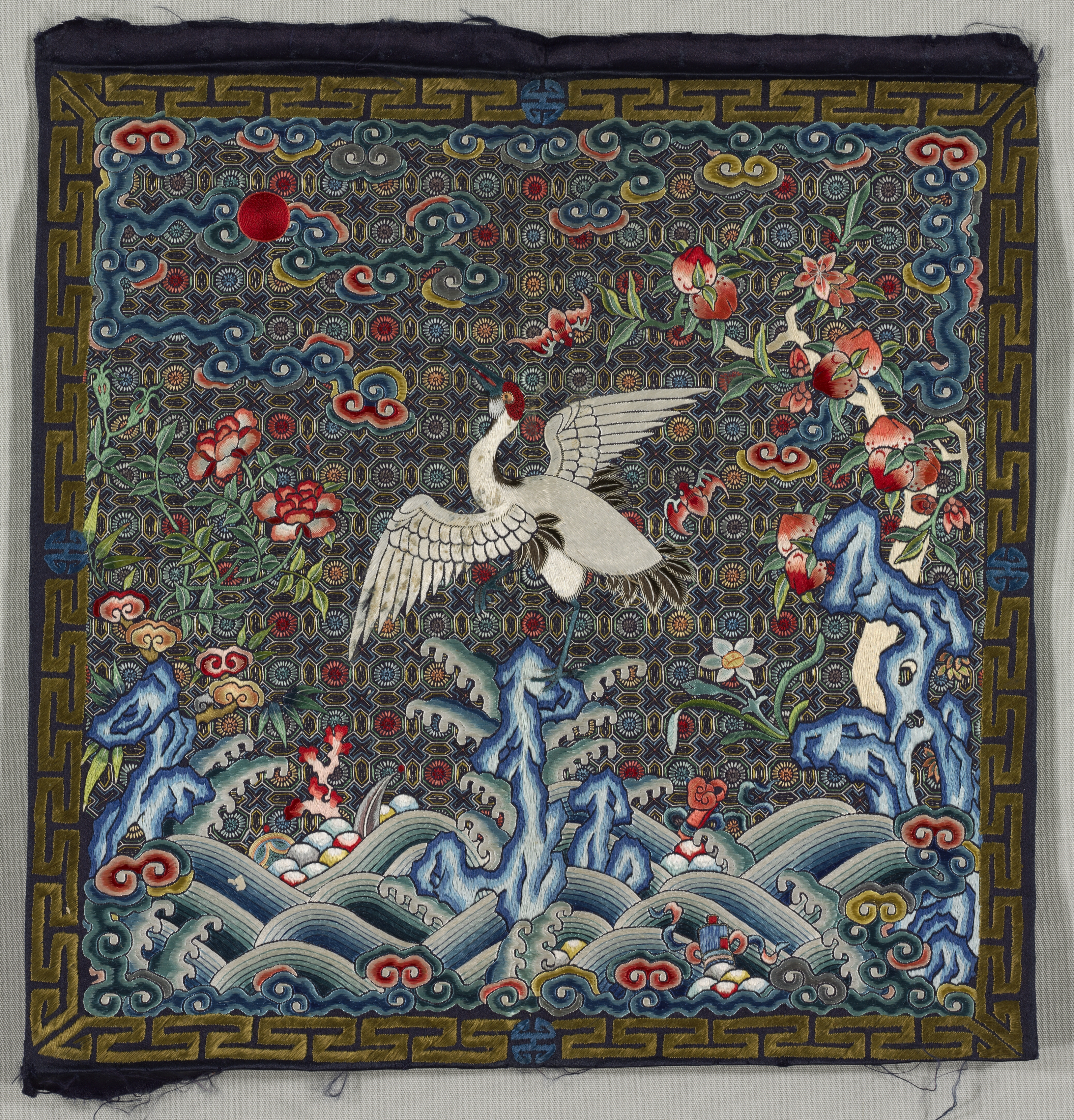
The provided artifact is a Qing Dynasty rank badge (buzi) from the Qianlong reign, constructed from silk satin weave with silk embroidery. Our deconstruction begins at the molecular level, treating the material not merely as fabric, but as a biological and structural blueprint. The satin weave is paramount. Unlike a simple plain weave, the satin structure features long floats of weft threads passing over multiple warp threads before being interlaced. This creates a supremely smooth, lustrous surface with a high light-reflective index, a deliberate technological choice. The surface becomes a radiant, unbroken canvas, designed to showcase the embroidered iconography without textile interference. The silk fibers themselves—proteins extruded by the Bombyx mori silkworm—provide a tensile strength and inherent sheen that synthetic polymers still struggle to replicate. This combination of biological material and advanced weave structure formed the ultimate luxury substrate of its era, a predecessor to modern technical fabrics engineered for specific visual performance.
The "New DNA Strand": Decoding the Semiotic Code
The reference to a New DNA Strand is a potent metaphor for our analysis. A rank badge was, in essence, a wearable genetic code of power and identity within the rigid social organism of the Qing court. Each element was a base pair in a legible sequence:
The Central Motif (The Primary Gene): The specific animal—a qilin for a first-rank military officer, a golden pheasant for a civil official—was an unambiguous identifier of rank and department. This was not decorative whimsy; it was a federally mandated uniform code.
The Cosmic Framework (The Supporting Helix): The motif was invariably set against a universe of symbols: stylized clouds, rolling waves at the badge's hem, perhaps a sun disc. This placed the official within the cosmic order, suggesting their authority was a natural, heaven-mandated part of the universe's fabric.
The Color Palette (The Epigenetic Expression): Ground colors (blue/black for lower ranks, ruby-like red for the highest) and the specific hues of the embroidery threads further refined this code, denoting subtle gradations in the hierarchy.
Thus, the badge functioned as a complete, scannable data packet. At a glance, any literate member of the court could "sequence" the wearer's position, a system of instant recognition more efficient than any digital badge today. The embroidery itself—the application of this code—utilized techniques like kesi (slit-tapestry) or intricate satin-stitch shading to create dimension, making the code not just legible but opulently tactile.
Reconstruction for Avant-Garde Praxis: From Courtly Code to Future Syntax
For Zoey Fashion Lab, this artifact is not a relic but a prototype. The avant-garde opportunity lies not in pastiche, but in a radical translation of its core principles: coded identity, structural symbolism, and bio-integrated materiality.
1. Re-engineering the Substrate: Programmable Surfaces
Replace the silk satin with advanced materials that share its core property of being a perfect canvas, but with dynamic capabilities. Imagine a micro-thin, satin-finish e-textile. Its weave integrates luminous threads or thermochromic coatings. The smooth "float" of the satin weave is now a functional conduit for light or a reactive surface for heat or touch. The substrate itself becomes interactive, a platform for mutable display.
2. Recoding the Iconography: Fluid Identity Data
The static, government-issued animal motif is obsolete. Our new "central motif" is a personal data signature. Using the e-textile canvas, the wearer can program their display. This could be:
Biometric Visualization: A real-time, abstract pattern generated from heart rate, breath, or EEG data, turning internal states into external emblem.
Digital Ecosystem Interface: The badge displays live environmental data (air quality, pollen count), network status, or curated digital art, making the wearer a node of information flow.
Dynamic Heritage: Instead of one fixed animal, a sequence that cycles through personal or cultural symbols throughout the day, challenging the notion of a singular, imposed identity.
3. Re-framing the Cosmos: Context-Aware Interaction
The cosmic borders (clouds, waves) transform from a fixed backdrop to an interactive frame. Using embedded sensors and micro-LEDs, this border reacts to the environment. It changes color with ambient light or sound, pulses in sync with a location's energy, or displays encrypted patterns when in proximity to another compatible garment—creating a silent, sartorial dialogue between wearers. The garment no longer places the wearer in a static cosmic order but visualizes their dynamic interaction with a digital-physical ecosystem.
4. Deconstructed Silhouette & Application
The rigid square form is exploded. The "badge" becomes a modular component—a flexible, programmable panel that can be attached, removed, or reconfigured on different garments: a sleeve, a back panel, a bag flap, a neckpiece. It exists as a detachable "identity drive." Alternatively, the entire garment could be constructed in a modern satin weave of recycled polyester or lab-grown silk, with the interactive panel integrated as a seamless, functional organ within the larger textile "body."
Conclusion: The New Mandate of Wearable Code
The Qianlong rank badge was a masterpiece of unambiguous, state-controlled communication through textile technology. Zoey Fashion Lab's avant-garde interpretation seizes its underlying logic—the garment as a certified interface for identity—and mutates it for a contemporary context. We move from state-mandated code to self-authored, fluid data; from static silk to reactive, intelligent textiles; from symbolizing placement in a fixed hierarchy to visualizing navigation within a fluid digital cosmos. The result is not a historical costume but a forward-looking proposition: clothing as a dynamic, bio-responsive, and deeply personal operating system, where the wearer is both the programmer and the displayed art. The DNA has been sequenced; now, we engage in conscious, couture-driven gene editing.