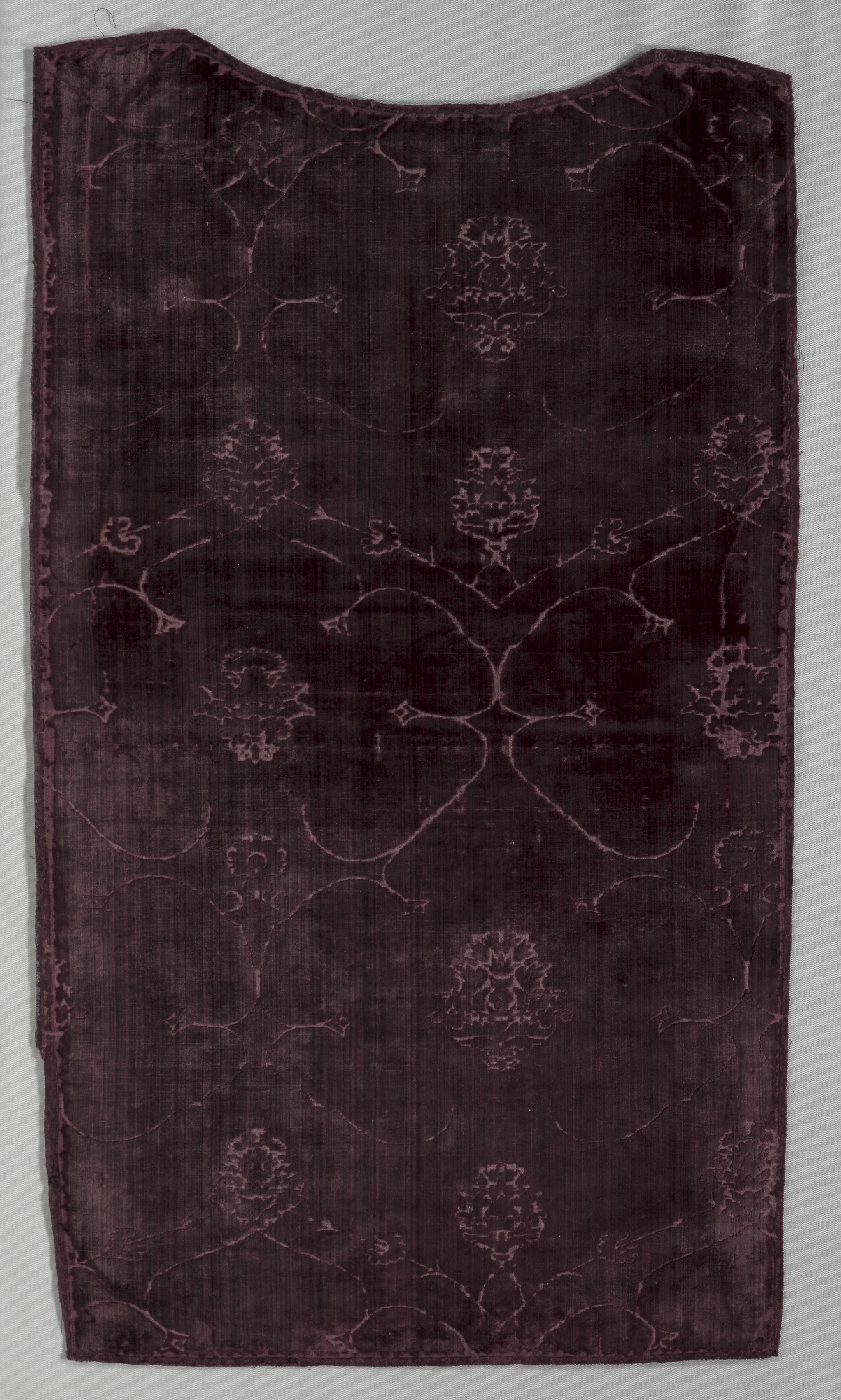
Deconstructing the Renaissance: Velvet with Pomegranate Pattern
At Zoey Fashion Lab, we approach historical textiles not as relics but as living blueprints for future innovation. The subject of this analysis—a 15th-century Italian velvet featuring a pomegranate pattern, constructed from silk thread in a cut and voided velvet weave—presents a paradox of opulence and restraint. Our task is to deconstruct this fabric’s DNA, extracting its core principles and re-engineering them into an avant-garde statement that challenges contemporary fashion norms. This process is not about replication; it is about reanimation through deconstruction.
Material Memory: The Silk Thread
The foundation of this textile is its primary material: silk. In the 15th century, silk was not merely a fiber; it was a conduit of global trade, a symbol of wealth, and a medium for artistic expression. The long, continuous filaments of silk provided the necessary strength and luster for the demanding velvet weave. For our avant-garde reinterpretation, we must consider the inherent tension between silk’s historical prestige and its potential for subversion. Rather than using pristine, uniform silk, we propose a process of controlled degradation: selectively burning, fraying, or chemically distressing the silk threads before weaving. This creates a fabric that simultaneously whispers of Renaissance luxury and screams of contemporary decay. The “new DNA strand” here is the intentional inclusion of imperfection—a direct contradiction to the flawless finish prized by 15th-century artisans.
The Velvet Weave: Cut and Voided
The technical structure of cut and voided velvet is where the most radical deconstruction can occur. In the original, the velvet pile is cut to create a plush, raised surface, while voided areas are left flat or woven with a different structure to create contrast. This technique was used to define the pomegranate motif against a ground of either silk satin or a lower pile. For the avant-garde iteration, we propose a hybrid weave that inverts the hierarchy of pile and void. Instead of the pattern being raised, the background becomes the plush velvet, and the pomegranate motif is rendered in a sheer, almost transparent, voided silk. This creates an optical illusion: the pattern appears to float or dissolve into the fabric’s depth. Furthermore, we can introduce asymmetrical cutting—where the pile is sheared at varying heights across the same piece, producing a topographical map of texture. This disrupts the original’s uniform opulence, introducing a tactile dissonance that aligns with avant-garde principles of fragmentation.
Symbolic Deconstruction: The Pomegranate Motif
The pomegranate was a potent symbol in Renaissance Italy, representing fertility, resurrection, and the unity of the Church. In the original fabric, this motif was meticulously repeated, emphasizing order and divine harmony. Our deconstruction must shatter this symbolic unity. We propose a process of digital distortion and manual fragmentation. First, we scan the original pattern and algorithmically warp it—stretching, compressing, and rotating individual pomegranate forms until they become unrecognizable, almost cellular. Then, we hand-embroider these distorted forms using a combination of the degraded silk and metallic threads that mimic the original’s gold-wrapped fibers. The result is a pattern that references the original’s organic shape but is now a chaotic, almost genetic, mutation. This new “DNA strand” is not about replication but about evolution—a pattern that mutates across the garment, creating a sense of biological growth rather than static decoration.
Structural Reconfiguration: From Fabric to Form
In the 15th century, velvet was used for rigid, structured garments like doublets, gowns, and liturgical vestments. The fabric’s weight and pile dictated its drape, often resulting in heavy, vertical folds. For our avant-garde application, we must liberate the fabric from its historical silhouette. We propose a technique of laser-cut sculpting where the velvet is precision-cut into interlocking panels that can be reassembled into non-traditional shapes. For example, the pomegranate motif can be isolated and used as a three-dimensional appliqué that extends beyond the garment’s edge, creating a sense of unfinished growth. Alternatively, we can invert the fabric’s weight by bonding it to a lightweight, transparent mesh, allowing the velvet to float away from the body rather than cling to it. This structural reconfiguration mirrors the avant-garde ethos of challenging the relationship between garment and wearer.
Color and Light: Subverting the Original Palette
15th-century Italian velvets were renowned for their deep, saturated colors—crimson, gold, emerald, and sapphire—achieved through natural dyes like kermes and woad. These colors were symbolic of power and piety. Our avant-garde deconstruction must redefine the color narrative. We propose a palette that is both a homage and a rebellion: a base of oxidized copper and tarnished silver, achieved through metallic thread blends, with the pomegranate pattern rendered in iridescent, color-shifting pigments that change from deep burgundy to electric violet under different light. This creates a fabric that is in constant flux, never settling into a single hue. The light interaction is further manipulated by strategic voiding—areas where the pile is completely removed, revealing a reflective foil backing. This turns the garment into a kinetic sculpture, capturing and scattering light in unpredictable ways. The original’s static luxury is replaced by a dynamic, almost volatile, visual experience.
The Zoey Fashion Lab DNA: A New Synthesis
The 15th-century velvet with pomegranate pattern provides a rich, complex starting point, but our analysis is ultimately about synthesis. The “new DNA strand” we propose is not a single technique but a methodology of intentional disruption. We combine the material memory of silk with the structural innovation of hybrid weaves, the symbolic chaos of distorted motifs, and the dynamic color language of modern pigments. The final garment is not a costume or a reproduction; it is a living artifact that bridges centuries. It acknowledges its Renaissance origins while violently rejecting their constraints. This is the essence of Zoey Fashion Lab’s avant-garde approach: to honor the past by breaking it open, extracting its essential elements, and reassembling them into something that challenges, provokes, and ultimately redefines what fashion can be. The velvet is no longer a signifier of wealth; it is a canvas for temporal collapse, a fabric that exists simultaneously in the 15th century and in the future.