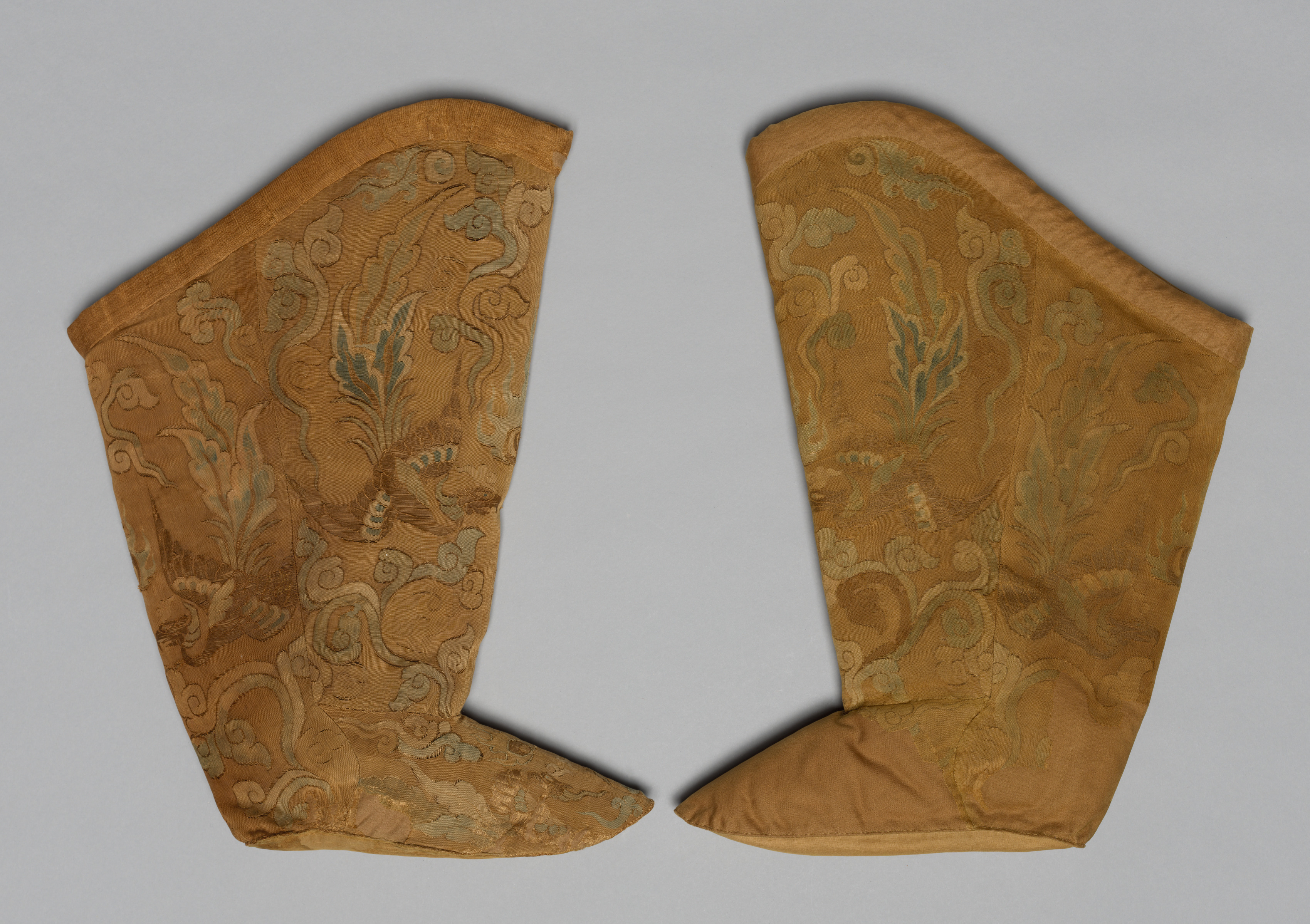
Deconstruction Report: Liao Dynasty Silk Tapestry Boots
As the Chief Fabric Deconstructionist for Zoey Fashion Lab, I present this analysis of a pair of boots originating from Northern China during the Liao dynasty (907-1125). This artifact, constructed from silk tapestry weave and incorporating two distinct types of metal threads, offers a profound case study in material innovation and cultural synthesis. The reference to "Archive Resonance" framing the object within the context of cultural collision and aesthetic fusion from the sixteenth to seventeenth centuries—though chronologically later—underscores a recurring theme in human history: the dynamic interplay between tradition and disruption. For an avant-garde fashion lab, these boots are not merely historical relics; they are blueprints for radical material exploration and narrative-driven design.
Technical Analysis: The Silk Tapestry Weave and Metal Threads
The primary construction technique—silk tapestry weave, known in Chinese as kesi or "cut silk"—is a pivotal element. Unlike conventional woven fabrics where weft threads run continuously, kesi employs discontinuous wefts that are woven back and forth in specific color areas, creating distinct, slit-like transitions. This method allows for intricate, pictorial designs without the need for embroidery or printing. For Zoey Fashion Lab, this technique represents a pre-digital form of pixelation, where each weft thread is a deliberate, isolated unit of color and texture. The boots' surface would have been a canvas for narrative motifs, likely depicting floral patterns, cloud scrolls, or animal forms symbolic of Liao identity—a blend of nomadic Khitan aesthetics and Tang Chinese influences.
The inclusion of two kinds of metal threads elevates this artifact from functional footwear to ceremonial or status-defining object. The first type is likely a flat, gilded paper or leather strip wrapped around a silk core, known as gold thread or jinxian. This type creates a reflective, linear shine that catches light with movement. The second type is probably a coiled or spiral metal thread, where a thin metal wire—often silver or a silver-gilt alloy—is wound around a silk filament, producing a textured, almost metallic yarn. This dual-metal approach creates a dynamic visual interplay: the flat threads offer broad, luminous fields, while the coiled threads add depth and a granular, almost chainmail-like surface. For the avant-garde designer, this is a lesson in material contrast—how two versions of the same substance can generate entirely different tactile and optical effects.
Cultural and Historical Context: The Liao Dynasty as a Crucible of Fusion
The Liao dynasty, ruled by the Khitan people, occupied a vast territory from present-day northern China into Mongolia and Siberia. Their culture was a unique amalgam: they maintained nomadic pastoral traditions while adopting Chinese bureaucratic systems, Buddhist iconography, and luxury crafts. The boots themselves are a testament to this synthesis. The use of silk, a quintessentially Chinese material, is combined with metal threads that evoke the Khitan love for mobile, durable, and reflective adornments—practical for a horse-riding elite yet luxurious enough for court rituals.
The reference to "Archive Resonance" situates this object within a broader narrative of cultural exchange. While the text mentions the sixteenth to seventeenth centuries, the Liao dynasty predates this by several centuries, yet the pattern of collision and fusion is identical. The boots are not purely "Chinese" nor purely "nomadic"; they are a third entity, born from the tension between settled and mobile, agrarian and pastoral. For Zoey Fashion Lab, this is a critical insight: avant-garde design emerges from the friction between opposing forces. The boots demonstrate how to hybridize materials (silk and metal) and techniques (tapestry weaving and metallic thread insertion) to create something that transcends its origins.
Avant-Garde Interpretation: Reimagining the Boots for Contemporary Fashion
To translate this artifact into an avant-garde context, we must deconstruct its components and reassemble them with a disruptive logic. Below are four conceptual directions for Zoey Fashion Lab:
1. Material Deconstruction and Reassembly: The kesi technique, with its slit weaves, can be abstracted into a modular system. Imagine boots where the upper is composed of independent, interlocking silk panels, each woven with a different metal thread density. The slits become intentional gaps, revealing skin or a secondary layer of translucent fabric. This creates a "deconstructed tapestry" effect, where the boot is both garment and architectural structure. The two metal threads can be used to create a gradient of reflectivity—from flat, mirror-like surfaces near the toe to coiled, textured regions around the ankle, mimicking the way light plays across a landscape.
2. Narrative Through Texture: The Liao boots likely told a story through their motifs. For an avant-garde version, we can replace figurative imagery with abstract, emotional narratives. Use the flat gold thread to create sweeping, calligraphic lines that suggest movement or wind, and the coiled silver thread to form dense, chaotic clusters that evoke conflict or energy. The boot becomes a wearable canvas for a non-linear story, where the viewer must "read" the textures rather than the images. This aligns with the "Archive Resonance" concept, where objects are witnesses to cultural collisions—here, the collision is between order (flat threads) and entropy (coiled threads).
3. Functional Reimagining: The original boots were likely soft-soled, designed for stirrups. An avant-garde reinterpretation could invert this functionality. Replace the silk with a high-tech polymer that mimics the hand of kesi but adds waterproofing and durability. The metal threads can be replaced with conductive fibers, allowing the boots to interact with digital environments—lighting up in response to movement or transmitting data. This is a direct homage to the Liao fusion of utility and ornament: the boots are still for "riding," but now the ride is through virtual landscapes.
4. Scale and Silhouette Distortion: The Liao boots were likely ankle-high or knee-high, conforming to the leg. An avant-garde version could exaggerate the boot's shape into an architectural sculpture. Imagine a boot that extends into a wide, flared cuff, woven with oversized kesi panels that are deliberately distorted—threads pulled loose, slits widened into gaping holes. The metal threads are left unbound, trailing like metallic vines. This challenges the notion of footwear as a rigid, functional object, instead presenting it as a living, decaying artifact. It echoes the "Archive Resonance" idea that objects are not static but are in constant dialogue with time and change.
Conclusion: The Boots as a Blueprint for Material Storytelling
These Liao dynasty boots are far more than a historical curiosity. They are a masterclass in how to use materials to encode identity, power, and cultural memory. The silk tapestry weave provides a structural vocabulary for precision and pictorial depth, while the dual metal threads introduce a language of light and texture. For Zoey Fashion Lab, the challenge is to honor this heritage while subverting it—to take the kesi technique and the metal threads and push them into new territories of form, function, and meaning.
The "Archive Resonance" philosophy reminds us that every object is a node in a network of cultural exchanges. By deconstructing these boots, we are not merely analyzing a product of the Liao dynasty; we are tapping into a timeless process of fusion and reinvention. The avant-garde is not about rejecting the past but about reanimating it with a disruptive energy. These boots, with their silk and metal, their slits and shine, offer a template for a fashion that is both archival and revolutionary—a fashion that, like the Liao dynasty itself, thrives at the crossroads of worlds.