The Unraveling Edge: Deconstructing the Border as a Site of Avant-Garde Potential
In the lexicon of fashion, the border has long been a site of termination—a hem, a seam, a line where fabric meets void. For Zoey Fashion Laboratory’s SS26 collection, we propose a radical inversion: the border as a genesis point, a frontier of structural and conceptual expansion. This analysis deconstructs the “Border” not as a limit, but as a volatile, generative threshold. By harnessing the ethereal precision of needle lace—a material historically synonymous with domesticity and ornamentation—we transform it into an instrument of architectural defiance. The Global Frontier, our origin point, is not a geographical boundary but a cognitive one: the edge of what garment construction can become. Here, we dissect how needle lace, when subjected to deconstructive logic and futuristic silhouette engineering, becomes a medium for redefining the very concept of containment and release.
The Needle Lace Paradox: From Delicacy to Structural Armature
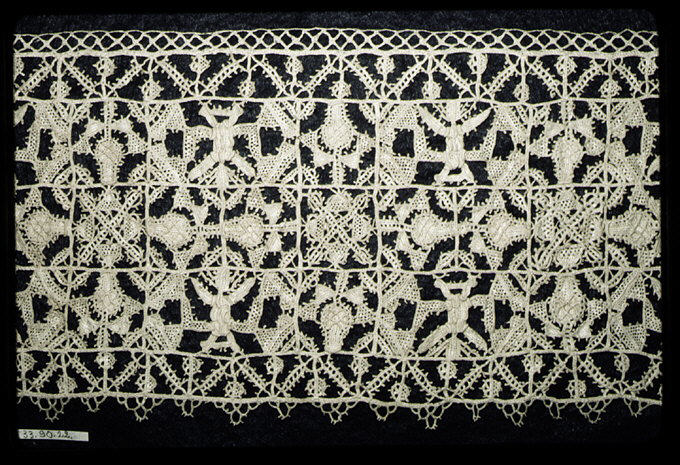
Needle lace, with its intricate loops and openwork, is traditionally a material of fragility and patience. Yet, within the avant-garde framework, its inherent porosity becomes a strength. For SS26, we reject the notion that lace must be soft or submissive. Instead, we treat it as a tensile membrane, a lattice that can be both transparent and load-bearing. The border, in this context, is not a hem but a self-terminating edge—a point where the lace’s loops are left deliberately unbound, fraying into negative space. This is not a sign of decay but of intentional release. The needle lace is engineered to resist closure, its threads forming a dynamic, unstable boundary that shifts with the wearer’s movement. Consider a garment where the lace is laser-cut and then reassembled with metallic threads, creating a hybrid of organic fiber and industrial rigidity. The border becomes a gradient of opacity, where the lace dissolves from dense pattern to pure air, challenging the viewer to discern where the garment ends and the body begins.
Futuristic Silhouettes: The Border as a Structural Cantilever
The silhouette for SS26 is defined by asymmetrical expansion and negative-space architecture. The border is no longer a passive outline but an active structural element—a cantilever that projects beyond the body’s natural contour. Imagine a jacket where the shoulder seams extend into needle-lace fins, each thread meticulously tensioned to hold a sharp, aerodynamic curve. The hemline of a skirt is not straight but a wave of interrupted lace, where sections are removed to create voids that reveal a secondary layer of transparent polymer. This is the border as a rupture, a deliberate break in the fabric’s continuity that generates new volumes. The waistline becomes a torsion point, where needle lace is twisted and bonded with thermo-adhesive to form a rigid, corseted structure that flares into a cloud of unspun threads. The result is a silhouette that appears to be unraveling in slow motion, a frozen moment of structural collapse that is, paradoxically, perfectly controlled.
Structural Innovation: Tension, Gravity, and the Unstable Edge
Innovation in this collection lies in the manipulation of tension. Needle lace is inherently a system of loops and knots; we exploit this by introducing differential tensioning across the garment. A dress’s border might be weighted with micro-beads of stainless steel, causing the lace to hang in catenary curves that defy gravity. Alternatively, the border is sewn with elastic thread that contracts and expands, creating a living hem that pulses with the wearer’s breath. The concept of the “Global Frontier” is literalized in the use of boundary-dissolving techniques: needle lace is fused with biodegradable polymers that dissolve upon contact with moisture, leaving only the thread structure—a garment that erases its own edge over time. Another technique involves magnetic thread integration, where the border of a cape is lined with micro-magnets that allow the fabric to self-assemble into sculptural, floating folds. This is architecture without anchors, a garment that negotiates its own boundary with the environment.
Deconstructive Aesthetics: The Unfinished as a Statement of Power
The deconstructive approach here is not about destruction but about revelation of process. The border is left raw, with needle lace tails trailing like unfinished sentences. Seams are exposed and exaggerated, with lace acting as a visible scaffolding that holds the garment together. A coat might have its entire front panel replaced by a single, massive sheet of needle lace that is deliberately over-stretched and distorted, creating a distorted grid that warps the wearer’s silhouette. The hem of a trousers is not hemmed but unraveled into a fringe of individual threads, each one weighted with a tiny glass bead. This is the border as a state of becoming, never finalized. The aesthetic is one of controlled chaos, where the garment’s fragility is its strength. The viewer is confronted with the materiality of the edge, forced to question whether the garment is being assembled or disassembled before their eyes.
Conceptual Implications: The Border as a Dialogue Between Body and Space
Ultimately, this collection asks: What happens when a garment refuses to end? The border becomes a site of negotiation, where the wearer’s body extends into the surrounding space through lace tendrils and floating threads. This is a futuristic embodiment of permeability, where the boundary between self and environment is blurred. The needle lace, with its openwork, allows for visual and physical penetration—the garment is no longer a shell but a filter. In this context, the “Global Frontier” is not a line on a map but a cognitive edge where fashion meets performance art, where clothing becomes a temporary architecture that redefines presence. The wearer is not simply adorned but activated, their movement becoming part of the garment’s structural logic. The border, in its unraveled state, is a manifesto against finality, a declaration that the most compelling edges are those that remain open, unstable, and perpetually in flux.
Conclusion: The Border as a New Beginning
For Zoey Fashion Laboratory’s SS26, the border is not a limit but a launchpad. By weaponizing the delicacy of needle lace and reimagining it as a tensile, structural medium, we create garments that exist on the threshold of form and formlessness. The futuristic silhouettes are not about the future as a fixed point but about the future as a continuous edge, always expanding, always unraveling. This is avant-garde couture that does not seek to please but to provoke—to challenge the very notion of where a garment begins and ends. The border, in its most radical interpretation, is not a line of termination but a line of flight, a portal to new possibilities in garment architecture. As the threads of needle lace catch the light and dissolve into air, they leave behind a single, resonant question: What lies beyond the edge? The answer, for SS26, is everything.