Deconstructing the Dervish’s Dowry: An Avant-Garde Analysis of Mughal Miniature and Material Narrative
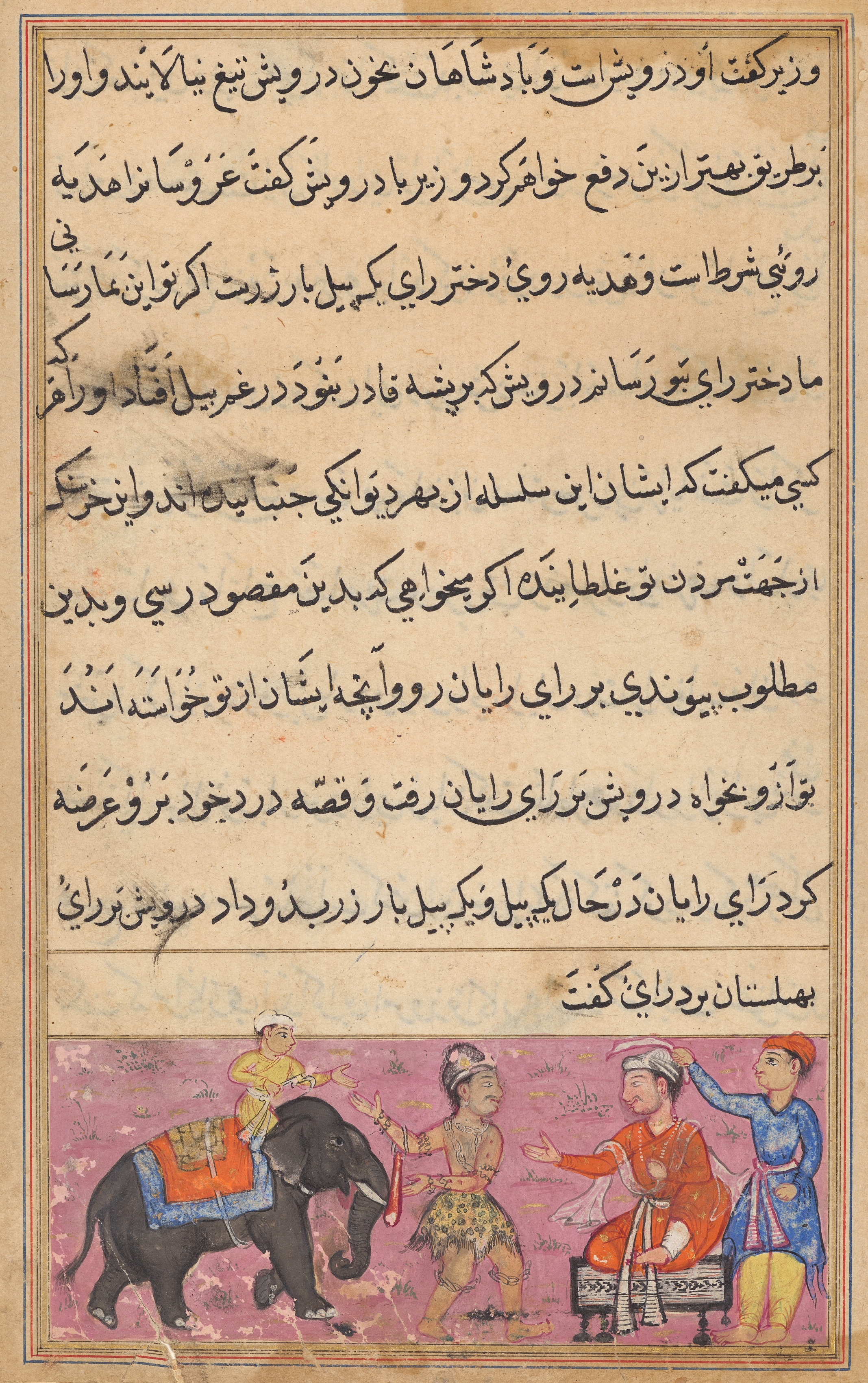
At Zoey Fashion Lab, our ethos is rooted in the radical deconstruction of historical textiles and visual narratives to forge new, avant-garde lexicons of form, texture, and cultural resonance. The subject of this analysis—a folio from the Tuti-nama (Tales of a Parrot), specifically the scene of a dervish bringing an elephant laden with gold as dowry—is not merely a miniature painting. It is a dense, multi-layered archive of power, transcendence, and material obsession. Created in the Mughal court of Akbar (1556–1605) using gum tempera, ink, and gold on paper, this work presents a profound challenge and opportunity for deconstruction. We must strip away the patina of exoticism and historical distance to reveal its structural, chromatic, and symbolic DNA, then reassemble it through an avant-garde lens. The provided archive resonance—a mirror with gold-inlaid palm leaves and a sarcophagus with relief narratives—serves as our conceptual crucible, forcing a dialogue between surface opulence and deep, buried story.
I. The Fractured Surface: Gold, Tempera, and the Illusion of Stability
The first layer of our deconstruction targets the materiality of the work. The use of gum tempera, ink, and gold on paper is not a neutral technical choice; it is a deliberate act of hierarchical ordering. The gold, applied with meticulous precision, functions as a luminous, reflective surface that simultaneously obscures and reveals. In the Tuti-nama scene, the elephant is laden with gold—not just as a dowry, but as a symbol of the dervish’s spiritual wealth rendered in worldly terms. The gold leaf creates a fractured mirror, echoing the archive’s “光洁银镜” (polished silver mirror). However, unlike the mirror’s smooth reflection, the gold in this miniature is broken by the intricate patterns of the elephant’s trappings and the surrounding landscape. The palm leaves, inlaid in gold on the mirror, are here transformed into the organic, yet metallic, foliage of the Mughal court. For an avant-garde fashion lab, this suggests a material study: how can gold leaf be deconstructed into a non-reflective, textured surface? How can tempera be used to create a tactile, almost sculptural, illusion of weight? The elephant, a massive, living form, is rendered weightless by the gold, yet burdened by its symbolic load. This tension between surface glamour and underlying gravity is the first thread we pull.
II. The Sarcophagus Narrative: Buried Stories in the Dervish’s Journey
The archive’s second component—the “冰冷石棺板上以浮雕诉说的生命叙事” (cold sarcophagus slab with life narratives told in relief)—provides a chilling counterpoint. The Tuti-nama scene, on its surface, is a celebratory procession: a holy man (the dervish) offering immense wealth to secure a bride. But beneath the gold and the vibrant tempera lies a sarcophagus of meaning. The dervish, in Sufi tradition, is a figure of renunciation, one who has abandoned worldly attachments. To see him as a bearer of gold is a profound narrative rupture. This is not a simple tale of romance; it is a story of spiritual compromise, of the tension between ascetic ideals and social necessity. The elephant, a symbol of royal power and divine Ganesha in Hindu context, is here re-purposed as a beast of burden for Islamic courtly transaction. The miniature becomes a relief carving of conflicting ideologies: the dervish’s inner poverty versus the outer display of wealth; the Mughal empire’s syncretic ambition versus the rigid structures of caste and class. In an avant-garde analysis, we must excavate these buried stories. The gold is not just a decorative element; it is a funerary mask over a living, breathing narrative of cultural negotiation. The sarcophagus, then, is not the elephant or the dervish, but the very form of the miniature itself—a frozen moment that entombs a dynamic, often contradictory, social reality.
III. Chromatic Deconstruction: The Palette as Political and Spiritual Code
Moving to color theory, the gum tempera palette of this Tuti-nama folio is a codex of power and transcendence. The dominant hues—deep lapis lazuli blue, vermilion red, emerald green, and the ubiquitous gold—are not arbitrary. Blue, often derived from lapis, signifies the infinite, the divine, and the heavens. In the miniature, it likely forms the sky or the dervish’s robe, positioning him as a conduit between the earthly and the celestial. Red, associated with both life and danger, marks the threshold of marriage and transaction. Green, the color of paradise in Islamic tradition, may adorn the landscape or the elephant’s trappings, suggesting that this worldly dowry is a shadow of a heavenly reward. For Zoey Fashion Lab, this palette must be deconstructed into its raw emotional and political frequencies. How does the blue of the dervish’s robe clash or harmonize with the gold of the elephant? The answer lies in a chromatic tension: the spiritual blue is subsumed by the material gold, just as the dervish’s asceticism is overwhelmed by the dowry. This is a visual argument about the corruption of purity. An avant-garde collection could extract these colors, but not as simple swatches. Instead, they would be fragmented, layered, and distressed—a blue that is cracked with gold veins, a red that is muted by a sepia wash, a green that is punctured by black ink. The palette becomes a narrative of decay and negotiation, not a static decoration.
IV. The Elephant as Architectural Garment: Deconstructing Form and Function
Finally, we turn to the central figure of the elephant. In the context of avant-garde fashion, the elephant is not an animal; it is a mobile architectural garment. Its body is a platform for display, a living mannequin for the gold that adorns it. The howdah (the carriage on its back) is a crown, a throne, a cage. The gold is not merely carried; it is woven into the elephant’s identity, transforming it from a living creature into a symbol of economic and spiritual capital. This is a profound deconstruction of the relationship between wearer and worn. The elephant wears the gold; the dervish wears the elephant’s burden. In fashion terms, this suggests a reversal of the garment-body hierarchy. A garment does not simply adorn the body; it redefines the body’s function. An avant-garde piece inspired by this could be a sculptural, elephantine silhouette—a coat that is not worn, but carried; a headdress that is a howdah in miniature; a fabric that is weighted with gold-leaf appliqué to mimic the elephant’s laden form. The texture of the elephant’s skin, rendered in the miniature with fine brushstrokes, becomes a pattern for a new textile: a wrinkled, folded, and pleated surface that tells of age, wisdom, and burden. The gold, then, is not a flat surface but a three-dimensional relief, a sarcophagus of light that both illuminates and entombs the elephant’s living form.
V. Synthesis: The Avant-Garde Mirror and the Sarcophagus of Gold
In conclusion, the Tuti-nama folio of the dervish and his elephant is a mirror that reflects not a face, but a system. The archive resonance—the polished silver mirror with gold palm leaves and the sarcophagus with relief narratives—is not a separate reference; it is the structural skeleton of the miniature itself. The miniature is a mirror of Mughal courtly ambition, its gold leaf a surface that distorts and idealizes. Yet, it is also a sarcophagus of the dervish’s spiritual truth, a relief that tells a story of loss and transaction. For Zoey Fashion Lab, the deconstruction yields a blueprint for a collection that is neither historical nor futuristic, but timeless in its material and narrative tension. We are not recreating the Mughal miniature; we are fracturing its gold, distilling its colors, and re-weaving its elephantine forms into garments that carry their own dowry of meaning. The final piece is a garment that is both mirror and sarcophagus: a reflective surface that hides a deeper, darker narrative, a beautiful form that entombs a painful truth. This is the essence of the avant-garde—not to reject history, but to deconstruct it, wear it, and transform it into a new, resonant language of the body and the soul.