Deconstructing the Etruscan Codex: The Earring as Architectural Prototype for SS26
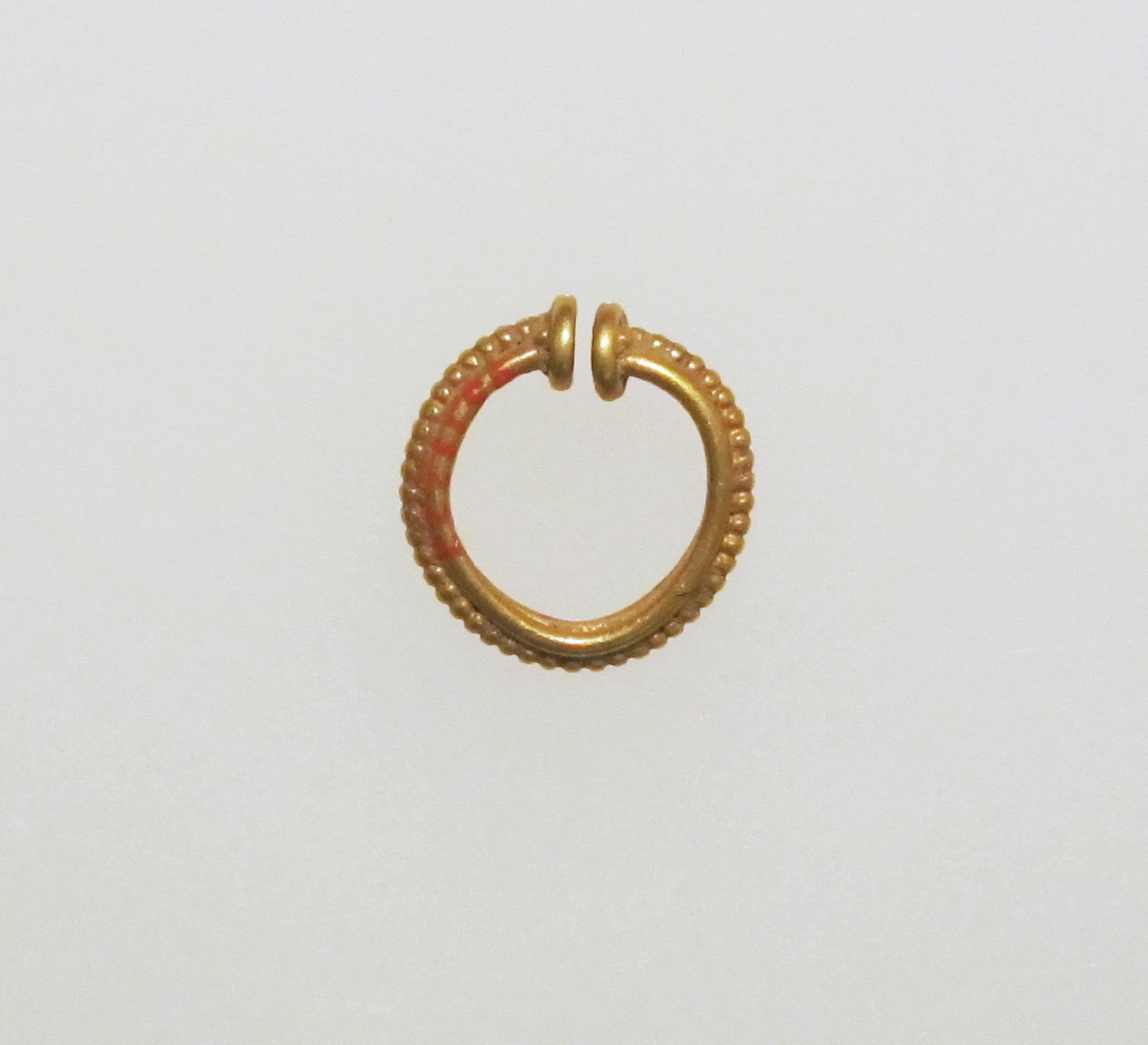
In the relentless pursuit of redefining the sartorial lexicon, Zoey Fashion Laboratory turns its analytical gaze to the primordial object of adornment: the earring. Within the context of our SS26 collection, we are not merely reimagining jewelry; we are reverse-engineering the very concept of wearable architecture. The subject of this definitive analysis is an Etruscan gold earring, a relic of a civilization that mastered the art of granulation and filigree. This artifact, when viewed through our deconstructive lens, becomes a critical data point—a genetic code for a new kind of futuristic silhouette. Its aesthetic correlation with our archive node, “一面是光洁银镜上以黄金镶嵌的纷繁棕叶纹,另一面是冰冷石棺板上以浮雕诉说的生命叙事——《Mirror with Split-Leaf...” , unlocks a paradoxical dialogue between polished surface and narrative depth, between the eternal and the ephemeral. For SS26, the earring is not an accessory; it is a structural manifesto.
Proto-Architecture: The Earring as a Load-Bearing Element
Historically, the Etruscan earring was a testament to opulence and divine protection, a miniaturized temple of gold. In our avant-garde analysis, we strip it of its historical piety and re-contextualize it as a load-bearing architectural component. The original artifact’s intricate spiral and disc forms are not decorative whims; they are the earliest examples of tensile strength and cantilevered balance in wearable form. For SS26, we extrapolate this into a new silhouette: the “Aural Scaffold.” This is a structural ear cuff that extends from the helix, wrapping around the concha to create a floating platform. The gold is not applied; it is grown via electrochemical deposition onto a 3D-printed lattice of biodegradable polymer. The result is a piece that appears to defy gravity, its mass distributed not on the earlobe but across the entire auricular cartilage. This is the first principle of our futuristic silhouette: form follows force distribution, not tradition.
The Etruscan granulation—thousands of microscopic gold spheres—is reinterpreted as a surface treatment of “micro-bollards” that catch light and create a moiré effect. This technique, which we call “Granular Disruption,” serves a dual purpose: it provides structural rigidity to the thin gold membrane while creating a visual texture that references the “纷繁棕叶纹” (lush palm leaf patterns) of the mirror. The earring becomes a tactile hologram, shifting from matte to specular as the wearer moves, a direct homage to the dual nature of our archive node—the polished silver mirror versus the narrative relief of the sarcophagus.
Narrative Topography: The Relief as Silhouette
The second half of our archive node—“冰冷石棺板上以浮雕诉说的生命叙事” (the life narrative told in relief on the cold sarcophagus lid)—informs the topographic silhouette of the SS26 earring. We reject the flat, two-dimensional approach to jewelry design. Instead, we employ a method of “stratigraphic layering.” The earring is no longer a single object; it is a micro-architecture of time. Using CNC milling and lost-wax casting, we carve the gold into a series of overlapping, undulating planes that mimic the geological strata of a tomb. The narrative is not illustrated; it is embedded in the negative space between these layers.
This creates a silhouette that is both massive and ethereal. From the front, the earring appears as a dense, solid form—a monolithic block of gold. But from a three-quarter angle, the viewer sees through the gaps, revealing an inner landscape of delicate bridges and voids. This is the “Split-Leaf Effect”—a reference to the mirror’s fractured botanical motif. The earring’s outline is not a smooth curve but a jagged, organic profile that echoes the split leaves of the original artifact. For SS26, we scale this concept into a full-body silhouette: a “Relief Coat” that uses the same stratigraphic layering to create a garment that is part armor, part topographical map. The earring becomes the prototype for this larger system, a proof-of-concept that adornment can contain narrative depth without sacrificing structural integrity.
Bio-Luminescent Integration and Future Materials
To push the earring into the realm of SS26’s futuristic vision, we must address the material’s static nature. Gold is eternal, but it is also inert. We introduce a bio-luminescent infusion into the gold alloy. Through a proprietary process of plasmonic doping, we embed quantum dots that emit a low-frequency, amber light when activated by the wearer’s body heat. This is not a battery-powered LED; it is a chemical reaction between the gold and the skin’s microbiome. The earring glows with a soft, organic luminescence, mimicking the ethereal quality of Etruscan tomb frescoes seen by torchlight. This transforms the piece from a static object into a living interface between the body and the environment.
The silhouette is further evolved by integrating shape-memory alloys into the earring’s structure. At room temperature, the earring maintains its rigid, architectural form. But as it absorbs the wearer’s body heat, the gold alloy—reinforced with a nitinol core—begins to unfold. The earring expands, creating a secondary silhouette that fans out like a peacock’s tail or a palm frond. This is the ultimate expression of the “Split-Leaf” concept: a piece that is in constant morphological flux. The wearer becomes a living archive, their adornment shifting between the polished mirror state (compact, reflective) and the narrative relief state (expanded, textured). This temporal dynamism is the core innovation for SS26: silhouette as a function of time and temperature.
Conclusion: The Earring as a Singularity
The Etruscan gold earring, when subjected to the Zoey Fashion Laboratory’s deconstructive and futuristic analysis, ceases to be a historical curiosity. It becomes a singularity—a point of convergence between ancient craftsmanship and speculative engineering. Its aesthetic correlation with our archive node is not coincidental; it is a deliberate mapping of the dualistic nature of existence: the polished surface of the mirror versus the deep narrative of the sarcophagus. For SS26, the earring is the minimum viable product of a new architectural language. It teaches us that adornment can be load-bearing, that narrative can be embedded in topography, and that materiality can be alive. This is not jewelry. This is proto-fashion—the first whisper of a new silhouette that will define the future of structural innovation. The earring is the key; the collection is the lock. We are turning the mechanism.