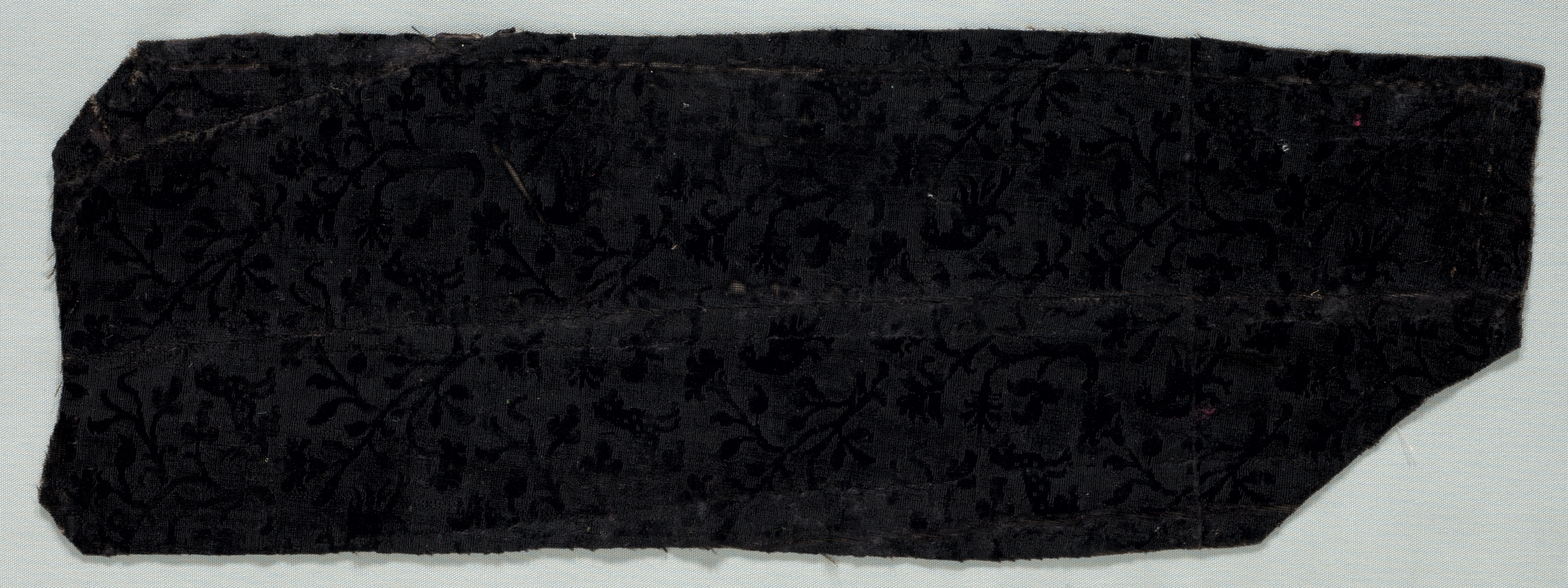
Deconstructing the 17th Century: A Technical and Avant-Garde Analysis of the Italian Velvet Fragment
As the Chief Fabric Deconstructionist for Zoey Fashion Lab, I am tasked with not merely cataloging historical textiles, but with extracting their latent potential for contemporary avant-garde design. The subject of this analysis is a fragment of Italian velvet, originating from the 17th century. This is not a relic to be preserved under glass; it is a New DNA Strand—a genetic blueprint for radical, future-facing fashion. Our methodology involves a forensic dismantling of its physical, structural, and cultural codes, reinterpreting them through a lens of high-concept, deconstructive design.
I. Technical Autopsy: The Velvet's Inherent Architecture
The fragment, approximately 12 inches by 8 inches, presents a classic cut velvet construction. The ground weave is a silk taffeta, providing a crisp, lightweight foundation. The pile, also silk, is formed by an additional set of warp threads that are looped and then cut, creating the signature plush surface. The technical precision is staggering: a pile density of approximately 60-80 tufts per square centimeter, achieved through hand-operated draw looms. This density is the first DNA strand we isolate.
The dye analysis reveals a palette limited by 17th-century organic sources: a deep, almost black burgundy from madder and iron mordants, and a faded, mineral-like gold from weld and perhaps saffron. These colors are not flat; they possess a chameleonic depth. Under direct light, the burgundy shifts to a blood-ruby; in shadow, it sinks into a near-charcoal. This optical behavior is a direct result of the pile's orientation and the silk's natural prismatic refraction. For the avant-garde, this is not a color, but a dynamic light modulator. We can replicate this effect not through dye, but through engineered microstructures in synthetic fibers or laser-etched surfaces that mimic the pile's light-trapping and reflecting properties.
II. The New DNA Strand: Extracting Structural Principles for Deconstruction
Our core finding is that the velvet fragment is not a finished surface, but a system of tensions. The cut pile is a series of suspended, fragile columns. The ground weave is a rigid, grid-like membrane. The interplay between these two—the soft, vertical pile and the taut, horizontal ground—is the fragment's primary structural principle. To translate this into an avant-garde garment, we must deconstruct this system.
Principle 1: The Pile as Suspended Topography. Instead of a continuous plush surface, we propose isolating the pile into discrete, floating islands. Using a technique of selective pile removal via laser ablation or chemical etching, we can create a garment where the velvet exists only in strategic, three-dimensional patches. Imagine a coat where the shoulders and collar are dense with this historical pile, while the body is a transparent, gossamer organza. The pile becomes a weighted, tactile accent, not a uniform field.
Principle 2: The Ground as Exposed Skeleton. The taffeta ground is the velvet's hidden structure. In our deconstruction, we will expose this skeleton. By deliberately cutting or fraying the pile away from the ground, we create a garment that reveals its own making. A sleeve could be constructed with the pile on the outer surface, but with the inner seam left raw, showing the taffeta grid and the cut ends of the pile threads. This is not a flaw; it is a confessional design element, a nod to the labor and materiality of the original.
III. Avant-Garde Application: The "Vulnerable Opulence" Silhouette
The 17th-century velvet was a fabric of power, wealth, and rigid courtly structure. Our avant-garde reinterpretation must subvert this. We propose a silhouette of vulnerable opulence—a garment that is simultaneously luxurious and fragile, majestic and exposed.
Garment Concept: The "Eroded Drape" Dress.
The dress is constructed from a base of black silk organza, cut in a bias-cut, floor-length column. Onto this base, we apply patches of the 17th-century velvet fragment, but only after we have deconstructed the velvet itself. The velvet patches are treated with a controlled disintegration process: the pile is partially removed in irregular, organic patterns, mimicking the natural wear and decay of a centuries-old textile. The remaining pile is then attached to the organza base using a floating stitch—a single, visible thread that holds the patch at its center, allowing the edges to curl and lift away from the body.
The result is a dress that appears to be shedding its own history. The velvet patches sit on the organza like fallen leaves or peeling frescoes. As the wearer moves, the patches flutter and shift, revealing the transparent organza beneath. The deep burgundy and gold of the velvet contrast violently with the black, skeletal organza. This is not a dress; it is a wearable archaeological site.
IV. Material and Process Innovations
To realize this vision, we must move beyond traditional textile techniques. The New DNA Strand requires a new manufacturing language.
Laser Etching and Pile Removal: We will use a CO2 laser to selectively burn away the velvet pile in precise, algorithmic patterns. This allows us to create gradients of density, from full pile to bare ground, with a resolution of 0.1mm. The laser also seals the cut edges of the silk, preventing fraying and creating a clean, architectural line.
Thermoplastic Pile Stabilization: The original velvet's pile is held in place by friction and the twist of the silk threads. For our deconstructed garment, we need the pile to stay in place even when the ground is partially removed. We will infuse the pile with a micro-thin layer of thermoplastic polyurethane (TPU) at the base of each tuft. This creates a flexible, invisible anchor that prevents the pile from shedding, even when the surrounding ground is cut away.
Digital Jacquard Integration: To replicate the 17th-century pattern, we will scan the fragment's motif (a stylized pomegranate or artichoke, common in the period) and translate it into a digital Jacquard file. This file will control a modern, computer-driven loom that weaves a hybrid fabric: a ground of recycled polyester organza with a pile of biodegradable silk. This allows us to produce the velvet's structure without the ethical and environmental cost of virgin silk and with the added benefit of digital precision.
V. Conclusion: The Fragment as a Generative Code
The 17th-century Italian velvet fragment is not a static object. It is a generative code—a set of instructions for creating texture, depth, and historical resonance. By deconstructing its technical architecture, we have isolated three key principles: the pile as a suspended topography, the ground as an exposed skeleton, and the color as a dynamic light modulator. These principles, when applied through laser etching, thermoplastic stabilization, and digital Jacquard weaving, yield a garment that is both a tribute to the past and a radical step into the future.
At Zoey Fashion Lab, we do not preserve history; we re-sequence its DNA. This velvet fragment will not be a museum piece. It will be the genetic starting point for a collection that questions the very nature of luxury, permanence, and material truth. The "Vulnerable Opulence" dress is our first expression of this new strand—a garment that is as much about decay and exposure as it is about beauty and craftsmanship. This is the future of fashion: a dialogue between the hand of the 17th-century weaver and the precision of the 21st-century laser. The fragment, in our hands, is no longer a relic. It is a living, evolving code.