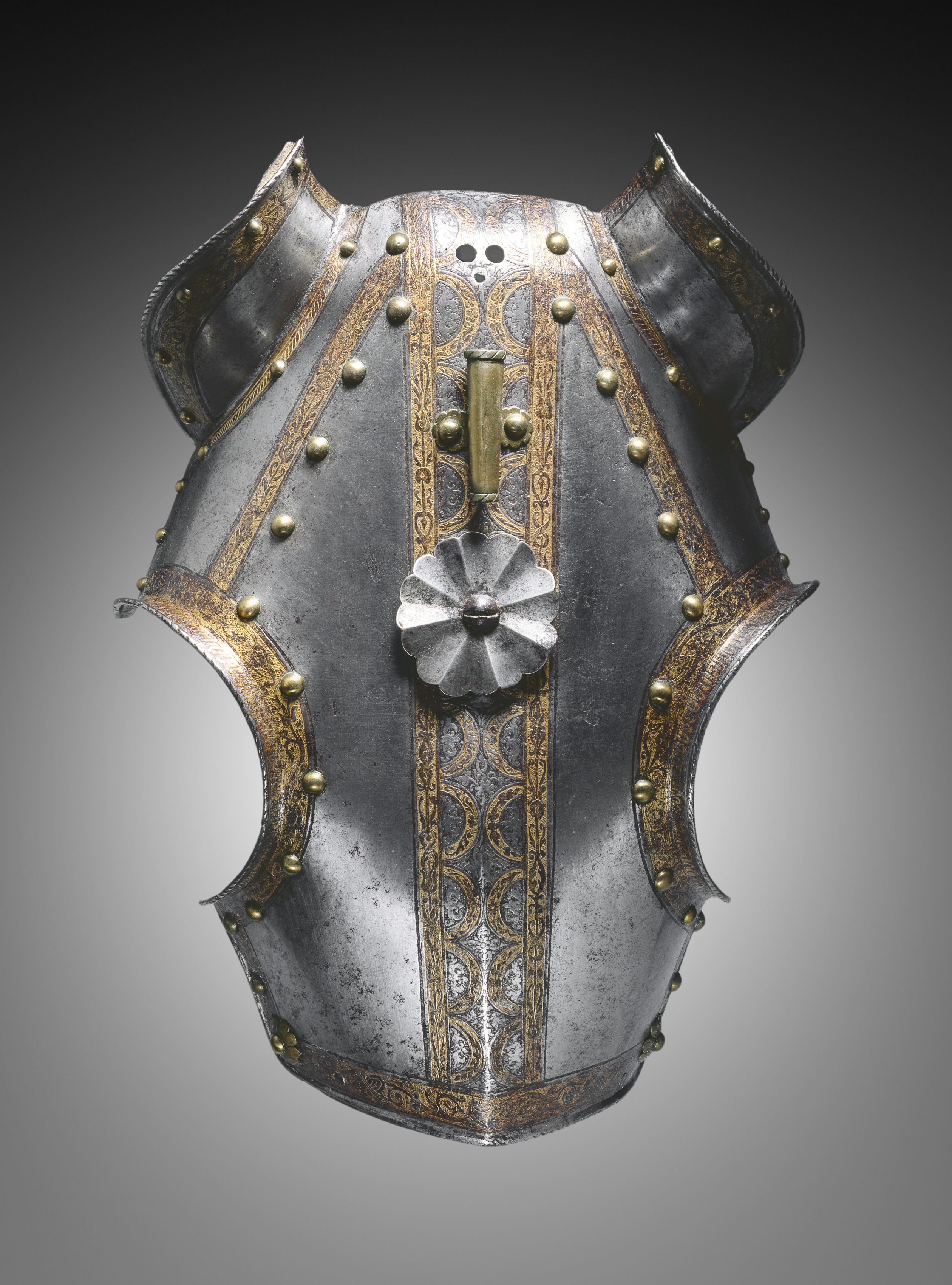
Deconstructing the Demi-Chanfron: An Avant-Garde Re-Evaluation of 16th Century German Equestrian Armor
As Chief Fabric Deconstructionist for Zoey Fashion Lab, my role is to dissect historical artifacts not as relics, but as dormant design DNA. The subject of this analysis—a 16th-century German Demi-Chanfron from Augsburg—is a prime candidate for such re-evaluation. This piece, a protective plate for a horse's forehead, is typically viewed through the lens of martial history. However, when we apply the New DNA Strand methodology, we see it not as a piece of armor, but as a proto-avant-garde structural garment. Its core materials—steel, etching, gilding, and leather—are not merely functional; they are a lexicon of texture, tension, and opulence waiting to be re-coded for contemporary fashion.
Material Provenance: The Steel and Leather Syntax
The Demi-Chanfron’s primary material, steel, is a study in extreme structural rigidity. In the 16th century, this was a necessity for deflecting lance blows. For Zoey Fashion Lab, this steel represents a foundational silhouette. It is not a fabric to be draped, but a volume to be engineered. The steel’s surface is not uniform; it is etched with intricate patterns—often floral, arabesque, or mythological scenes. This etching is a form of negative-space texturing, a technique we can translate into laser-cut leather, laser-etched polymer panels, or even embossed neoprene. The gilding, a layer of gold applied to the etched recesses, introduces a chromatic counterpoint. It is not a solid color but a highlight, a flash of light within the darkness of the steel. In our translation, this could be achieved through metallic foil applications, iridescent thread embroidery, or even thermochromic pigments that reveal gold undertones under heat.
The leather component—the straps and padding that secured the chanfron to the horse’s head—is equally critical. This is the interface material, the point of contact between the rigid shell and the living form. In the original, it was utilitarian: thick, vegetable-tanned leather, often dyed black or left natural. For our avant-garde interpretation, leather becomes a soft, reactive chassis. We can deconstruct it into webbing, harnesses, or even re-imagine it as a lattice that allows the steel-like panels to float above the wearer’s body. The contrast between the hard, polished steel and the soft, worn leather is a core tension we must preserve and amplify.
Structural Deconstruction: The Demi-Form as a New Silhouette
The Demi-Chanfron is a demi-form—it covers only the forehead and the bridge of the nose, leaving the lower face and neck exposed. This partial coverage is a radical design choice. It is not a full helmet; it is a focal point. In equestrian armor, this strategic exposure allowed the horse to breathe and see while protecting the most vulnerable strike zone. For Zoey Fashion Lab, this principle translates into asymmetrical, sculptural pieces that frame the face or body. Imagine a high-fashion collar that cups the jawline and extends into a rigid, gilded plate over the crown, leaving the rest of the neck bare. Or a shoulder piece that mimics the chanfron’s curve, protecting only the deltoid and leaving the arm free. The demi-principle is about selective fortification, not total enclosure.
The chanfron’s curvature is also instructive. It is not a flat plane; it is a compound curve that follows the equine skull’s anatomy. This is a lesson in ergonomic rigidity. We can achieve this in modern materials using molded thermoplastics, resin-infused carbon fiber, or even 3D-printed polymer lattices that mimic the etched patterns. The leather straps, in our re-imagining, become adjustable tension points—think of them as dynamic closures that allow the wearer to modify the piece’s fit and silhouette. The original’s buckles and rivets are not just fasteners; they are ornamental engineering, a detail we can exaggerate into oversized, sculptural hardware.
Avant-Garde Translation: The New DNA Strand in Practice
Applying the New DNA Strand methodology requires us to extract the core genetic code of the Demi-Chanfron and re-express it in a contemporary, subversive context. The original’s purpose was protection and status display. Our translation must retain the visual language of protection while subverting its martial origins. We are not making armor; we are making wearable architecture that comments on vulnerability and strength.
First, consider the etched and gilded surface. In the 16th century, this was a sign of wealth and artistic patronage. For our collection, we can reinterpret this as digital etching—a pattern of micro-perforations or embedded LEDs that create a glowing, gilded effect. The gold is not a static layer but a responsive surface that interacts with light. The etching itself can be abstracted into a geometric code, a pattern that references the original’s floral motifs but is re-synthesized into a fractal, algorithmic design. This is the New DNA Strand: taking a historical aesthetic and splicing it with digital fabrication.
Second, the leather-steel interface. We can invert this relationship. Instead of leather as the soft backing, we can use laser-cut steel-like leather—a material that looks metallic but drapes like fabric. Or we can use exoskeletal leather, where the leather is treated with resin to become rigid, then etched and gilded. The straps become decorative harnesses that crisscross the body, creating a second skin that is both constrictive and liberating. This echoes the horse’s barding but is re-contextualized as a human garment. The tension between freedom and control is a core theme we can exploit.
Finally, the demi-form itself. In our collection, this could manifest as a headpiece that is part crown, part visor. It could be a collar that extends to the chest, or a gauntlet that covers only the forearm. The key is that the piece is incomplete—it invites the viewer to imagine what is missing. This incompleteness is a powerful avant-garde tool. It challenges the notion of a finished garment. The Demi-Chanfron, in its original context, was part of a larger armor set. By isolating it, we create a fragment that stands alone as a statement piece.
Conclusion: The Chanfron as a Proto-Avant-Garde Artifact
The 16th-century German Demi-Chanfron is not a dead object. It is a living design code that speaks to the power of selective protection, the interplay of rigid and soft materials, and the opulence of surface decoration. For Zoey Fashion Lab, it is a blueprint for a new kind of garment—one that is sculptural, interactive, and deeply historical yet utterly contemporary. By deconstructing its materials, structure, and purpose, we have extracted the New DNA Strand that can be re-synthesized into avant-garde fashion. The steel becomes a silhouette, the etching becomes a texture, the gilding becomes a light, and the leather becomes a connection. This is not a costume; it is a re-contextualized artifact that bridges the gap between the battlefield and the runway. The Demi-Chanfron is not just a piece of armor; it is a proto-avant-garde garment waiting for its second life.