Deconstructing the Sacred: An Avant-Garde Analysis of the German Altarpiece with The Passion of Christ
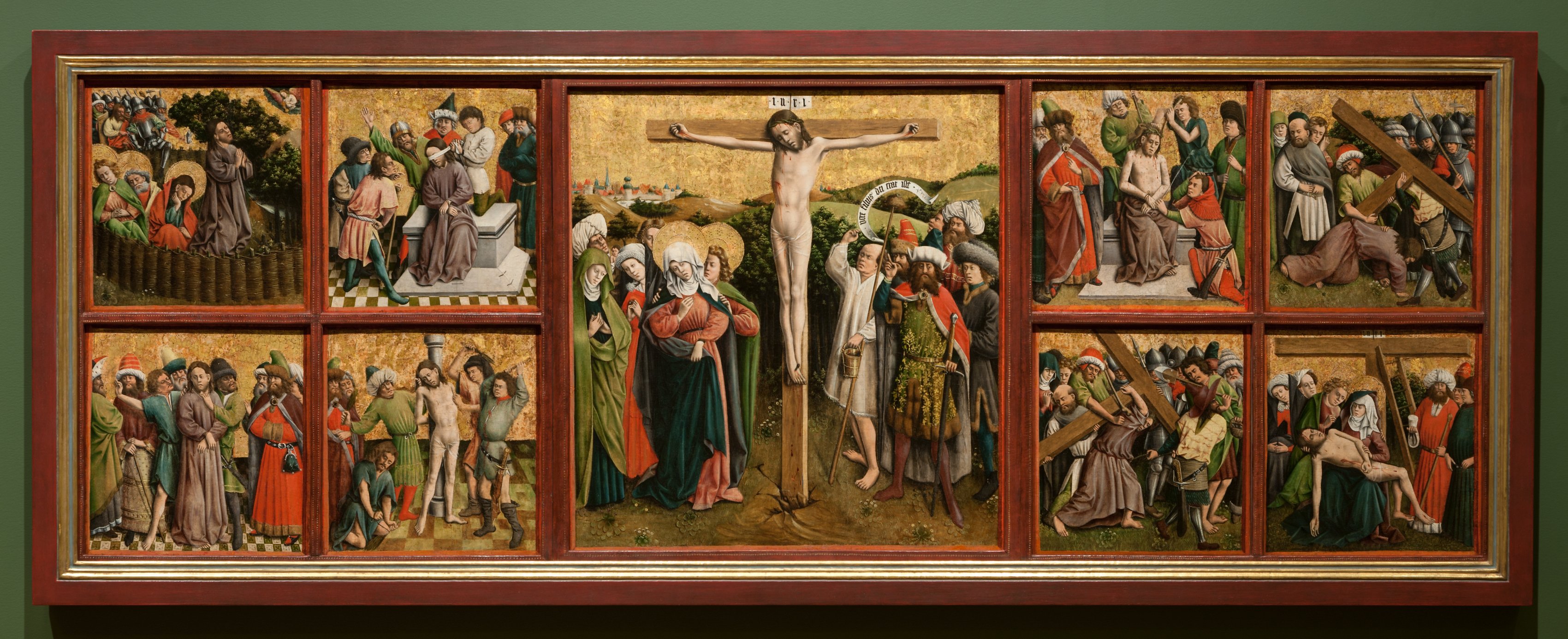
At Zoey Fashion Lab, our mission is to unravel the threads of historical artifacts and re-weave them into the fabric of contemporary avant-garde design. The subject of this analysis—a German altarpiece depicting The Passion of Christ, rendered in oil and gold on wood—presents a rich paradox. On one surface, it is a relic of medieval devotion; on another, it is a proto-avant-garde text of material and narrative tension. Drawing from the Archive Resonance of a “一面是光洁银镜上以黄金镶嵌的纷繁棕叶纹,另一面是冰冷石棺板上以浮雕诉说的生命叙事” (a smooth silver mirror inlaid with gold and intricate palm leaf patterns on one side, and a cold sarcophagus slab with a life narrative told in relief on the other), we propose a radical deconstruction. This analysis will dissect the altarpiece’s dualities—sacred vs. profane, fixity vs. flux, and narrative vs. abstraction—to extract design principles that challenge the boundaries of fashion and material culture.
I. The Mirror and the Sarcophagus: Duality as Avant-Garde Strategy
The Archive Resonance describes a mirror and a sarcophagus, two opposing surfaces that nonetheless coexist. The altarpiece, too, embodies this duality. Its gold ground—a luminous, reflective surface—functions as the “silver mirror,” while the narrative scenes of the Passion—the flagellation, crucifixion, and entombment—serve as the “sarcophagus slab” of frozen, sacred history. In avant-garde fashion, this duality is not a contradiction but a generative tension. The gold leaf is not merely a backdrop; it is an active, destabilizing force that reflects the viewer, inserting their contemporary gaze into the medieval narrative.
For Zoey Fashion Lab, this suggests a design methodology where surface and depth are in constant dialogue. Consider a garment that is at once a reflective, metallic shell (the mirror) and a textured, narrative interior (the sarcophagus). The gold-embellished palm leaf motifs—a symbol of victory and martyrdom—can be translated into intricate, laser-cut patterns on a structured, mirrored fabric. Meanwhile, the Passion story, with its raw emotional weight, can be encoded into the garment’s lining or underlayer, visible only through strategic cutouts or reversible construction. This is not decoration; it is a narrative of concealment and revelation, where the wearer becomes both the observer and the observed, the sacred and the profane.
II. Materiality and Alchemy: Oil, Gold, and the Avant-Garde Body
The technical medium—oil and gold on wood—is a study in alchemical transformation. Oil paint, with its slow drying time and capacity for luminous glazes, allowed medieval artists to create depth and emotion. Gold leaf, beaten to translucent thinness, was a material of divine light, a symbol of the celestial. In avant-garde terms, these materials are not static; they are agents of material deconstruction. The wood panel, often considered a passive support, becomes a structural element that warps, cracks, and ages over time, introducing an element of entropy.
From this, Zoey Fashion Lab can extract a principle of dynamic materiality. Imagine a collection where garments are treated as living surfaces: oil-based finishes that shift in color with body heat, gold leaf applied to fabrics that crack and peel with movement, revealing layers of narrative beneath. The “wood” of the altarpiece can be reimagined as a structural lattice—perhaps a corset or exoskeleton—that supports and constrains the body, echoing the Passion’s theme of physical suffering and transcendence. The avant-garde body is not a passive mannequin; it is a stage for material alchemy, where gold and oil become metaphors for transformation and decay.
III. Narrative Fragmentation: The Passion as a Non-Linear Text
The altarpiece presents the Passion of Christ as a sequential narrative, but in the context of avant-garde deconstruction, this linearity is a fiction. The scenes are often arranged in a grid or triptych, forcing the viewer to jump between moments—the betrayal, the trial, the crucifixion, the resurrection. This fragmented narrative structure is a precursor to modernist and postmodernist techniques. The Archive Resonance’s reference to a “life narrative told in relief” on a sarcophagus slab suggests a compressed, layered storytelling, where past, present, and future coexist.
For fashion, this translates into non-linear design thinking. A garment can be a “narrative patchwork,” where different panels tell different parts of a story—perhaps the sleeve depicts the agony of Gethsemane, while the back panel shows the empty tomb. The order of these panels is not fixed; the wearer or viewer can rearrange them through modular construction, zippers, or magnetic closures. This interactive narrative aligns with avant-garde fashion’s rejection of passive consumption. The Passion story becomes a tool for exploring themes of suffering, redemption, and the body’s fragility—not as a religious doctrine, but as a universal human condition.
IV. The Gold Ground as Avant-Garde Void
The most radical element of the altarpiece may be its gold ground. In medieval art, this flat, non-illusionistic space was a symbol of heaven, a realm beyond time and perspective. For the avant-garde, this gold ground can be read as a void or a blank canvas—a space of potentiality. It disrupts the narrative, forcing the viewer to confront the materiality of the artwork itself. This is akin to the “silver mirror” in the Archive Resonance, which reflects the viewer’s own image, breaking the fourth wall.
In fashion, the gold ground becomes a design principle of negative space. A garment might feature expansive areas of reflective, metallic fabric that do not depict anything, but instead mirror the environment, the audience, or the wearer’s own movements. This reflective void challenges the traditional emphasis on pattern, print, or silhouette. It is a statement of absence, a pause in the narrative. The palm leaf motifs, when they appear, are not applied as decoration but as fractured interruptions—golden shards that emerge from the void, like memories or visions. This creates a visual rhythm of silence and eruption, echoing the Passion’s cycles of stillness and violence.
V. Avant-Garde Resonance: From Altarpiece to Wearable Art
Finally, we must consider the cultural resonance of this artifact. A German altarpiece from the late medieval period was a communal object, a tool for religious instruction and emotional engagement. In the avant-garde context, it becomes a provocation—a challenge to the viewer’s assumptions about beauty, function, and meaning. The Archive Resonance’s juxtaposition of “smooth silver mirror” and “cold sarcophagus slab” suggests a tension between surface allure and existential weight.
Zoey Fashion Lab can harness this tension by creating wearable artifacts that function as both mirrors and sarcophagi. A coat might have a mirror-like exterior that reflects the world, while its interior is lined with narrative embroideries of suffering and resurrection. A dress might be constructed from panels that are at once rigid (like a sarcophagus) and fluid (like a mirror’s surface), forcing the wearer to negotiate between stillness and motion. This is not costume but critical fashion—a dialogue with history, materiality, and the body.
In conclusion, the German altarpiece with The Passion of Christ, when viewed through the lens of avant-garde deconstruction, offers a rich lexicon of design strategies: duality, material alchemy, narrative fragmentation, negative space, and cultural provocation. For Zoey Fashion Lab, this artifact is not a relic but a living text, one that challenges us to reimagine fashion as a form of critical and emotional inquiry. The mirror and the sarcophagus are not opposites; they are partners in a dance of reflection and remembrance, light and shadow, surface and depth. This is the avant-garde imperative: to deconstruct the sacred in order to reconstruct the possible.