Deconstructing the Divine: An Avant-Garde Analysis of a Paracas Textile Fragment
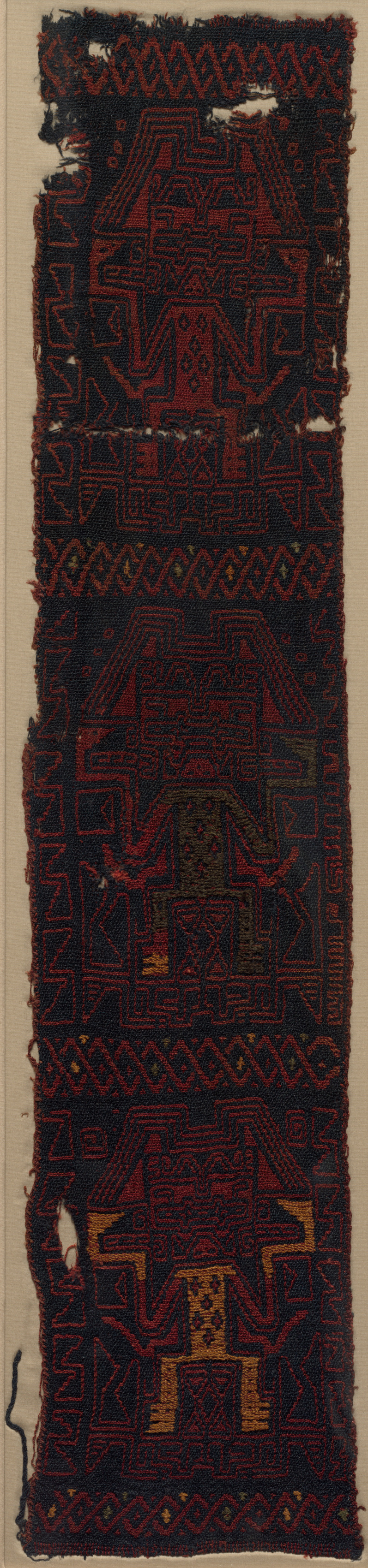
At Zoey Fashion Lab, our mission is to dismantle the temporal and material boundaries of textile history, extracting the radical, avant-garde potential embedded within ancient artifacts. The subject of this analysis—a textile fragment from the Paracas culture of Peru’s South Coast (700 BC – AD 1), likely from the Yauca Valley—is not merely a relic. It is a manifesto in camelid fiber, a pre-Columbian blueprint for a fashion language that defies linear time. Crafted using double-cloth with structural embroidery, this fragment features three frontal deities and an interlace pattern. To our contemporary, avant-garde sensibilities, it is a shock of the old: a composition of graphic power, structural audacity, and spiritual geometry that resonates deeply with the principles of deconstruction, abstraction, and wearable architecture.
I. The Fragmented Divine: Deities as Graphic Avatars
The presence of three frontal deities is the fragment’s most commanding feature. In the context of Paracas iconography, these figures are likely representations of the “Oculate Being” or a similar anthropomorphic entity, characterized by large, staring eyes, a trapezoidal headdress, and a rigid, symmetrical posture. From an avant-garde perspective, these are not merely religious symbols; they are the first graphic avatars. Their frontality—the direct, confrontational gaze—creates a powerful visual impact that predates modern portraiture and branding by millennia.
The Deity as a Modular Motif: The repetition of the three deities is not a sign of redundancy but of rhythmic, modular thinking. This is a core principle of modern and avant-garde design, from the serial repetition in Andy Warhol’s silkscreens to the grid-based compositions of Piet Mondrian. The Paracas weaver understood that the power of an image is amplified through iteration. For Zoey Fashion Lab, this suggests a design strategy: a single, potent motif—perhaps a stylized eye or a geometric face—can be repeated across a garment, creating a hypnotic, almost digital pattern. The “deity” becomes a logo, a sigil, a brand of the sacred.
The Avant-Garde Gaze: The exaggerated, almond-shaped eyes of the deities are not passive. They are active, demanding engagement. This is a precursor to the confrontational aesthetics of 20th-century fashion, from the bold, graphic eyes in Elsa Schiaparelli’s surrealist designs to the unflinching, robotic stares in the work of Rei Kawakubo. In our deconstruction, we propose a garment that wears the gaze—a jacket with the deity’s face laser-cut into the back panel, or a dress where the eyes are rendered as oversized, transparent lenses. The fragment teaches us that fashion can be a medium of direct address, a tool for challenging the viewer’s passivity.
II. The Interlace Pattern: The Architecture of Entanglement
The interlace pattern that surrounds and connects the deities is not mere decoration. It is a structural and conceptual framework. In Paracas textiles, interlace—often in the form of stepped frets, zigzags, or serpentine lines—creates a visual rhythm that binds the composition. Technically, this is achieved through the double-cloth technique, where two layers of fabric are woven simultaneously, allowing for a reversible design with negative-positive color relationships. The structural embroidery further reinforces these lines, adding a tactile, almost three-dimensional quality.
Double-Cloth as Deconstruction: The double-cloth technique is a literal deconstruction of the fabric plane. It is a woven binary, a two-sided conversation. This is the ancestral precursor to the avant-garde fascination with inside-out garments, reversible jackets, and the exposure of seams and linings. In this fragment, the interlace pattern is the active code that holds the deities in place, much like the structural seams in a garment by Martin Margiela or Yohji Yamamoto. The pattern is not applied; it is intrinsic to the fabric’s DNA.
From Interlace to Digital Glitch: The stepped, angular nature of the Paracas interlace pattern bears a striking resemblance to the pixelated forms of early digital graphics and the aesthetics of the “glitch.” The pattern’s repetitive, almost algorithmic quality suggests a pre-Columbian understanding of modular, computational design. For Zoey Fashion Lab, this is a direct invitation to translate the interlace into a contemporary material language. Imagine a fabric where the interlace is not woven but etched onto a metallic mesh, or where the pattern is created through a series of laser-cut slits that reveal a contrasting underlayer. The interlace becomes a structural grid, a framework for a garment that is both rigid and fluid.
III. Materiality and Technique: The Avant-Garde in Camelid Fiber
The material—camelid fiber (likely alpaca or llama)—is not a passive substrate. It is an active agent in the textile’s meaning. Camelid fiber is strong, lustrous, and possesses a natural thermal and moisture-regulating property. In the arid climate of the Paracas Peninsula, this fiber was a technology of survival and ritual. For the avant-garde, the choice of material is a political and aesthetic statement.
The Fiber as a Statement of Purity: In a fashion industry dominated by synthetic blends and fast fashion, the use of pure, natural camelid fiber is a radical act. It is a return to a pre-industrial, slow-technological process. The fragment’s survival for over 2,000 years is a testament to the fiber’s durability. For our Lab, this suggests a design philosophy of permanence over disposability. A garment inspired by this fragment would be built to last, its value increasing with age.
Structural Embroidery as 3D Printing: The structural embroidery on this fragment is not decorative in the conventional sense. It is a form of additive manufacturing in fiber. The embroidery reinforces the double-cloth, adding thickness and rigidity to specific areas, creating a relief effect that is both tactile and visual. This is a direct ancestor to modern techniques like 3D printing and textile sculpting. In an avant-garde context, we can reimagine this as a process of textile grafting: adding layers of contrasting fiber—perhaps a stiff, metallic thread or a bio-degradable polymer—to create a garment that is part woven, part embroidered, part sculpted.
IV. The Avant-Garde Synthesis: A Garment for the Future-Past
To synthesize this analysis into a design concept for Zoey Fashion Lab, we propose a garment that is a deconstructed relic. Imagine a long, asymmetrical coat, cut from a base of heavy, undyed camelid felt. The three deities are not printed or woven but cut out as negative spaces, their forms defined by the void. These voids are then filled with a contrasting double-cloth panel, woven in a modern, high-contrast color palette—perhaps a neon magenta and an acid green—that echoes the original reds, blues, and golds of Paracas textiles. The interlace pattern is not a flat print but a series of structural seams and laser-cut slits that run along the coat’s seams, creating a visual and physical grid. The structural embroidery is translated into a series of 3D-printed polymer nodes that are stitched onto the fabric at key stress points, mimicking the ancient technique while using a material of the future.
The Garment as a Portal: This coat is not a costume. It is a portal. It collapses the 2,000-year gap between the Yauca Valley and a contemporary runway. It asserts that the Paracas weaver was an avant-garde artist, working with the most advanced technology of her time: the loom. The fragment is not a static artifact to be preserved under glass; it is a dynamic code to be decoded and re-encoded. The three frontal deities become the garment’s guardians, their gaze demanding that the wearer and the viewer confront the cyclical nature of time and the enduring power of the handmade.
In conclusion, this textile fragment from Paracas is not a piece of history. It is a piece of the future, mislabeled and buried in the past. For Zoey Fashion Lab, it is a source of radical inspiration, a reminder that the most avant-garde ideas are often those that have been waiting for the right moment to be re-read. The double-cloth, the interlace, the frontal deities—these are not ancient motifs. They are the foundational elements of a new, timeless fashion language.