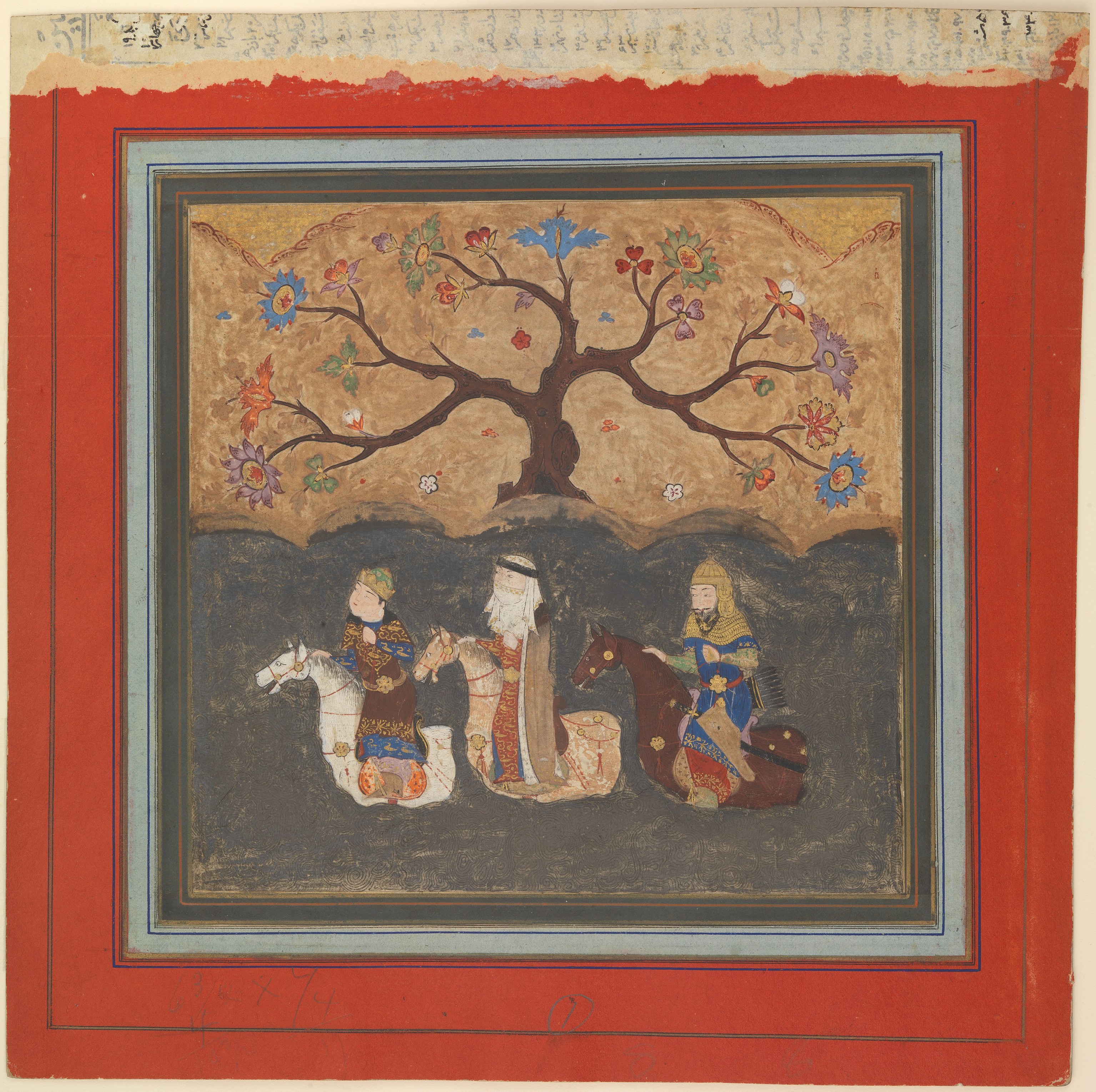
Deconstructing the Epic: Kai Khusrau, Farangis, and Giv Crossing the River Jihun
The folio from the *Shahnama* (Book of Kings) depicting Kai Khusrau, Farangis, and Giv crossing the River Jihun (Oxus) is not merely a historical manuscript illumination; it is a blueprint for a radical, futuristic couture dialogue. For Zoey Fashion Laboratory’s SS26 collection, this 15th-century Persian masterpiece—executed in ink, opaque watercolor, silver, and gold on paper, with margins of ink and gold on dyed paper—serves as a metaphysical and material catalyst. The work’s intrinsic tension between narrative stasis and dynamic movement, between earthly weight and celestial transcendence, directly informs a structural innovation that redefines the silhouette. This analysis dissects the folio’s visual grammar to extract a lexicon of avant-garde garment architecture, focusing on three core pillars: fluid armor, chromatic stratigraphy, and marginal expansion.
Fluid Armor: The Silhouette of Crossing
The central action—the crossing of a tumultuous river—demands a rethinking of protection and movement. In the folio, the figures are not static; they are caught in a moment of perilous transit. Kai Khusrau, Farangis, and Giv are clad in armor that is simultaneously rigid and fluid, a paradox that becomes the foundation for SS26’s key silhouette: the hydro-dynamic carapace. Traditional chainmail and plate armor are reimagined as a lattice of interlocking, laser-cut metallic scales, each one a micro-architecture of reflective silver and gold leaf—echoing the manuscript’s metallic pigments. These scales are not fixed; they are mounted on a flexible, bio-mimetic base of liquid silicone and recycled polymer, allowing the garment to ripple like water while maintaining a defensive structure.
The silhouette itself is elongated and asymmetrical, mimicking the diagonal thrust of the river’s flow. The shoulder line is exaggerated, not through padding, but through a cantilevered framework of carbon fiber and hand-stitched silk, a nod to the figures’ raised arms and spears. The waist is cinched not by a belt, but by a series of articulated, spine-like segments that follow the body’s torsion—a direct reference to Giv’s tense, protective posture. The hemline is deliberately uneven, cascading from a sharp, knee-length point at the front to a sweeping, ankle-grazing train at the back, simulating the splash and drag of water. This is not a garment for standing still; it is a garment for crossing, for transition, for the liminal space between safety and danger. The hydro-dynamic carapace is a statement on resilience: armor that moves with the wearer, not against them.
Chromatic Stratigraphy: The Palette of Power and Preciousness
The folio’s chromatic language is a masterclass in symbolic and structural layering. The use of opaque watercolor, silver, and gold on paper creates a depth that is both literal and metaphorical. For SS26, this translates into a technique we term chromatic stratigraphy: the layering of color and material to create a narrative of light and shadow, of surface and depth. The primary palette is extracted directly from the manuscript: deep lapis lazuli blues, vermillion reds, emerald greens, and the luminous, reflective whites of the river’s foam. These are not applied flatly; they are built in strata.
The base layer is a digitally printed, water-resistant silk organza, patterned with the folio’s intricate geometric and floral marginal motifs. Over this, a second layer of hand-painted, translucent resin panels—each one a distorted echo of the figures’ faces and armor—is suspended via micro-magnets, creating a floating, holographic effect. The third layer is the metallic intervention: silver and gold leaf are applied not as embellishment, but as structural elements. Gold leaf is used to reinforce stress points—shoulders, elbows, the hip—while silver leaf is applied in swirling, calligraphic lines that trace the river’s currents. The result is a garment that changes with the viewer’s angle and the ambient light, a living painting that reveals its own construction. This is not decoration; it is functional preciousness, where the metal is as integral to the garment’s integrity as the fabric.
Marginal Expansion: The Frame as Garment
The most radical innovation for SS26 emerges from the folio’s margins. The dyed paper, with its intricate ink and gold borders, is not a passive frame; it is an active, expanding field of pattern and meaning. In the manuscript, the margins contain the narrative, but they also threaten to overwhelm it, bleeding into the central image. Zoey Fashion Laboratory exploits this tension through a concept we call marginal expansion: the garment’s boundaries are not fixed, but are instead a continuous, evolving pattern that extends beyond the body.
This is achieved through a modular system of detachable, pattern-cut panels. The core garment—a structured, sleeveless bodysuit in matte black micro-fiber—is the “central image.” Attached to it via a series of invisible, magnetic clasps and zippers are a series of “marginal” panels: wide, flared cuffs that extend past the fingertips; a high, collar-like neckpiece that rises like a manuscript’s border; and a train that fans out behind the wearer, printed with a digitally enlarged reproduction of the folio’s gold and ink marginalia. These panels are not decorative; they are functional, altering the silhouette from a sharp, streamlined form to a wide, architectural one. The wearer can choose to wear the garment in its “core” state—a minimalist, second-skin silhouette—or expand it into a full, ceremonial ensemble, referencing the manuscript’s dual nature as both intimate object and public spectacle.
Structural Innovation: The River as Seam
Finally, the folio’s most potent structural metaphor is the river itself. The River Jihun is not a background element; it is a force that shapes the figures’ poses and the composition’s rhythm. For SS26, the river becomes a dynamic seam. Traditional garment seams are static, dividing one piece of fabric from another. Here, the seam is a living line, a channel of movement and energy. Using a technique of heat-bonded, liquid crystal polymer threads, the seams of the garment are designed to shift color and texture in response to body heat and humidity. As the wearer moves, the “river” seam glows from a cool, silver-blue to a warm, gold-amber, mimicking the folio’s depiction of water as both reflective and turbulent.
This is not a garment that merely references a historical artifact; it is a garment that embodies the act of crossing. The hydro-dynamic carapace, chromatic stratigraphy, and marginal expansion are not separate elements; they are a unified system of structural innovation. The SS26 collection from Zoey Fashion Laboratory is not about nostalgia; it is about recontextualizing a 15th-century epic into a futuristic, wearable narrative of power, transition, and preciousness. The folio of Kai Khusrau, Farangis, and Giv is not a museum piece; it is a manifesto for the future of couture architecture.